Captain Edward William Rose Jasper Sutherland
1872–1942 · Master Mariner · Elizabeth’s grandfather
Centred on Elizabeth Hancock, née Wynne, born 1936
Everything the papers hold on one man, with his ships identified.
He died when Elizabeth was five. What came down to her was a house in Mossley Hill, a painting of a ship, and a great deal of his own writing that nobody in the family knew existed.
The ships have been matched against published registers and fleet lists; his rank in each is given only where a document states it. Where the evidence is thin, or where his own accounts of himself disagree, that is said plainly.
No photograph of him is known. One exists in print — see below — and the wider ambition is to put a face to every person in this family. Anyone holding a photograph, however uncertain the identification, is asked to say so; and anything pencilled in the margins of a printed copy can be added to the account.
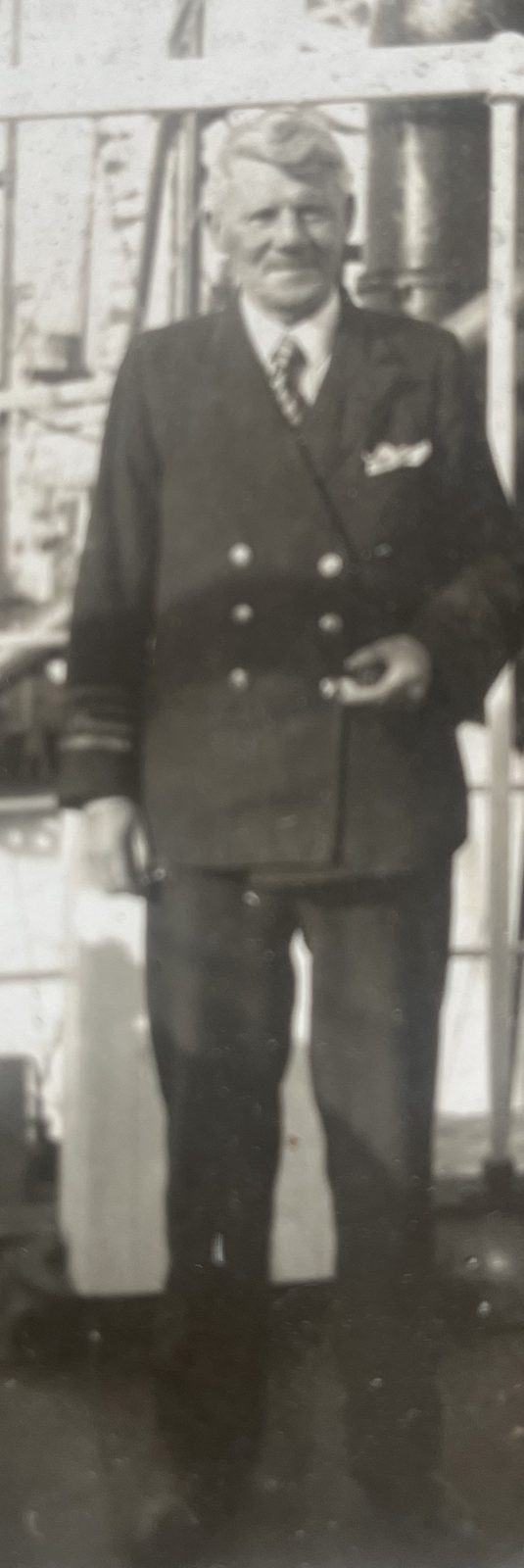
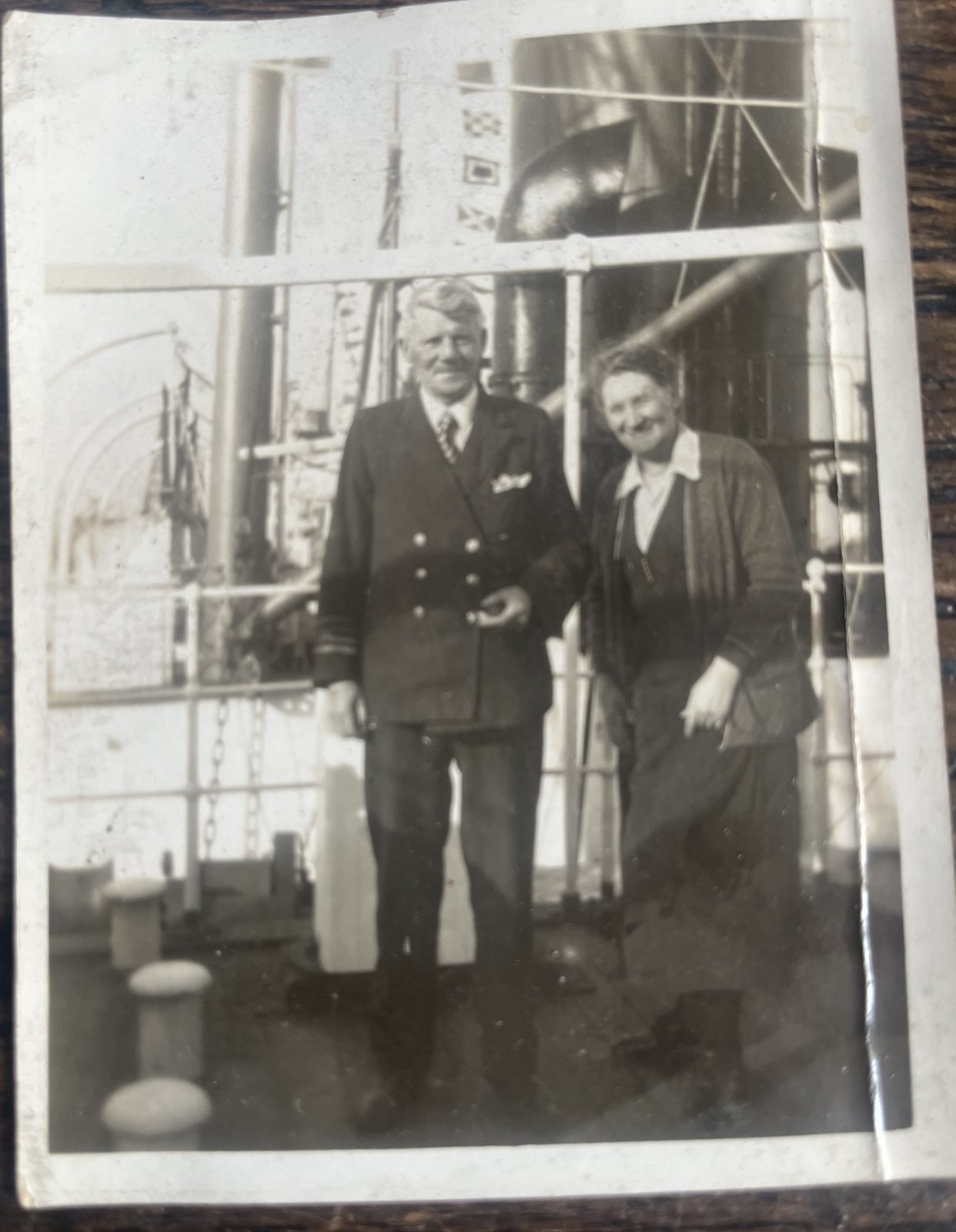
⚠ Corrected 26 September 2026. The paragraph above stood from the first draft until Elizabeth laid out fifteen loose prints from the collage she made for her mother and identified two of them as her grandfather. One is dated and named on the back — “Kenmore. Taken Oct. / 30” — and shows him in uniform on the deck of the Kenmore with Annie beside him; his own writings put him in her in July 1930 and November 1931 (see “Where he actually was, when”). The other, undated and out of uniform, shows the two of them seated outdoors, probably in Liverpool. So there are now two photographs of him in the family’s hands, and the printed one on page 248 of Sea Breezes is no longer the only likeness. The crops and the whole print are in the photos folder, filed under his name with “kenmore oct 1930”. Elizabeth, 25 September 2026: “My grandfather, Edward William Jasper Rose, and my grandmother, Annie Sheen … on board a boat. She did go, apparently, quite frequently, with my grandfather on short trips, not long ones.” (Recording The Old Coach House 24.)
The shape of the life
| Born | 19 February 1872 at Kamptee, India — an army cantonment near Nagpur, where his father was serving |
| Mother died | Madras, 1875. He was three; there were three children under six |
| Educated | Grammar School, Ashburton, Devon, entering 1880, aged eight |
| Went to sea | 1887, aged fifteen, apprenticed to Henry Fernie & Sons, 7 Rumford Street, Liverpool |
| In sail | Nine years with Fernie’s, the last three as Chief Officer (his account of 1929) |
| Master’s certificate | 23 March 1899, living at 111 Bagot Street, Wavertree |
| Into steam | March 1899, third officer of the Lochmore, Johnston Line |
| Married | 6 April 1897, S. Thomas’ Church, Toxteth Park, to Annie Sheen |
| Children | Edward Rollo · Kenneth Graham · Ella Mary Edith |
| In command | Johnston Line ships, and Furness Withy’s after the 1916 absorption |
| Retired | announced Journal of Commerce and Shipping Telegraph, 5 January 1935 — forty-eight years at sea |
| Remarried | between January 1938 and May 1939, to Emily Rigby Sutherland — “Emmie” |
| Died | 11 April 1942, aged 71, at Plattsville Road, Mossley Hill, Liverpool |
| Buried | Wavertree Churchyard, grave 430 N.C.Y., 14 April 1942 — probably in his first wife’s grave |
Freemason of the Minerva Lodge, Liverpool, from 1920. Long on the management committee of the Imperial Merchant Service Guild, and a member to the end — his card for the year commencing 1 June 1934 survives.
A number that needs checking. The five-generations biography says he died at 33 Plattsville Road. His own will of 1939, Annie’s death certificate of 1938 and the American envelope of 1931 all say 31.
His ships
The ship names come from his own writings and from his obituaries; the build details, owners and fates come from published registers and fleet lists, cited at the end.
In sail — Henry Fernie & Sons of Liverpool, 1887–c.1896
Fernie’s ran a fleet of iron full-riggers whose names almost all ended in -omene. He calls them “the Omones” and lists thirteen as the fleet standing when he joined.
| Ship | Built | Builder | Tons | His position | Fate |
|---|---|---|---|---|---|
| Laomene | 1880 | W. H. Potter & Son, Liverpool | 1,797 (he says 1,745) | Apprentice, then junior officer — five years, his whole indentures | — |
| Pythomene | 1880 | Oswald, Mordaunt & Co., Southampton | 1,954 | Second Mate (stated by the magazine’s editor) — and by the family narrative, five years rising A.B. → third mate → second mate → two years Mate | Italian Reno c.1910; Monte Nero c.1919; broken up in the 1920s |
| Aristomene | 1881 | W. H. Potter & Son | 1,795 | Second Mate, then Mate | Italian Olona c.1910; diesel auxiliary barque 1918; broken up c.1922 |
| Chrysomene | 1873 | Potter & Hodgkinson | 1,835 | — (he praises her as a flyer under Hogan and Trevenna) | Sold German c.1900 as Elfrieda; seized by Britain in the First War as Clevedon; hulked at Fremantle 1922 |
| Sardomene | 1882 | Oswald, Woolston, Southampton | 1,860 | — | Sunk by the Germans, July 1915 |
| Idomene | 1874 | Oswald & Co., Pallion, Sunderland | 1,424 | — | Wrecked 14 November 1887 — within months of his joining the firm |
The others he names in the fleet — Argomene, Cypromene, Cleomene, Dynomene, Jessomene, Nylomene, Orchomene, and the four-masted barque Eulomene launched later — are not yet individually traced. Fernie’s also owned, he says, the barques Cashmere, Champion and Grampian of about 1,400 tons, and the Russia, Malta, Iron Cross and Great Victoria, “the latter a composite ship with wooden bumpkins and the only ship I ever saw with the cro’jack braces leading aft.”
The detail that authenticates him. He wrote that the Pythomene was built “at Oswald Mordaunt’s, Southampton.” The registers say exactly that. He was writing forty-odd years after the fact, from memory, at sea.
In steam — Johnston Line, and Furness Withy after 1916
William and Edmund Johnston of Liverpool bought their first steamer in 1872 for the Black Sea, Greece and Turkey; Atlantic sailings began in 1880 in conjunction with the Baltimore & Ohio Railroad, specialising in the live cattle trade. Furness Withy took half the company in 1914 and all of it in 1916. Johnston Line ships were named “-more”.
| Ship | Built | Tons | His position | Fate |
|---|---|---|---|---|
| Lochmore | 1889 | 2,140 | Third Officer, joining March 1899 — his first steamer | Sold to Greece 1912, renamed Theokespasti |
| Dromore (4) | 1920 | 4,096 | writing from her in the Mediterranean, quoted in The Ashburtonian, Autumn 1927 | Transferred to Johnston-Warren Line, 1935 |
| Kenmore (2) | 1923 | 3,616 | Master — he writes from her in July 1930, November 1931, March 1932 and May 1933 | Transferred to Johnston-Warren Line, 1935 |
Two things fall into place here.
His essay describes “the joys (?) of a cattle tender, in the foc’s’le of more than one Western Ocean trader.” The Johnston Line’s Atlantic service was the live cattle trade. He was describing his own employer’s business.
And the Johnston Line ran to Boston. The only American item among his papers is an envelope posted to him in December 1931 from 259 School Street, Watertown, Massachusetts — a town four miles from Boston. A correspondent named Gibson at that address is far more likely to be someone from the Boston run than a stranger.
Where he actually was, when
| Date | Place | Source |
|---|---|---|
| Autumn 1927 | The Mediterranean, in the Dromore — a letter chased him to “a Rumanian Port” | The Ashburtonian |
| 24 November 1929 | Braila, Romania (Danube) | his own sign-off |
| July 1930 | the Danube, in the Kenmore | his own heading |
| February 1931 | — | sign-off, “To the Vanished Days of Sail” |
| November 1931 | Mediterranean Sea, in the Kenmore | his own heading |
| 7 December 1931 | receiving mail from Massachusetts at Mossley Hill | the envelope |
| 18 March 1932 | the Norwegian coast, in the Kenmore — pilot aboard among the skerries | his own letter |
| 19 March 1932 | Smyrna (Izmir) | his own sign-off |
| 5 May 1933 | in the Kenmore | printed sign-off |
| 5 June 1933 | Braila | his own sign-off |
| 12 August 1933 | at sea | “In Defence of our Cloth” |
The two March 1932 datelines are a day apart and half of Europe apart. One of the two readings is wrong, or one sheet was written up later from notes. Flagged, not resolved.
The writer
He was published, over his own name and over the pen-name “Standing Rigging and Running Gear”. Nobody in the family knew.
In print, in the family’s own copies:
- “A Tribute to the Vanished Days of Sail” — first in THE LOG, the quarterly of Furness Withy, Houlder Bros., Prince Line and associated companies, March 1932; reprinted in Sea Breezes / The P.S.N.C. Magazine, pp. 226–229. He calls it “my maiden effort.”
- “As One Seaman to Another — Retrospect” — Sea Breezes, pp. 103–104, by-lined By Captain E. Sutherland, Liverpool; signed from the s.s. Kenmore, 5 May 1933.
- “The Second Mate’s Story” and “The Skipper’s Yarn” — pp. 137–139.
In draft, unpublished or not yet found in print: “In Defence of our Cloth — Noting Protest” (12 August 1933, signed); an obituary, “Ships that Pass in the Night — Vale”, for Otto Nicholson; the Waverley dog serial; and the coffin yarn.
What he was like on the page
On his first sight of the sea from aloft, aged about sixteen:
“A glorious morning, sky a cloudless blue, and here I am swaying lightly 180 feet above the deck… Sailing towards me, borne on level unwavering pinions, comes an albatross; he bears right for me, regards me with a sternly malignant, not to say disparaging, eye, and, when close to, with a contemptuous upward lift, he ‘hards-a-port’ and passes astern.”
On the rigging at night:
“…those lovely, swaying, snowy pillars of canvas look far too ethereal to be made of hemp — and that network of brace and lift and running gear must surely have been woven by some gigantic marine spider and never evolved from a smelly rope walk.”
On his own life, which is the passage to keep:
“I am glad, and exult in the thought, and nothing can rob me of it, that though I am, always have been, and always shall be, a poor man (for the mariner rarely finds the golden eggs of the elusive ‘oof bird,’ and the sea is a hard mistress) yet I have experienced the joy and thrill, the very poetry of motion, under such conditions as above, denied to the richest man of the present day.”
And refusing to be sentimental about the age he was mourning:
“I have travelled hard in my time… have seen men rot and die of malignant disease in tropic climes; yet ‘By and Large,’ as seamen say, I realise my ‘span’ at sea has arched many waters, and while regretting the passing of the spacious days of sail, rejoice that this interval has brought in its wake many changes for the benefit of sailors, who to-day are undoubtedly better fed, paid, housed, and cared for than when I first ‘took ship’ and learned to steer ‘by the wind.’”
He read Conrad, Masefield, Kipling, Clark Russell, Jack London, Basil Lubbock, Captain Sir David Bone — “this is the goods” — and “especially Miss Fox Smith’s poems, beloved of all sailormen.”
The photograph
There is a photograph of him, and the family does not have it.
The Editor’s Foreword to A Tribute to the Vanished Days of Sail says the article was submitted
“together with a photo of members of the crew of Fernie’s Pythomene, he himself being Second Mate. This picture will be found on page 248.”
No likeness of him survives among the family papers. The pages of the magazine that are held run to pp. 103–104, 137–139 and 226–229, and page 248 is not among them. The oil painting of a full-rigged ship is his ship, not his face; the unidentified carte-de-visite is of a much older man in uniform and belongs, if to anyone, to Major Edward Sutherland.
Three routes to it, in order of cheapness:
- The family’s own copy. Does the bound volume or the set of loose pages run to page 248? It is in the same volume as pages 226–229, which the family has.
- The Log, March 1932 — the photograph’s first publication. Furness Withy’s house magazine.
- The Sea Breezes run — Merseyside Maritime Museum, Liverpool Central Library, National Maritime Museum. The issue is identifiable from the pagination and the May 1933 sign-off.
What is still open
- Page 248. The only known likeness of him. Highest value item in the domain.
- His master’s certificate — Board of Trade certificates of competency, TNA BT 122–127. It would date every rank and settle the discrepancy below.
- The discrepancy in his own accounts. March 1932: “over 40 years at sea… only sailed under two House Flags — 15 years in sail in one firm.” November 1929: “I remained with them for nine years, the last three as chief officer.” Both his. Not reconciled.
- Crew agreements (TNA BT 99; Maritime History Archive, Newfoundland) for the Laomene 1887–92, the Pythomene, the Aristomene, the Lochmore 1899.
- Was the rest of it printed? Sea Breezes from 1919 and The Log from Furness Withy. He was invited to write “any future articles.”
- Gibson of 259 School Street, Watertown, Massachusetts — 1930 and 1940 US censuses, indexed by street. Almost certainly a Boston-run connection.
- Angus, his chief engineer, “gallant old Scot, now lies buried under Italian skies, having died in harness at sea” — and old O’Leary, lost off the Pitch of the Horn.
- The ship in the painting. Still unnamed. It is a sailing ship, so it is a Fernie ship, and the candidates are now down to six identified hulls.
\pagebreak
The papers themselves
The papers themselves, as they survive. There is no photograph of the man among them — the two photographs now known (above) came from the collage, not the papers.
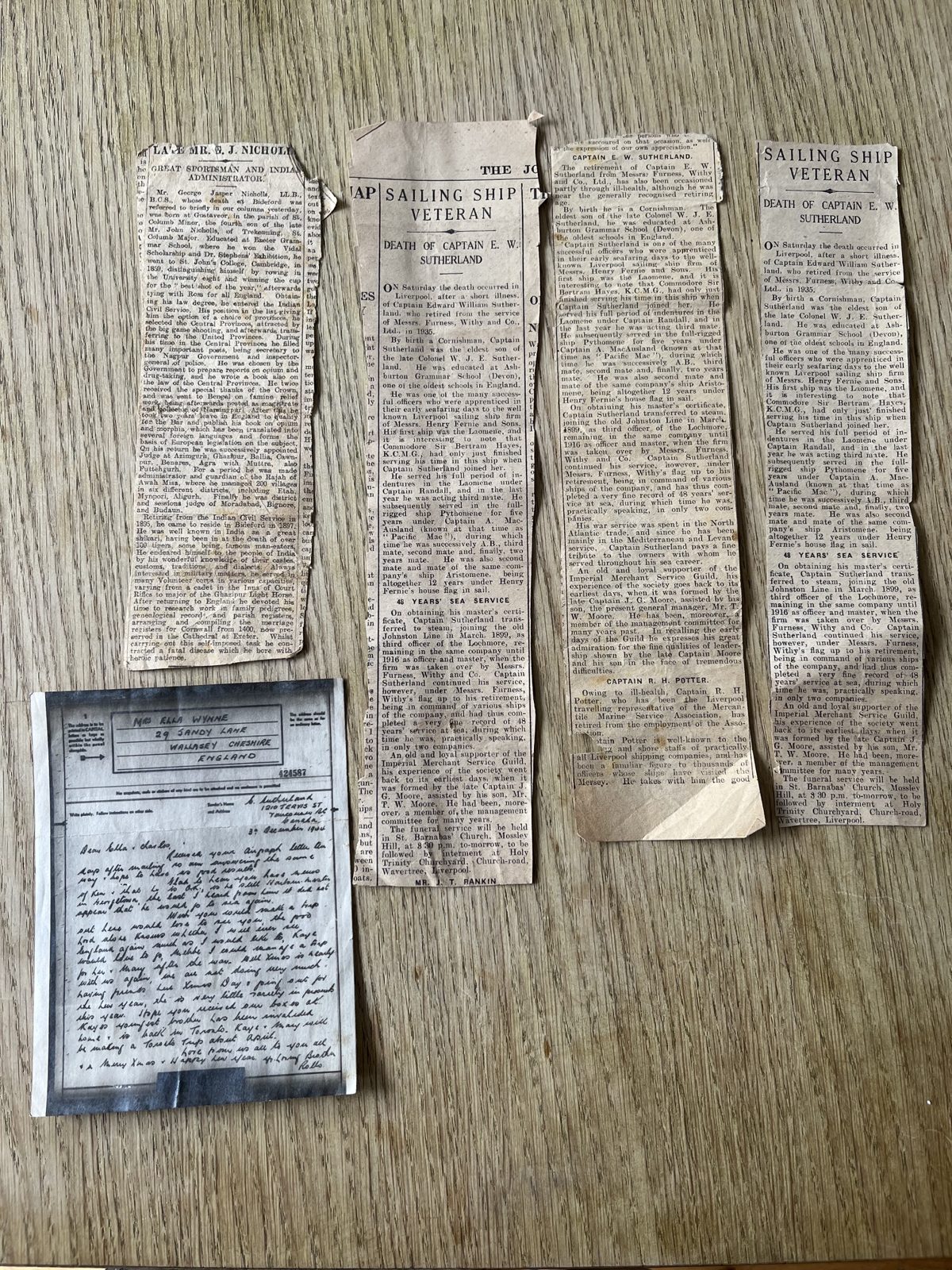
Obituary cuttings for Captain E. W. Sutherland, with Rollo’s airgraph of 3 December 1944 — The airgraph is the only document in the archive in Rollo’s own hand - headed 1210 Jervis Street, Vancouver, British Columbia, signed ‘Yr Loving Brother, Rollo’, asking whether Kenneth is ‘still Harbour-master in Georgetown’ and mentioning his wife Kaye and daughter Mary.
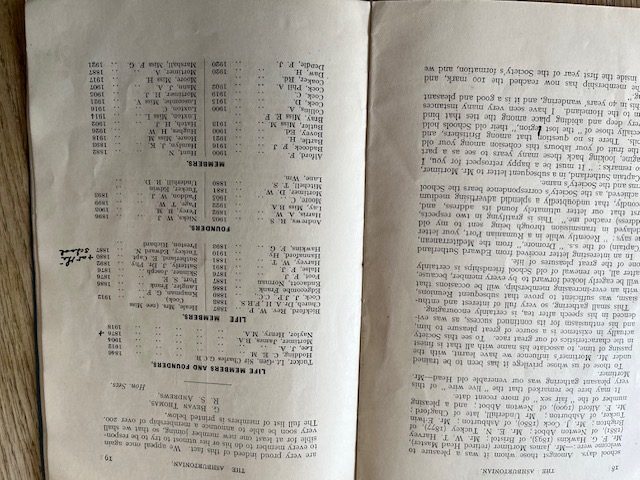
The Ashburtonian, Autumn 1927, page 19 - the Old Boys’ roll listing ‘Sutherland, E. Capt. 1880’ — THE PAGE THAT CLOSES THE GAP between his mother’s death at Madras in 1875 and his indentures at Liverpool in 1887. Under LIFE MEMBERS: ‘Sutherland, E. Capt… 1880’, with a family hand writing ‘+ at the school’ in the margin against that one line. The year in these rolls is the year of entry, which puts him at Ashburton Grammar School at eight; the rank printed is the one he held as a grown man, and Life Membership is an adult subscription.
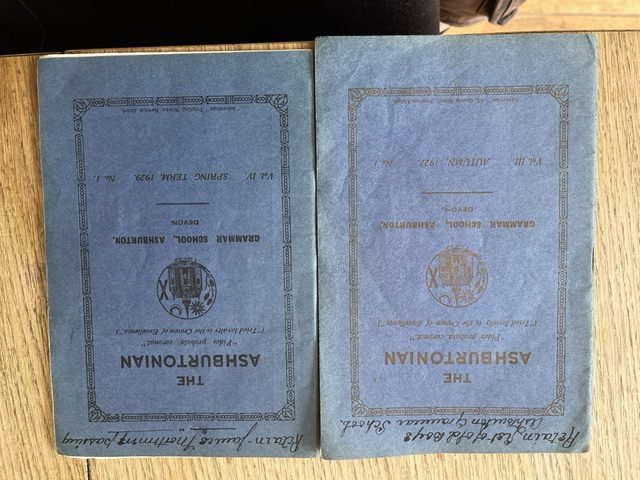
Two issues of The Ashburtonian kept in the family papers, endorsed by hand — Vol. III, Autumn 1927, endorsed ‘Retain - List of old Boys, Ashburton Grammar School’; Vol. IV, Spring Term 1929, endorsed ‘Retain - James Mortimer passing’. Grammar School, Ashburton, Devon; motto ‘Fides probata coronat’ - ‘Tried loyalty is the Crown of Excellence’.
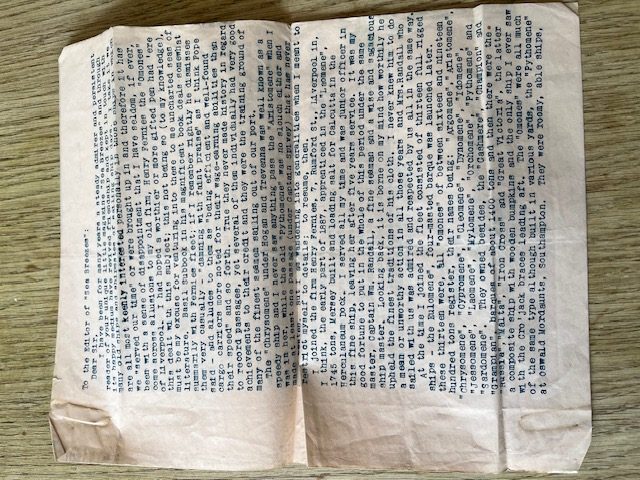
Typescript letter to the editor of Sea Breezes on the Fernie fleet, c.1931-33 — His own account of his beginnings: ‘I joined the firm Henry Fernie, 7, Rumford St., Liverpool in 1887, apprenticed in the LAOMENE, 1745 tons, Mersey built and loading salt for Calcutta in the Herculaneum Dock.’ It names the whole thirteen-ship fleet and pays tribute to his first master, Captain Wm. Randall.
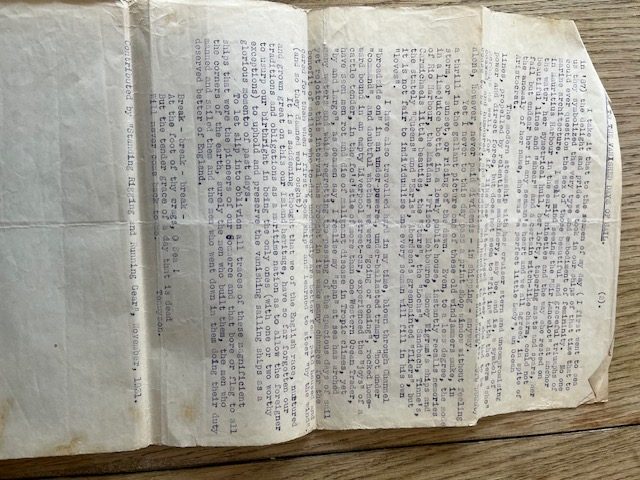
Typescript of his essay ‘To the Vanished Days of Sail’, page 2 — The best-written thing in the archive - the Sir Lancelot at anchor in Mauritius Harbour in the early nineties, ‘a perfect little Lady, an Ocean Aristocrat’, and a refusal to be sentimental about the life: sailors today ‘are better fed, paid, housed and cared for than when I first took ship and learned to steer by the wind’.
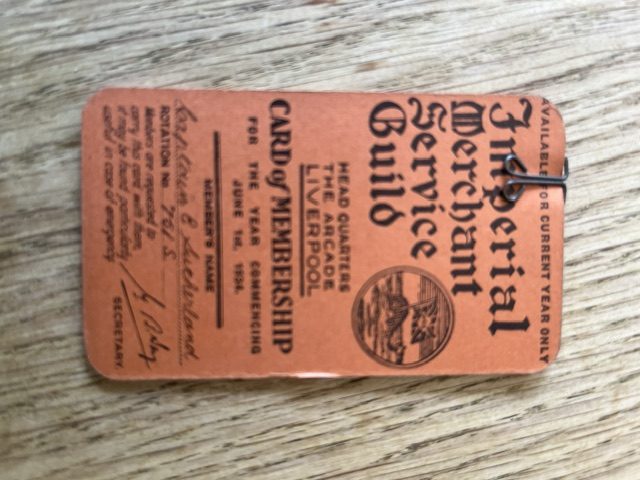
Imperial Merchant Service Guild card of membership, year commencing 1 June 1934 — Head Quarters, The Arcade, Liverpool. Made out to Captain E. Sutherland seven months before his retirement was announced in the Journal of Commerce.
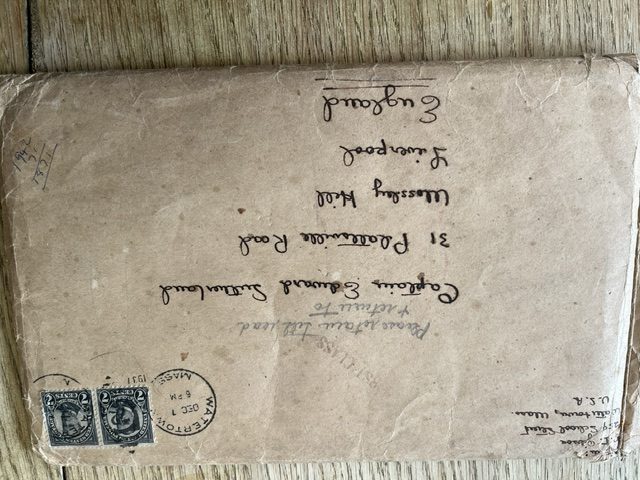
Envelope from Watertown, Massachusetts, 7 December 1931, inscribed ‘Please retain till read & return to’ — The only United States connection in the archive. Addressed to Captain Edward Sutherland at 31 Plattsville Road, Mossley Hill; the enclosure is gone and the sender’s name in the corner cannot be read at 640x480.
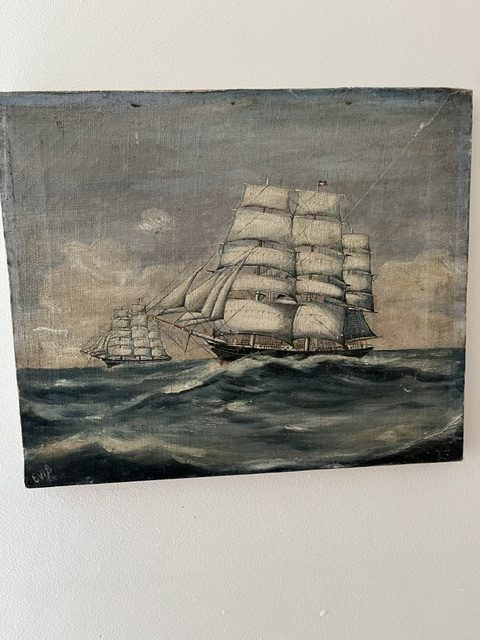
Oil painting of a three-masted square-rigged ship under sail — Unframed on its stretcher. Will states it shows a vessel his great-grandfather commanded; the family record identifies that man as Edward William Rose Jasper Sutherland, forty-eight years at sea out of Liverpool. THE SHIP IS NOT NAMED and naming her is an open task - his commands are recoverable from the Journal of Commerce retirement notice and from crew lists.
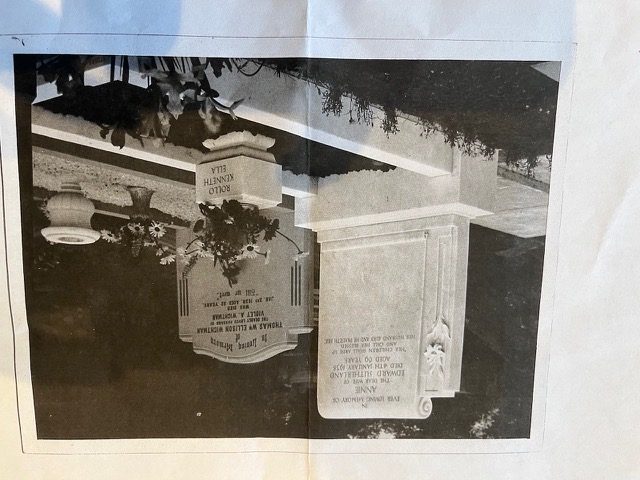
The Sutherland family grave - memorial to Annie, kerb inscribed ROLLO KENNETH ELLA — ‘IN EVER LOVING MEMORY OF ANNIE, THE DEAR WIFE OF EDWARD SUTHERLAND, DIED 4TH JANUARY 1938, AGED 69 YEARS’. The kerbstone at the foot carries the names of the three children who raised it. Photographed upside down in the batch and read on 3 Aug.
Sources for the ships
Family papers for everything about the man. For the vessels, published maritime records and fleet lists:
- The Ships List — Johnston Line fleet list (build years, tonnages, fates, and the numbered Kenmore and Dromore sequences): https://www.benjidog.co.uk/TheShipsList/JohnstonLine.php
- The Ships List — Furness Withy: https://www.benjidog.co.uk/TheShipsList/Furness.php
- Wikimedia Commons, Laomene (ship, 1880): https://commons.wikimedia.org/wiki/Category:Laomene_(ship,_1880)
- The Liverpool Shipping Co Ltd (H. Fernie & Sons fleet notes): https://www.wikitree.com/wiki/Space:The_Liverpool_Shipping_Co_Ltd
- Western Australian Museum, Maritime Archaeology Databases — Clevedon, ex Elfrieda, ex Chrysomene: https://museum.wa.gov.au/maritime-archaeology-db/wrecks/id-900
- Furness Withy, company history: https://www.gracesguide.co.uk/Furness,_Withy_and_Co
A note on one of them: Ron Parsons records that Lubbock and Hurst confused Fernie’s PYTHOMENE and PHILOMENE and attached later names to the wrong hull. The reading above follows the register entries, not the histories.