VI. Flying — Eagle Airways, c.1957–1961
This section did not exist before 21 August 2026. It is the largest single addition the archive has ever made to her life, and she is the only source for nearly all of it.
How she got the job
She does not know why she wanted it. “I don’t really remember why… I don’t think I knew anybody” who did it — and her son points out it was a rare thing to want: “it’s not like now, where it’s a common career.” What she remembers is not the wanting but the getting.
She was interviewed for BOAC and does not remember where. The job she got was with Eagle Airways. They put her up in the Cambridge Hotel in Camberley for three weeks’ training, and she was flying out of Blackbushe — “all my Eagle flying started off at Blackbushe.”
“The Cambridge Hotel is a fairly prominent hotel in Camberley, where we ended up living in 1969.” Her first night in Camberley was as a trainee air stewardess in 1957, twelve years before the family moved there. She had noticed the coincidence and was saving it.
She was excited and she says so — a rare thing in six hours of tape. “Being put up in a hotel when you’re just…” — and then the detail that fixes it: the room next to hers on the top floor held an American naval officer, who later visited her at the family house, and to whom Ella gave a sword out of the sea trunk. “Amazing thing for her to give to him.” ❓ The sword is unaccounted for, and the house name in the transcript is garbled beyond recovery.
Christmas Island, Cyprus and the wet leases — what she added on 6 September
- Christmas Island. “We did lots of them.” Eagle flew the Christmas Island trooping runs at the time of the nuclear tests. Asked what she saw: “Honestly, I didn’t hear any explosions.”
- Cyprus and Switzerland were wet leases — “they hire the pilots and the aircraft, because they were Eagle aircraft, but it was an MOD aircraft.” That is what she was doing in Nicosia.
- ★ An Eagle captain who was gay, and his partner an engineer, whom they met by chance in Athens — “quite unusual in those days”, said entirely without edge.
The airline
Eagle was small, and she liked that it was. “It was started by a man called Harold Bloomberg… He was a very wealthy man, everybody liked him. It was a small airline.”
⚠ HAROLD BAMBERG, not Bloomberg. Eagle Aviation, later Eagle Airways and British Eagle, was founded in 1948 by Harold Bamberg. This is a speech-recognition error, not hers, and the correction is safe. Everything else she says about him is consistent with the record: he was young, he was independent, and he built the largest of the British independents.
About 60% of the work was military trooping. “It must have been quite trusted, to have been doing all the military flights” — “Yeah, I would say probably about 60 percent.” The rest was scheduled passenger work: Hamburg and Copenhagen out of Blackbushe, and later a posting to Manchester. She flew the Bristol Freighter — “the most peculiar aeroplane… it was obviously a freight aeroplane”, high-winged, with a ladder up to the flight deck. The ladder is the detail she and her son both reach for, and for the same reason: the crews wore pleated skirts, and going up it they flew up. It is why the ladder is remembered at all, and it is the setting for the day she met her husband.
The crews were the war’s leftovers. “They were pretty much all wartime pilots… and a lot of Poles, lovely Poles.” One of them played the violin on night flights. Crews flew together as fixed units — “they all flew together, that way it worked.”
The company ran a village. A white van collected the crews from their houses and took them home again: “so I knew where all the houses were, where everybody lived… I just knew everybody.” Eagle people lived all round Camberley and Fleet, and a large number of the friendships of her whole adult life start here — the Warmans, the Seiberts, the Kohns, the Noons, the Greens, the Brodericks, the Earlams, and Steve and Marge.
Christmas Island
She flew troops to Christmas Island during the British nuclear tests, and she knew exactly what was happening there.
“Christmas Island during the testing.” — “So you took some hapless squaddies who are now poisoned by that experience.”
“And did you have any idea what they were doing?” — “Yes, I knew it was nuclear testing.”
“Did you know the context?” — “Yes, and you can’t exaggerate the lack of interest.”
That last sentence is the most historically valuable thing in either recording. It is a first-hand account of the ordinariness of it, from someone who was there and who is not, now, pretending to a concern she did not have.
What she remembers of the island is domestic and exact: an airstrip and not much else; two women on the island besides the crew; a tent each for the girls, with beds set high because of what moved underneath them; and the crew’s own verdict on the men — “we all said we much preferred the ranks, not the officers. Didn’t like the officers at all.” The men were “a bit starved of women… desperately wanting to talk”, and each mess wanted the crew to itself. She judged it not permissive but disciplined.
⚠ Dating. Operation Grapple ran at Christmas Island in 1957–58. She and Will together reach “58, 59?” in conversation. 1958 is the most likely single year and fits both her arrival at Eagle and the tests.
And on the way home she left her passport behind. They were barely airborne when she realised; Honolulu was the first landing; an aircraft was sent after it. “The captain was Icelandic, and he was very…” — and there she stops. The word is CROSS. Her son’s response is the joke of the whole recording: “at least it’s not just me that does that — but slightly higher consequences, to fly around the world.”
⚠ She left the sentence unfinished on the tape and the archive carried it that way. Will supplied the missing word on 8 September 2026: the Icelandic captain was very cross. Recorded as his, not hers — but he was in the room, and a man who has just sent an aircraft after a stewardess’s passport is not likely to have been anything else.
The Mediterranean
The other standing work was trooping around the Mediterranean, run out of Nicosia with two or three crews rotating and an aircraft shuttling between garrisons: Benghazi, Aden, Cairo. “They moved soldiers around the Med… they didn’t actually leave the Med, really.” Eagle was a private airline operating from an RAF base, which her son puts to her as “almost a military kind of job, really, but contracted” — “yes, it was very tied up.”
The ball of light through the cabin
On a flight home over the Alps the aircraft was struck by lightning, and a ball of light came down the length of the cabin. She told it on 10 September 2026, in eighty-five seconds, after finding a letter about it in her papers:
“We hit a storm in which the aircraft was hit by lightning, it was ball lightning … when we landed there was a smaller ring of, a hole in the nose of the aircraft and blackened ring surrounding the hold and a larger, as I remember it, a larger hole in the tail of the aircraft. It appeared to be like a ball of light running right through the cabin and one of my colleagues, we were in the galley and strapped in, said I think we’ve had a fuse.”
Ball lightning inside an aircraft has been described by only a handful of people, ever. She described it twice, forty-four years apart, and the two accounts agree. The first time was in 1982, when she heard Professor Sir Brian Pippard of the Cavendish Laboratory ask on Radio 4 for reports of the phenomenon and wrote to him. The second is the voice note above. In between, on 12 June 1989, a physicist at the Central Electricity Generating Board’s research laboratories, David Turner, who had been shown Pippard’s letters and was building a theory of ball lightning, wrote to her at Fenton: hers was unusual, he said, because the ball had moved faster than in other aircraft accounts and had rolled, and because the strike had done enough damage to hole the nose and the tail — and could she put him in touch with “the two surviving crew members”? Whether she did is not known.
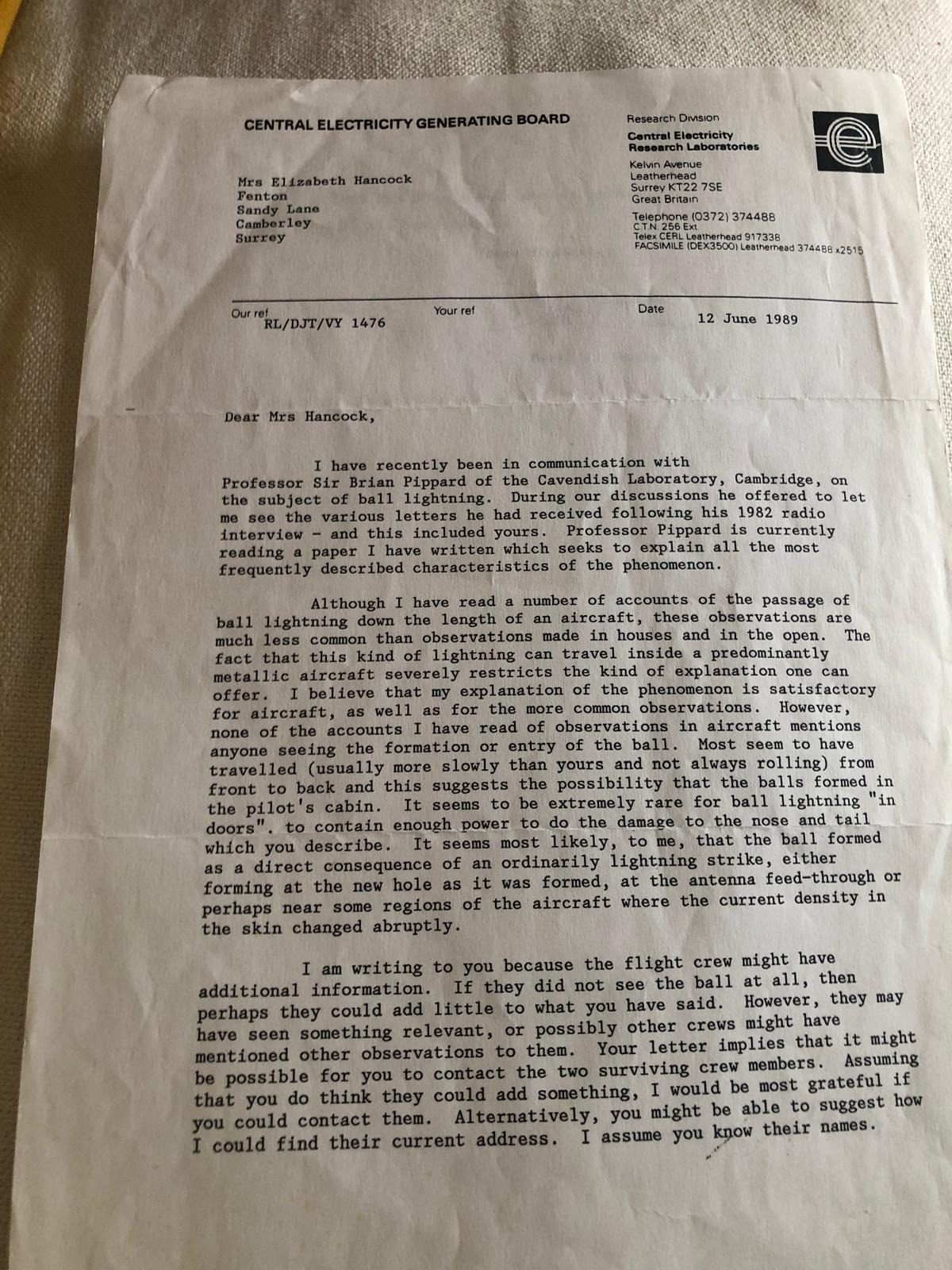
And it is almost certainly in the textbook. Mark Stenhoff’s Ball Lightning (1999), the standard work, lists among the few cases ever seen inside an aircraft: “A DC6 aircraft was flying north over the Alps in heavy turbulence when a luminous ball … was seen traveling rapidly along the floor of the central aisle … on landing blackened holes were found in the nose and tail of the aircraft, 3 to 4 in. and 10 to 12 in. in diameter, respectively.” The Alps, the turbulence, the speed, the small blackened hole forward and the big one aft: every detail she gave in 2026 is there, and the book’s source is a 1992 paper by a physicist working from the same collection of reports. It also supplies what she could not: the aircraft was a DC-6, of which Eagle had three from 1958 — so the flight was 1958–60, homeward from the Mediterranean.
⚠ The match is graded plausible, not proved: the 1992 paper is not online and Stenhoff names no witness. She cannot place it herself: “I can’t remember where I was coming from.” “Going back to Heathrow” is either a slip for Blackbushe or dates it to Eagle’s last year at Heathrow, 1960. The exact date, the route, the crew and the colleague in the galley are all open, and Tony’s presence on the flight must not be assumed. The full account, with the letter transcribed and the physics explained, is.
Berlin, 16 March 1959 — the manifest she kept
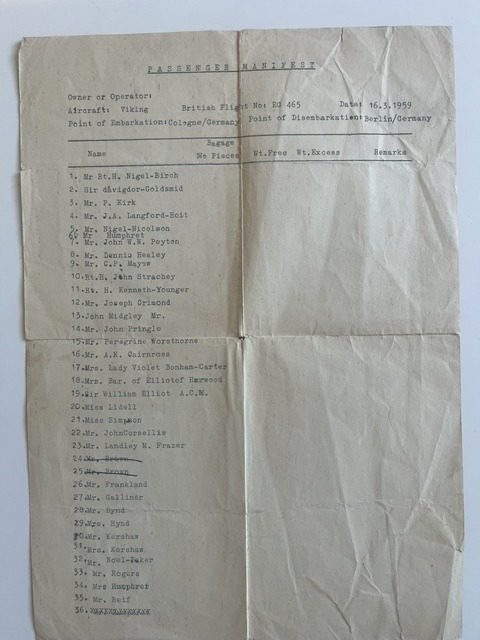
One sheet of paper survives from her flying, and it is the most historically loaded thing in the whole archive. It is a typed passenger manifest — Aircraft: Viking. British Flight No: EG 465. Date: 16.3.1959. Point of Embarkation: Cologne/Germany. Point of Disembarkation: Berlin/Germany — with thirty-six numbered lines, two of them struck through in ink. EG was Eagle’s flight code; the Viking was Eagle’s aeroplane; she was the stewardess. Her name is not on it, because crew are not passengers, and it has been in her keeping for sixty-seven years.
The names on it are these: Nigel Birch, who had resigned from the Treasury the year before; Sir Henry d’Avigdor-Goldsmid; Peter Kirk; John Langford-Holt; Nigel Nicolson, the publisher, son of Vita Sackville-West, thrown out by his constituency a month earlier for opposing Suez; John Peyton; Denis Healey — typed “Dennis”; Christopher Mayhew; John Strachey, a Secretary of State for War; Kenneth Younger; Jo Grimond, leader of the Liberals, and his mother-in-law Lady Violet Bonham Carter, Asquith’s daughter, seventy-one, typed “Mrs. Lady Violet Bonham-Carter”; Baroness Elliot of Harwood, one of the first women ever to sit in the Lords; Air Chief Marshal Sir William Elliot; Lindley Fraser, the BBC’s wartime voice to Germany; the economist Alec Cairncross; Peregrine Worsthorne of the Telegraph; John Hynd, who had run occupied Germany from Whitehall in 1945, with his wife; Anthony Kershaw and his wife; a Noel-Baker; and a handful of journalists, secretaries and names nobody has yet placed. Three parties, both Houses, the press and the BBC, in one twin-engined aeroplane, with one stewardess.
Why they were going matters. On 27 November 1958 Khrushchev had given the West six months to get out of West Berlin — the deadline was 27 May 1959 — and the whole world was talking about a second blockade. Macmillan had just come back from Moscow and had been in Bonn with Adenauer three days before this flight. A British party embarking at Cologne, the airport for Bonn, on a Monday in mid-March is the British delegation to the annual Königswinter Conference — the Anglo-German talking shop across the river from Bonn, which drew exactly this mix every spring, and whose tenth meeting was that March — flying on to Berlin as the Governing Mayor’s guests, which the conference’s own history says the British party did every year from 1957. Only British, American and French aircraft could use the corridors into the city. So an Eagle Viking took them in — on the evening of the day Eisenhower went on television to promise that the corridors would be kept open, “not one inch” of retreat.
Thirty-six years later she wrote to Denis Healey and sent him the manifest. He answered from the House of Lords on 18 July 1995, three sentences on crested paper:
“Thank you so much for sending me the passenger manifest. We went to Berlin from the House of Lords to learn how they were standing up to the second blockade — Willy Brandt was Lord Mayor at the time so we had great pleasure in meeting him.”
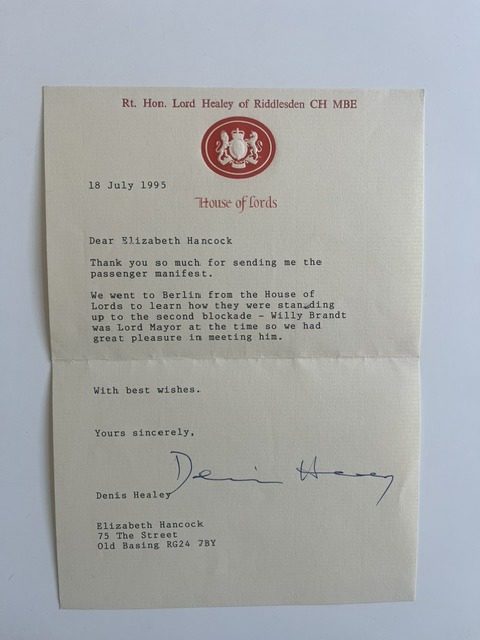
So the party met Brandt. Willy Brandt, Governing Mayor of West Berlin, later Chancellor of West Germany, the man whose city it was. And the woman who had served them their coffee over the Soviet zone kept the sheet of paper that proves it.
She was in the hotel with them, not only in the aeroplane. Will, 10 September 2026: “Mum rode in the lift with Bonham Carter.”
⚠ Healey’s “from the House of Lords” is where he was writing from in 1995, not where the party came from in 1959; he and nearly everyone on the list were then in the Commons. “Lord Mayor” is his English for Regierender Bürgermeister. The Königswinter reading rests on the Society’s own published history, the date, the airport, the company, and the fact that not one of the MPs on the sheet spoke in the Commons that week; it is corroborated. The printed British participant list for 1959 exists in the Bundesarchiv at Koblenz (B 296/75) and has not yet been seen. The full story of the flight, the crisis and every name on the sheet is told separately in.
Her own account, 9 September 2026, is one sentence. Will read her the names from the manifest — Healey, Lady Violet Bonham Carter, John Strachey, Kenneth Younger, Nigel Birch, Sir William Elliot — and asked what she remembered of the flight. “The only thing is that I remember going up in the lift with Violet one time. I don’t remember anything else.” She does not remember who the crew were. ❓ Why she wrote to Healey in 1995 was not reached. (9 Sep 2026)
Churchill Crescent, and what happened there
In Camberley she had the whole upstairs of a big old house halfway up Churchill, let to her by Ethel McNamara — “her brother was a bishop, she had another sister who was a nun. It was very Catholic.” ❓ Churchill Crescent, Camberley, is the likely street.
She shared with two other Eagle women: Sheila Ryland, who had “some connection with JCB”, and Patty.
This is the only passage in six hours of recording where she describes doing something at real personal risk, and she tells it without any framing at all.
Gander, Newfoundland — the posting they took together
They were posted to Gander together. A photograph of the two of them in uniform brought it out:
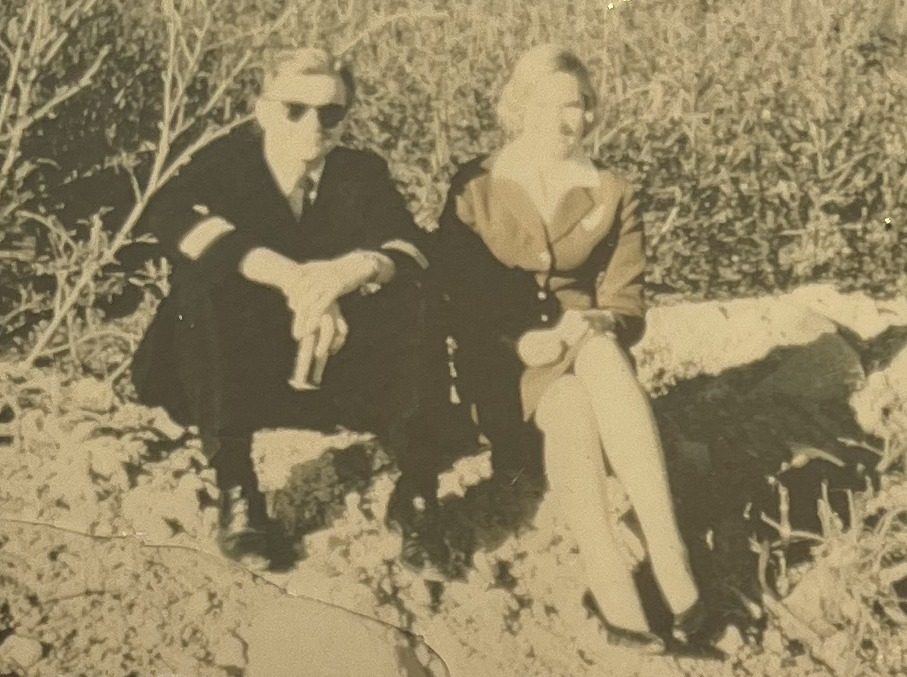
Tony in uniform, Liz in uniformIMG_0841_cut02.jpg
“This was in Gander, with his uniform on… Yeah, they’re both, we’re both in uniform.”
And with it, something the marriage section did not have:
“It was a sort of joint decision that we’d go — you know, this posting was available. But I’d been flying with him from Manchester, so I knew him quite well. I don’t think we were going out together really.”
So they knew each other as crew on the Manchester run before they were a couple, and took the Gander posting together while they still weren’t one. ❓ Dates not established; it belongs between Eagle and the marriage of July 1960.