V. Canada, c.1956–1957
She went out to Canada in her late teens, on an assisted passage that cost her £10. The plan came from another secretary at Rodney Street whose uncle lived in Montreal, so there was somebody to meet them.
⚠ On the tape she and her son both reach for “Ten Pound Poms”, and he immediately catches it — “Except it was Canada.” They are not the same scheme. The Ten Pound Pom was the British Government’s Assisted Passage Migration Scheme to Australia and New Zealand. Canada ran its own assisted-passage arrangements, and her own reading of why is probably right: “I think it was more that Canada wanted people.” What she paid, and under what scheme, is worth establishing — it is the kind of thing the Canadian immigration records for the period will show.
She landed in Montreal, stayed a couple of nights at Mount Royal, then took the train to Toronto to her cousin Mary Sutherland — Rollo’s only daughter, exactly her own age, and the person who made the deepest impression:
“She had her own car. I couldn’t believe it. She picked me up at the station in a car. And she’s the same age as me, and the idea of anybody my age having a big car…”
They shared a bedroom, a record player and a great deal of Frank Sinatra. She also met her uncle Rollo — the family’s black sheep, who got almost nothing in his father’s will because he had already had “hundreds and hundreds of pounds” — and did not warm to him. “I liked Auntie Kate, his Canadian wife. And I liked Mary, but I wasn’t keen on him really. Not like Uncle Ken, who was gorgeous.”
She spent more of the time in Montreal than Toronto, registered with the temp agency Office Overload — “once you’re registered, you can go to any city and work” — and shared a flat with another girl in a modern block that astonished her: one room with a kitchen in it, a sofa bed, a pink sofa, and washing machines in the basement. “Things I’d never seen before.”
And then the job she had never mentioned to anyone:
“I worked as a journalist.” — “Wow. Didn’t know that.” — “Well, I’m called a journalist, but it was for a sort of internal paper… Alcan. Aluminium Company of Canada. I lied. I said I had a degree. Nobody could check in.”
They sent her to interview a woman aboard a Russian ship. She still has a photograph of it somewhere — of the Russian woman, not of herself.
A second Montreal suitor, in her own words on film (2020). “I met an Irish guy there who had the lovely name of Chesley Millican” ⚠ spelling unverified — he worked on the stock exchange and talked her into letting him invest the money she had kept for her fare home, “and it lost it all of course, so I then had to work to get enough money to get back.” “That romance failed… I did look him up on the internet later and he’s dead now… he ended up as a pop group producer.” She kept the other boyfriend — Clive Tanner, below. The crossing may be dated by a photograph in the same film: a lifebelt reading SAXONIA (not established), Cunard’s Liverpool–Quebec–Montreal liner from 1954, and a domed church on a hillside that looks like St Joseph’s Oratory. (probably) (The Venerable Vulnerable, 10:04, 12:53; 5 Oct 2026)
Clive Tanner — identified and verified, 16 August 2026
In Montreal she met Clive Tanner, and came home engaged to him. He is now identified beyond reasonable doubt, and he had a considerable life.
CLIVE TANNER (7 January 1934 – 9 September 2022). Born at Edmonton, Middlesex, son of Arthur Tanner and Doris Gilbertson. Emigrated to Canada. Member of the Yukon Territorial Council for Whitehorse North, 1970–74, and Yukon Minister of Health. Member of the Legislative Assembly of British Columbia for Saanich North and the Islands, 1991–96, for the BC Liberals; stood unsuccessfully in 1986 and withdrew from the 1987 leadership race after a leg injury. With his wife Christine, whom he married in 1961, he founded Tanner’s Books and, from 1993–94, made Sidney, British Columbia into “Book Town” — explicitly on the model of Hay-on-Wye, which the Tanners visited on trips back to the UK. At its height Sidney had a dozen bookshops. He died at Sidney aged 88.
Every substantive thing she remembered about him is right. The bookshops; the island in British Columbia; Hay-on-Wye as the model; and that he went into politics. ⚠ Her word was “MP”; he was in fact an MLA — a provincial legislator — and before that a territorial councillor and health minister in the Yukon. Loose, but not wrong in substance.
And the dates fit her account exactly. He was born in 1934 and she in 1936. She met him in Montreal in the later 1950s; she married in July 1960; he married Christine in 1961.
What she told the interview, before any of that was known:
- He was selling greeting cards when they met, and was living in Canada, not travelling.
- Her mother’s verdict was one word — “brash” — and that, she says, “was the end of that”, before correcting herself: “No, it wasn’t… it wasn’t because of my parents. I’d sort of moved on, I think.”
- He followed her to England. They came back together on a boat from New York, and he played poker the entire crossing: “I never saw him.”
- His father made the money building bus shelters. ❓ That is Arthur Tanner, and it is checkable.
- ✅ THE THAMES HOUSE IS NAMED — 31 AUGUST 2026. It is “THE SEVEN DEADLY SINS”, SHOOTER’S HILL, PANGBOURNE, BERKSHIRE. She remembered it herself, unprompted, and told Will. See the panel below. The tension with Clive’s Edmonton birthplace (which is on the Lea, not the Thames) is unresolved: either the family moved, or the birthplace and the family home are different addresses.
- Decades later, buying a house in Glen Road, Fleet, her solicitor turned out to be Peter Tanner. ⚠ She calls him Clive’s brother and then immediately doubts herself — “Clive’s brother, Peter, who was his son?” Clive had a son named Peter. The archive cannot tell which, and the dates would decide it.
- He married a Canadian First Nations woman. ⚠ Her words were “a red Indian princess”, followed at once by her own “I don’t think you can say that anymore” and her correction to “Native Canadian”. The published sources name his wife as Christine and say nothing of her background, so this is unverified and should be handled with care.
Leaving Canada — the anchor date, and what happened next
She turned 21 in Liverpool, and that fixes the return. Asked to date the transition, she reached for the one date she is sure of: “I know I have my 21st birthday in Liverpool, so that means in 57.” She was born 2 September 1936, so her 21st was 2 September 1957 — and the Canadian year sits immediately before it, not after: out in 1956 or early 1957, home by the late summer of 1957.
The birthday itself was nothing. “It was memorable in that it wasn’t memorable. People didn’t have parties in those days. I think my parents might have taken me out to dinner… a Chinese.” It stayed in her mind only because it fixes where she was. “That’s a non-story, really.” (9 Sep 2026)
Clive Tanner came back with her and did not last long. “You came back from Canada with Clive in tow, didn’t you?” — “Oh, that’s right, I did. And so that fizzled out when he was deemed to be — what was it — brash. My mother said brash.” This is the second telling and it is firmer than the first: in the 15 August interview she withdrew the suggestion that her mother ended it. Here she puts it back. ⚠ Both versions are hers, six days apart. The honest reading is that her mother’s verdict was a real and remembered factor and not the whole of it.
She has since looked him up herself: “I looked Clive up on Google the other day.” She had seen a photograph of him late in life and read about the book fair — “anybody can start a book fair up” — which is the archive’s own identification of September 2022 reaching her by a different route.
✅ The Thames house, named at last — 31 August 2026
On the tape she raised it and let it go: “nowhere near understanding where that place was on the Thames. It’s not important, is it?” Ten days later she remembered it.
It is “THE SEVEN DEADLY SINS” at PANGBOURNE, Berkshire — not a house name but the local name for a group of seven, on Shooter’s Hill above the river.
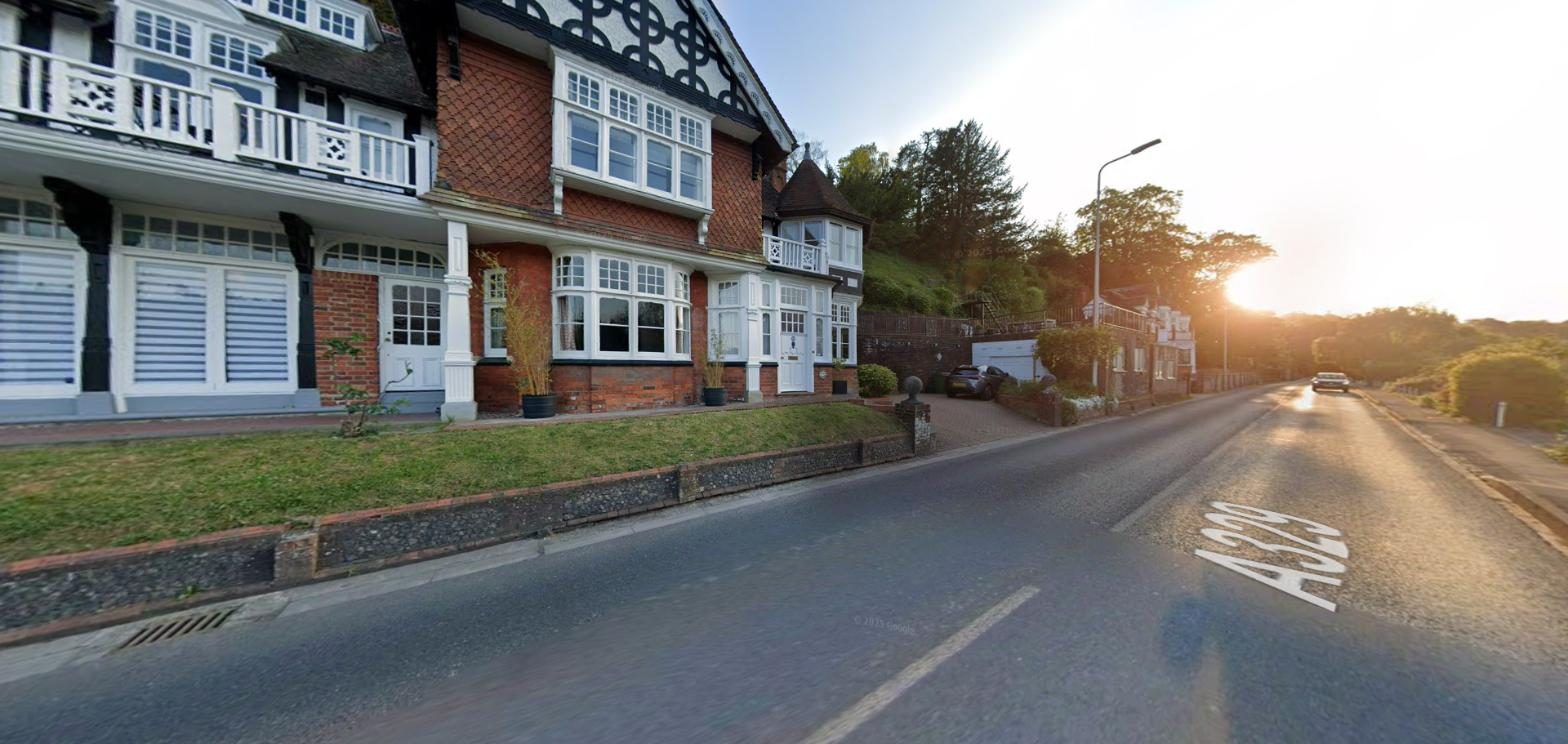
The row, looking south-east down the A329 — tile-hung gables, balconies, a turret, the chalk cliff rising directly behind them and the houses receding one after another down the road.
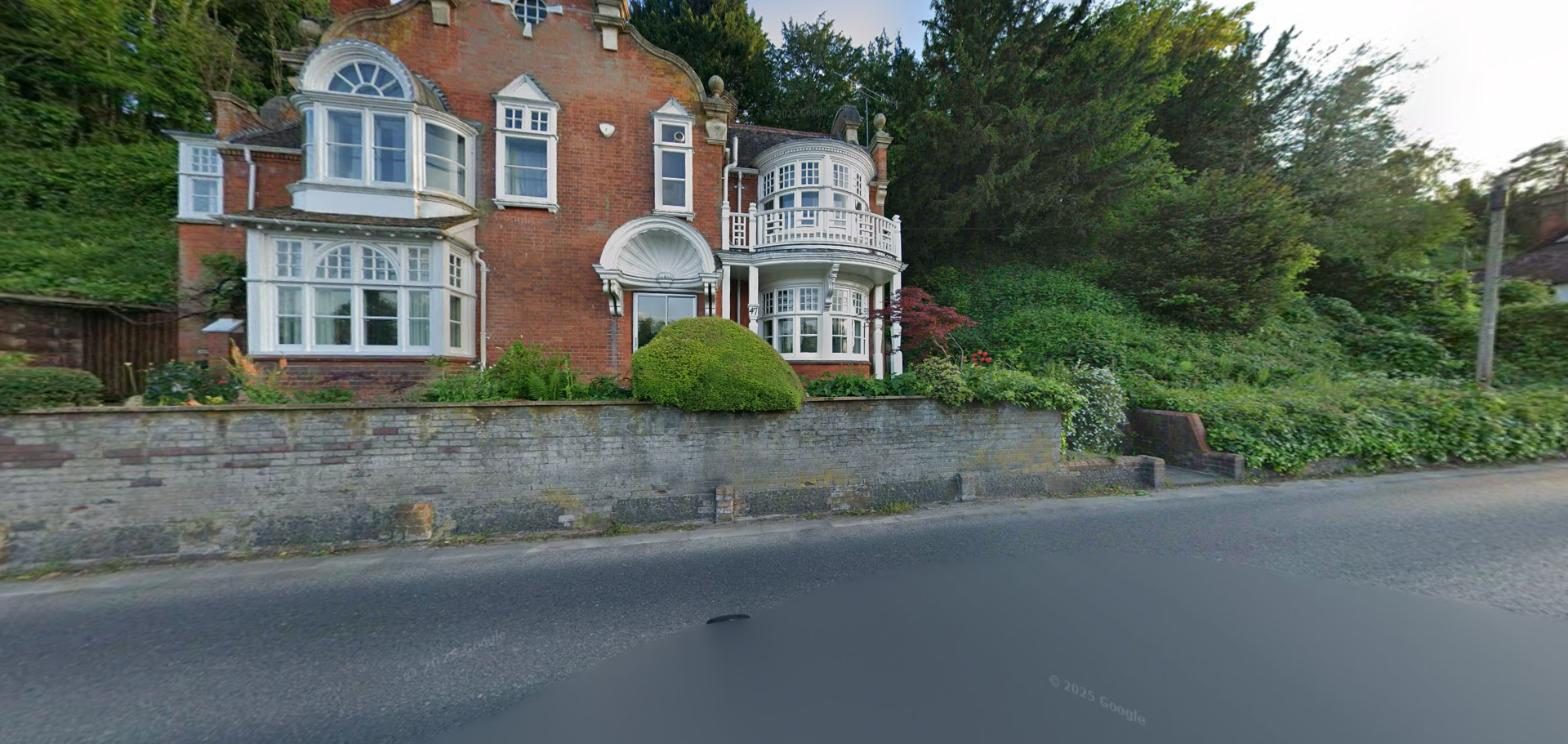
No. 47 — red brick, white bays, the half-round pedimented porch and the turret with its balcony. The door number is on the wall to the right of the porch.
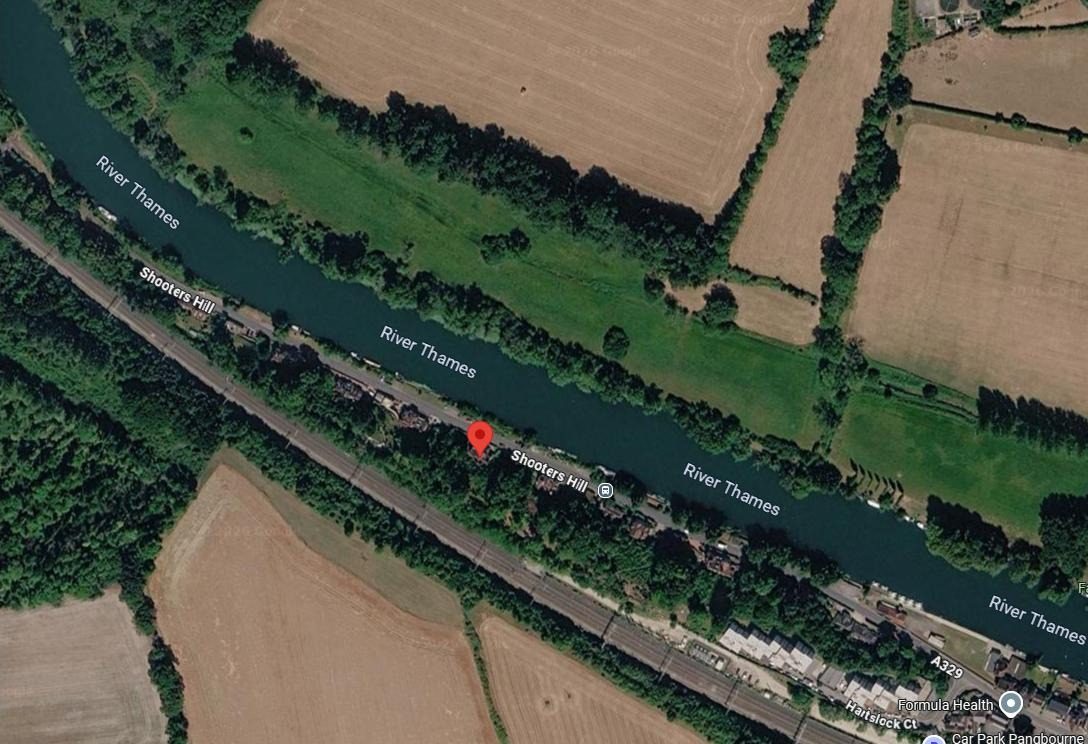
From above: the Thames on one side of the road, the seven houses on the other, backed hard against the wooded cliff. This settles the point below — no garden here runs to the water.
Google Street View and Google Earth imagery, captured 5 September 2026. © Google — held for family reference, not for republication.
What the place is. Seven large houses built in 1896, cut into the chalk cliff on the Reading road north of Pangbourne — now the A329 — with the Thames below them. Domes, turrets, balconies and gables, in a loose Queen Anne Revival. Each is separately Grade II listed: no. 41 Bankside, no. 45, no. 47, no. 51 Craigside, no. 55 Northridge.
The nickname is an insult, not an affection. It was the public’s verdict on the architecture, and it stuck. A critic, more than thirty years after they went up: “an example of the pretentious and expensive sort of building which has not been mitigated by gardening. These houses have been locally christened the Seven Deadly Sins, which is sufficiently indicative of the opinion of the public upon such architectural disfigurement.” The apocryphal story — that they were built for seven mistresses, or for seven lady friends of the Prince of Wales — is repeated everywhere and evidenced nowhere. The builder is usually named as D. H. Evans, the department-store magnate.
⚠ One detail does not fit, and it is worth putting to her. She described “a big house directly on the Thames, the garden running to the water”. The Seven Deadly Sins are on the far side of the road from the river — confirmed on the imagery of 5 September 2026: the river bank opposite is thick scrub, not lawn, and the houses back straight onto the chalk cliff, wedged between the cliff and the highway, and their gardens do not run to the water. Either the memory has merged the view with the frontage — easy enough at seventy years’ distance — or the Tanners had a river frontage opposite. Ask; do not correct her.
❓ Which of the seven? Not established, and she can very probably say on sight: they are individually photographed and online. See the interview brief.
Where the pictures are: Historic England’s Images of England holds photographs of no. 47 and of Craigside, no. 51 (IOE01/01549/25 and /24); Geograph has the group (photo 1386201); and the Tate Archive holds two photographs of them by JOHN PIPER (TGA 8728/1/2/168 and /169) — which, for a woman whose own interest is design, is worth showing her for its own sake.
And then, immediately: flying. “So I must have gone straight into flying.”