Five generations
⬇ five_generations_complete.pdf
Lives, as far as we know them, from a Cornish parish and a Nova Scotian garrison to a Liverpool shipping office.
Centred on Elizabeth Hancock, née Wynne, born 1936
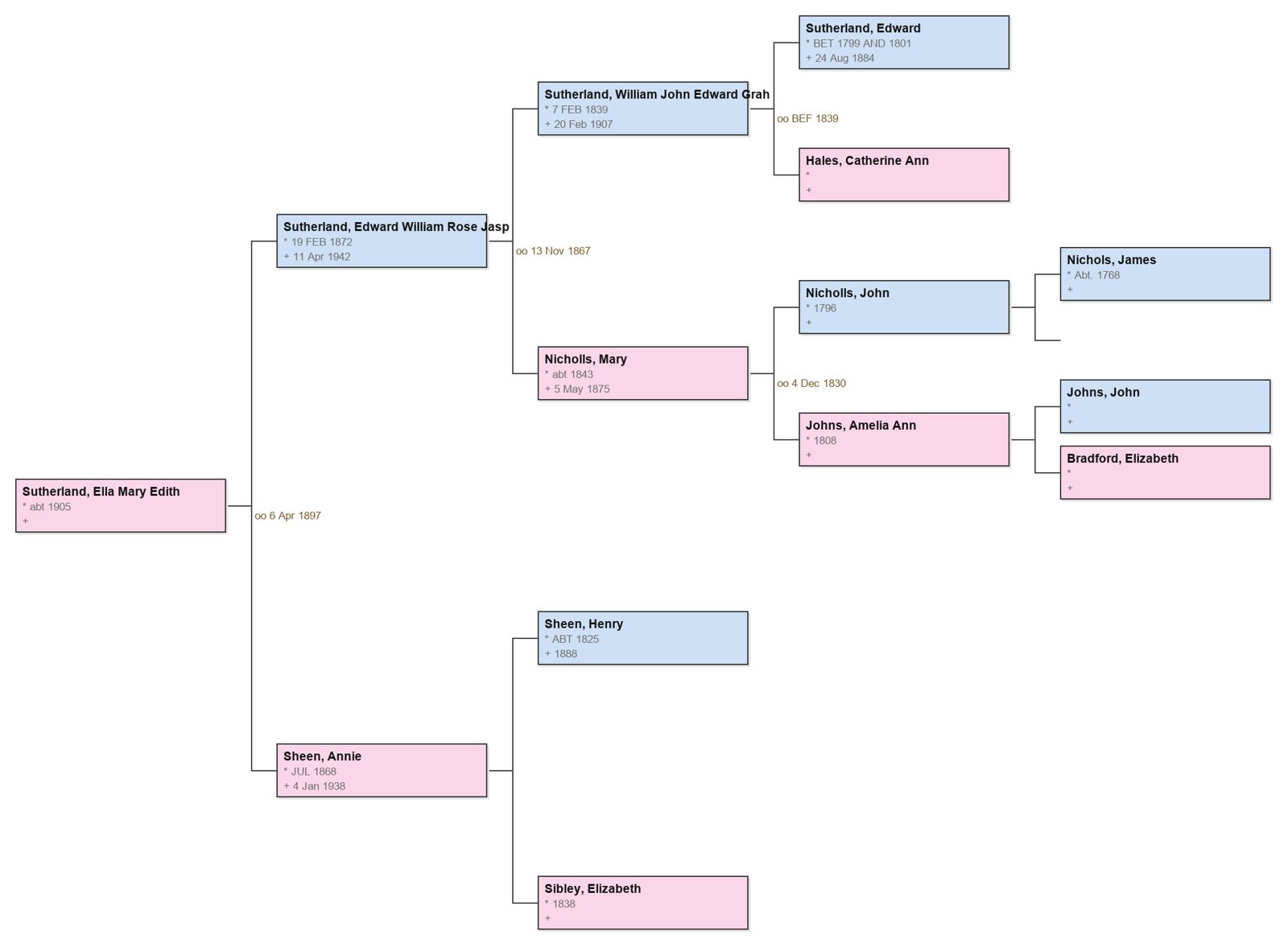
Elizabeth’s mother’s pedigree, four generations back.
Elizabeth Hancock, née Wynne, was born at the beginning of September 1936. This account is reckoned from her: her mother, her grandparents, and the people behind them, back to a Cornish parish and a garrison in Nova Scotia.
It sets out what the certificates, letters, censuses and family papers actually say. Where they are thin, silent or contradict one another, that is said plainly rather than smoothed over.
The ambition is to put a face to every person here. At present very few of them have one. There is a photograph of Annie Sheen, a watercolour said to be Mary Bradford Johns, an oil painting of a ship — and for most of the rest, nothing at all. Anyone reading this who holds a photograph, a portrait, a snapshot in an album or a face on the back of a postcard is asked to say so, however uncertain the identification: a picture with a doubt attached to it is worth more than a blank.
And please write on it. Corrections, names, dates, half-remembered stories — anything pencilled in the margins of a printed copy can be added to the account. Much of what is here came out of exactly that: notes in somebody’s hand on the back of something else.
The ladder
Counted from Elizabeth:
| Generation | ||
|---|---|---|
| Elizabeth | Elizabeth Hancock, née Wynne | b. 1936 |
| her parents | Ella Mary Edith Sutherland & Charles Wynne | 1904–? · 1905–1992 |
| her grandparents | Edward William Rose Jasper Sutherland & Annie Sheen | 1872–1942 · 1868–1938 |
| her great-grandparents | W. J. E. G. Sutherland & Mary Nicholls | 1839–1907 · 1843–1875 |
| her great-great-grandparents | Major Edward Sutherland & Catherine Ann Hales | c.1801–1884 · c.1804–1866 |
| her great-great-grandparents | John Nicholls & Amelia Anne Johns | 1796–1874/82 · 1807–1894 |
The two sets of great-great-grandparents are of the same generation, and their children married each other at St Columb Major in 1867 — which is why the Cornish and the army halves of this story meet where they do.
Going further back: John Johns (1773–1852) and Elizabeth Bradford (1778–1823) are Elizabeth’s 3× great-grandparents, as are James Nicholls (1768–1851) and Mary Penrose. Mary Bradford Johns (1800–1882), of the watercolour, is Amelia’s sister and so Elizabeth’s great-great-aunt.
John Nicholls (1796 – 1874 or 1882) & Amelia Anne Johns (1807–1894)
Elizabeth’s great-great-grandparents.
John
Born at St Columb Minor, Cornwall, in 1796, the son of James Nicholls (1768–1851) and Mary Penrose. He is styled Esquire and Gentleman in the records — a landed Cornishman rather than a professional man, and the family’s status is best measured by what his sons became.
He married Amelia Anne Johns of Crantock at Crantock on 25 November 1830 — she was 23, he 34.
Amelia
Born at Crantock in 1807 and christened there on 22 May, daughter of John Johns (1773–1852) of Carloggas, St Columb Major, and Elizabeth Bradford (1778–1823).
She was one of eleven. Her childhood was hard in the ordinary way of the period: her sister Caroline died at two, her brother Bradford at two, her brother Richard at thirteen, and her mother died when Amelia was sixteen. Her surviving siblings included John Bradford Johns (1799–1884), Mary Bradford Johns (1800–1882) — the “lady in a gray dress” of the family watercolour — Constantine Bradford Johns (1803–1871), Gertrude (1804–1888), Elizabeth Bradford Johns (1806–1846), Maria (1810–1884) and William Francis (1817–1837, died at Liverpool).
Their children — seven
| James | b. St Columb Minor, chr. 21 Nov 1831 – d. 28 July 1917, aged 85. Physician |
| Thomas | b. 28 May 1834 – d. 23 Aug 1885 at Trekenning, aged 51. Solicitor |
| Elizabeth Helen | 1836 – d. January 1869 at Kensington |
| William Francis | b. 3 July 1838 |
| George Jasper | 1841 – 1920. Indian Civil Service judge |
| Mary | b. abt 1843, chr. St Columb Minor 21 Nov 1843 – d. 5 May 1875, India |
| John Godolphin | b. July 1845 – d. December 1855, aged ten |
Trekenning
The family did not begin there. The elder children were born at Gustaveor, in the neighbouring parish of St Columb Minor — Dr James Nicholls “was born at Gustaveor, in St. Columb Minor, Oct. 18, 1831”. By the 1861 census the household is at St Columb Major; by 1871 it is unambiguously at Trekenning House. The move falls somewhere between 1846 and 1861 and is not yet pinned down.
Trekenning is a Grade II listed house south of St Columb Major — a mid-17th-century farmhouse given a symmetrical Georgian front, and remodelled internally in Gothic style in the mid-to-late 19th century, which is precisely the period the Nicholls held it. It had earlier belonged to the Paynter family, among them James Paynter, who proclaimed the Old Pretender in St Columb market square in 1715 and was acquitted of treason by a jury of Cornish tinners. How it passed from Paynter to Nicholls is unknown.
The census of 2 April 1871 gives the best picture of the house: twelve people, three generations — John 75, Amelia 62, Thomas 37, George Jasper 29, their married daughter Mary 27 home from her husband’s regiment, her daughter Ellen aged 1, and a grandson of one month. Five of the twelve are still unnamed.
Amelia died at Trekenning on 5 December 1894 and was buried at St Columb Minor on 10 December, having been widowed there and head of the household in the 1881 and 1891 censuses. She lived in that house for at least thirty years and died in it.
Unresolved. John’s death is given as Trekenning, 11 September 1874 in one source and Liskeard, April 1882 in another. Both cannot be right and neither is a record.
The pull of St Columb
Something worth noticing about this parish: people married into it kept coming back to it.
Sophia Dunbar Gordon Sutherland was William’s sister — a daughter of Major Edward Sutherland, born at Chelsea in 1841, and married at St Philip’s, Earls Court, Kensington, on 25 November 1880 to Albert Harold Carlyon, son of Edward Carlyon and Harriet Simmons. She had no Cornish blood at all. She died at St Columb in 1929 — and so did her husband, the same year.
That is a London-born army officer’s daughter ending her life in the parish her brother had married into sixty years earlier, among his first wife’s people, half a century after that wife had died at Madras. Two of the Nicholls brothers are here too: Thomas died at Trekenning in 1885, Dr James in 1917. Amelia died in the house in 1894 after thirty years in it.
There is a plainer explanation to weigh first. Albert Harold Carlyon was himself Cornish — he is recorded as of St Just — and Carlyon is one of the old Cornish names. A Cornishman retiring to Cornwall needs no accounting for. But St Just is not St Columb, and of all the parishes in the county they settled in that one.
Open. Their probate entries and the St Columb burial register would show where exactly the Carlyons were living, and whether it was at or near Trekenning. If it was, then the house was more than the Nicholls family seat by the end — it was where this family went.
Major Edward Sutherland (c.1801–1884) & Catherine Ann Hales (c.1804–1866)
Elizabeth’s great-great-grandparents. The most obscure and the most intriguing pair in the tree.
Edward
Born at Halifax, Nova Scotia, most probably between late 1799 and 1801. The 1881 census of England has him at 10 Pembroke Gardens, Kensington, aged 80, a “Retired Major of the Army”, birthplace “Halifax, North America”. He died at Plymouth on 24 August 1884.
His father is unknown. He is where the Sutherland line stops, and finding him is the oldest unanswered question in the family history.
What he did with his life is now partly clear:
- The New Annual Army List for 1855 lists him among the staff of the Royal Hospital, Chelsea — “Storekeeper, Captain Edward Sutherland, h.p. Unatt.” He was on the staff, not a pensioner, which overturns the story the family told for a century. Elizabeth had independently written down “Steward at Royal Hospital, Chelsea”.
- A family note styles him “Edward (Yeoman of the Guard) Sutherland, Major”. If true, he held a place in the Sovereign’s bodyguard — and it would explain the carte-de-visite in the family papers of an elderly officer in full dress with a plumed cocked hat, which is the dress of that corps’s officers. Unverified.
- A second photograph, framed, was put forward on 10 September 2026 as “Elizabeth’s great-great-grandfather” — a young officer in full dress. Counted on the ladder above, that label points here, to Edward. The picture itself says otherwise: the dress is post-1855 and the sitter is about thirty, and Edward was past fifty-five by then. It is placed under his son William, below, where the reasons are set out; the family’s words are kept with it.
- Family tradition, set down by his granddaughter Nellie in 1938, says that Prince Edward, Duke of Kent — Queen Victoria’s father — stood godfather to him at Halifax. The Duke commanded the garrison there in those years. There is no proof. But the family papers contain an original letter headed Kensington Palace, 1 August 1803, signed simply “Edward” — as a royal duke signs — about securing an army commission for a correspondent’s son. The address panel has never been examined, so it is not known who it was written to.
Catherine
Recorded on the Ancestry tree as born about 1804 in Jamaica, and dying in 1866 in Surrey. An index entry gives the marriage: Catharine Ann Hales, widowed, married Edward Sutherland at Newport, Isle of Wight, on 4 March 1821 — Newport being the garrison town of Albany Barracks.
Her death in 1866 fits what the censuses independently show: with Edward in 1851, replaced by “Mary B” by 1871.
Her surname. Three sources agree on Hales: Elizabeth’s own papers, a Canadian cousin descended from one of the daughters, and the marriage index entry above. The family had long said Beauchamp instead — but that name belongs to Eliza Cregoe Beauchant, who married Catherine’s son, one generation further down.
Open question: the 1821 entry calls her a widow, so Hales may be her first husband’s name rather than her own. If so her maiden name is still unknown.
Still unresolved. If she was born about 1804 she was sixteen at a marriage that records her as a widow. Either the birth year is wrong or the 1821 entry is a different couple. The Newport register would settle it.
Their children — “a heap of daughters and one son”
Nellie Sutherland’s letter of 2 November 1938 describes her grandfather as “then a widower with a heap of daughters and one son, our father.” She was right. From a Canadian cousin and from Elizabeth’s own notes:
Mary Ann Fredrica Gordon (1833–1887, d. Devonshire) · Eleanor Maria · Edward (died the day he was born) · Frances · Caroline · Sophia Dunbar Gordon (b. 11 Sept 1841 Chelsea, m. Albert Harold Carlyon 1880, d. 1929 St Columb) · Childers Meadows (died young) · and William John Edward Graham, the only surviving son.
Two carry Gordon, one Dunbar — Scottish names that recur in the family and are the only hint we have of where the Sutherland name itself came from.
Eleanor Maria married a McMahon, and through her the family reaches the Nicholsons of Charlottetown, Prince Edward Island — the branch that produced Otho, who gave Ella away at her wedding in 1933.
Lt-Col William John Edward Graham Sutherland (1839–1907) & Mary Nicholls (1843–1875)
Elizabeth’s great-grandparents on the Sutherland side.
William
Born 7 February 1839. The tree carries Ayrshire; Elizabeth’s notes say Glasgow, Lanarkshire, “year of birth and place from Civil Service records” — which is the better source. He was at Chelsea as a boy, and in London, Christchurch, Middlesex at the 1851 census.
His career comes from a War Office letter of 22 January 1925, furnished from the official papers:
| Ensign, 44th Foot | 11 March 1859 |
| Lieutenant | 1 April 1863 |
| Captain | 25 September 1869 |
| Paymaster, 61st Foot | 1 April 1878 |
| China | 9 Oct 1860 – 11 Oct 1861 |
| East Indies | 12 Oct 1861 – 14 Feb 1866 |
He finished as Lieutenant Colonel in the Army Pay Department, and was Staff Paymaster by October 1902. The War Office is careful to note that no war service was found and that he is not on the China Medal Roll — he was in the theatre but is not evidenced as having fought.
His postings can be read off his children’s birthplaces: Cornwall 1869–71, Kamptee, India 1872–73, Cornwall and Truro 1878, Ayrshire 1883, Heywood, Lancashire 1886–90, Sliema, Malta 1892, Yarmouth, Norfolk 1901.
His face — the young officer in the oval frame
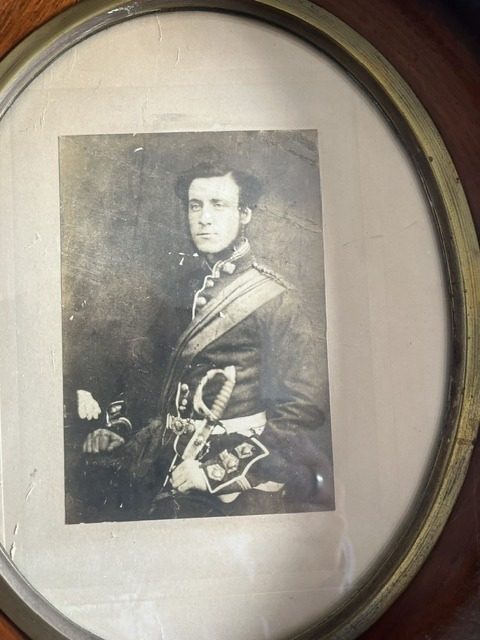
This is the first face the Sutherland line has. The photograph came out of Elizabeth’s keeping on 10 September 2026, in a dark oval frame behind glass, with the family’s label that it was her great-great-grandfather. On the ladder that is Major Edward. The uniform and the face say it is William, and the two readings are set down here side by side rather than one being quietly preferred.
What the picture shows: a man of about thirty, dark hair brushed up, side-whiskers and a clean chin, seated three-quarter length. A dark single-breasted tunic with a high closed collar edged in lace; a twisted gold cord on the shoulder — a thin rope, not the fringed epaulette of an earlier generation; a broad pouch belt crossing the chest from his left shoulder to his right hip; a sash round the waist with its tassels falling at the left hip; a sword with a gilt guard and knot under his left hand; a glove in his right. At his left knee, an embroidered flap bearing a row of badges — either a sabretache hanging from the belt, or headdress laid on the table; the phone photograph cannot tell them apart.
What that dress means. Twisted shoulder cords, the closed-collar tunic and the sash at the waist came in with the reforms of 1855 and lasted, with changes of detail, into the early 1880s. So the sitting is after 1855. A pouch belt worn with a sabretache is the equipment of a mounted officer — cavalry, artillery, engineers, or an infantryman in a mounted appointment. The plain front rules out hussars.
Now put the family beside it. Major Edward was born about 1801; in any photograph taken in this dress he was fifty-five or more, and this is not the face of a man of fifty-five. William was twenty in 1859, when he was commissioned Ensign in the 44th Foot; a lieutenant in 1863; and “Lieut. & Adjt. 44th Regt.” — an adjutant, who rode — when he married Mary Nicholls in 1867, aged twenty-eight. A photograph of him at that rank, in the 1860s, is exactly the age, the date and, if the sabretache is a sabretache, the appointment the picture shows. His son Edward went to sea; the sons of the second marriage were born from 1880 and would be photographed in a later cut of tunic. He is the only Sutherland in the tree who fits.
The likeliest account of the label is a slip of one generation. Counted from Will, William is the great-great-grandfather; counted from Elizabeth, he is her great-grandfather. The words may simply have crossed the table.
What would settle it. Take the print out of its frame and photograph the back of both — framers’ labels and pencilled names live there, as one did on the Annie Sheen card. Then rephotograph the face square-on, out of the glass, at full resolution: the facing colour on collar and cuffs (the 44th wore yellow, which reads pale in a photograph of this date), the badge on the sabretache, and the pattern of the collar lace would each name the regiment. The National Army Museum reads uniforms for exactly this purpose. Until then: William, plausible; Edward, contradicted by the sitter’s age. Record:
photograph-portrait-young-officer-oval-frame.
He died at West Ham, Essex, on 20 February 1907, aged 68, and was buried on 23 February at Chingford Mount Cemetery — section G11, grave 74848.
Mary
Baptised at St Columb Minor, 21 November 1843. She married William at St Columb Major on 13 November 1867; the register gives him as “Lieut. & Adjt. 44th Regt.” of Aldershot, and her of Trekenning.
Trekenning was her home, not theirs. In 1871 she is recorded there as “Mary Sutherland Nichols, 27, relation to head of house: Daughter“ — a married daughter in her father’s house, with her two small children, while her husband was with the regiment. Both her Cornish children were born and baptised at St Columb Major.
How did they meet?
Nothing in the papers answers this, and it is worth stating as a question rather than guessing at. He was a serving officer at Aldershot, born in Scotland, brought up around his father’s postings and bound for India, Malta and Lancashire. She was a Cornish gentleman’s daughter who, on every record that survives, was at Trekenning — born there, married from there, and back there with her babies while he was with the regiment. Their worlds do not obviously overlap, and no letter, no introduction and no shared acquaintance has been found.
One apparent explanation can be ruled out. Mary’s aunt, Mary Bradford Johns, did marry William’s father, Major Edward Sutherland — but the Major was not widowed until 1866 and that marriage cannot be dated earlier than the year before William and Mary’s own. Both were then in their sixties. It is far likelier that the older pair met through the younger couple’s wedding than the other way about, which leaves the original question untouched.
Open. The marriage licence of 7 November 1867 should give William’s and Mary’s stated residences a week before the wedding, which is the obvious first place to look. After that: her brothers, Dr James Nicholls and George Jasper Nicholls of the Indian Civil Service, both of whom moved in wider circles than she did; and the stations of the 44th Regiment in the west of England.
She followed him to India. She died on 5 May 1875 and was buried at Madras the next day, aged 32, leaving three children under six.
Why her death brings Mary Bradford Johns into the story
Nellie Sutherland’s 1938 letter devotes more space to Mary Bradford Johns than to anyone else, and until the shape of 1875 was clear it was not obvious why. It is obvious now.
When Mary Nicholls died at Madras, she left Ellen aged five, Edward aged three, and Annie aged one, in India, with a father who was a serving officer of the 44th Foot and could not raise them. The children came home. Someone had to take them, and there was one person doubly placed to do it.
Mary Bradford Johns was connected to those children twice over. By blood she was their great-aunt — sister of Amelia Anne Johns, their grandmother at Trekenning. By marriage she was their step-grandmother — she had married their grandfather, Major Edward Sutherland, as his second wife, some time in the 1860s. Nellie states both relations in one breath: “Grandma Nicholls’ sister (our great aunt)… she… married our grandfather, Major Edward Sutherland, then a widower with a heap of daughters and one son, our father.”
And she was childless. Nellie is explicit — “no children by either husband” — a woman then in her seventies, married to the children’s grandfather, with no family of her own and every reason to take in three orphaned great-nephews and nieces.
Where were the three children in 1881? This is the question that would show who actually raised them, and it has not yet been answered. In April 1881 Ellen was 11, Edward 9 and Annie 7. Their mother had died at Madras in 1875 and their father had remarried in 1878. They could be with their father and stepmother — his postings put him around Heywood, Lancashire in that decade; with their grandmother Amelia at Trekenning; with Mary Bradford Johns and the Major, who that April were at 10 Pembroke Gardens, Kensington (RG11/24/57 p.27) with no children of that age in the household; or at school. Each answer means something different about the childhood Edward later wrote about. Three names, one census — it is a single afternoon’s work for anyone with access to the 1881 returns.
That is why she looms so large in the letter sixty years later: why she was “much respected by all her step-children”, why her watercolour portrait hung in the family and still does, why the Indian rosewood furniture she brought home from her first marriage came down through the family, and why “the chair for you, was hers”.
The order of the two marriages. The Johns and Sutherland families were joined twice — the younger couple in November 1867, and the older pair, Mary Bradford Johns and Major Edward Sutherland, at some point between his first wife’s death in 1866 and the census of 1871. Both of the older couple were then in their late sixties. The likeliest reading is that the second marriage followed from the first — that the widowed Major met his wife’s niece’s family through his son’s wedding — rather than that it made the introduction.
This is inference, and it is flagged as such. No record has yet been found of who had charge of the children between 1875 and their father’s remarriage in 1878, and the reconstruction rests on the relationships, the dates and Nellie’s own emphasis. The 1881 census would test it directly — it will show where Ellen, Edward and Annie were living and with whom. Mary Bradford Johns died at Plymouth on 13 December 1882, and Major Edward Sutherland died at Plymouth on 24 August 1884; where the children were in 1881 is the missing piece.
Their children
- Ellen “Nell” Graham Sutherland (1869–1953), b. July 1869, bapt. St Columb Major 4 Oct 1869
- William Edward Sutherland, b. Trekenning, 16 February 1871, bapt. 26 Feb — almost certainly died in infancy, since his name was given again
- Edward William Rose Jasper Sutherland (1872–1942), b. Kamptee, India, 19 February 1872, bapt. there 5 April
- Annie McGregor Sutherland, b. Kamptee, 21 August 1873
William remarried at Truro in September 1878 to Eliza Cregoe Beauchant (1857–1945) of Rosevine, Gerrans, and had five more children — Francis, Bertram Rollo Usticke, Nowell Dunbar Ommanney, Irene Mary Primrose and Zoe, with Helena following.
What the second marriage rests on. No marriage certificate for it has been seen. The evidence is: an index entry for a Sutherland–Beauchant marriage at Truro in the September quarter of 1878, among the papers in the house; a woman recorded elsewhere as Eliza Cregoe (Beauchant) Sutherland, of Gerrans, 1857–1945; six children carrying Sutherland and Beauchant names, several of them baptised at Heywood, Lancashire in the 1880s where his Army Pay Department postings put him; and Eliza recorded as a widow at Lymington in 1911, four years after William’s death in 1907. Taken together that is a strong case and not a proved one.
The certificate would close it: the GRO marriage entry, Truro district, September quarter 1878. It would give his rank, his age, his father’s name — and hers.
The Beauchants, and Nellie’s letter
That second marriage is what Nellie Sutherland’s letter of 2 November 1938 is really about, and it took this project a fortnight to see it.
Writing to her brother Edward — Elizabeth’s grandfather — about the disposal of the family papers, she says:
“Among the papers that will go to Irene, is a certificate of our grandfather’s first marriage, to a widow: also the signature of Queen Victoria’s father, who was our grandfather’s godfather: they ought to have been left to you (they are useless to Frank, who cannot marry) nor is Irene likely to, but our poor cousin was obsessed with the idea of the “Beauchant” superiority in point of birth to our mother’s — now we need not refer to this again… but keep this letter. Some day your children may want to know.”
Read cold, that passage is baffling. It reads like a squabble with some distant cousin about a name nobody can place. It is nothing of the kind. Nellie and Edward were children of the first marriage, to Mary Nicholls of Trekenning. Irene, Frank, Zoe, Nowell and Helena were children of the second, to Eliza Cregoe Beauchant. They were half-siblings, and the quarrel ran straight down the middle of one household — the Beauchant side against the Nicholls side, Cornish gentry against Cornish gentry. When Nellie writes “our mother’s“, she means Mary Nicholls, and the comparison being made was between her mother’s people and her stepmother’s.
It also explains the thing that most needed explaining. The papers went to Irene — the certificate of the Major’s first marriage, and the Duke of Kent signature — and Nellie plainly thought they should have gone to Edward. They went to the Beauchant half, because that half set store by descent. Her flat, tired “now we need not refer to this again” is the sound of a woman closing a subject she has argued too many times.
And here is the point for anyone reading this as their own family history: the Beauchant line is a dead end, blood-wise — but the children of that marriage are not.
Elizabeth descends from W.J.E.G. Sutherland by his first wife, Mary Nicholls — through their son Edward William Rose Jasper, born at Kamptee in 1872, six years before the second marriage took place. Eliza Cregoe Beauchant was his stepmother, and is no blood relation to this family at all. Nor is her father George Beauchant of Rosevine, nor the Beauchants of Falmouth behind them. No Beauchant blood comes down this line.
Her children are a different matter, and an earlier draft of this got it wrong. Frank, Nowell, Zoe, Irene and Helena were William’s own children by his second wife. They shared a father with Edward and Nellie, which makes them half-brothers and half-sisters — half-blood kin, not strangers, and Elizabeth’s half-great-uncles and half-great-aunts. Half the ancestry of each of them is the same Sutherland ancestry as her own.
Were they his, or did he marry into an existing family? Fairly asked, and the answer is that they were his. Eliza was twenty at the wedding — born December 1857, married September 1878 — far too young to have arrived with five children. And the children’s names settle it from the other direction: they carry their father’s family names alongside their mother’s maiden name — Francis Graham Beauchant Sutherland, Nowell Dunbar Ommanney Sutherland — Graham from William himself, Dunbar from his sister Sophia Dunbar Gordon Sutherland. Children of another man would not carry those.
There is a quiet irony in it. The cousin’s boast about “Beauchant superiority in point of birth” concerned a lineage that Nellie did not share, Edward did not share, and Will does not share — and the family treasures went that way regardless. Nellie’s own scepticism is audible in the quotation marks she puts round the name.
The confusion has had a long life. The family carried “Beauchamp” as the Major’s wife’s surname for generations — and the name was real enough: it had been in the family’s talk for a century because of this quarrel. It had simply attached itself, over four generations, to the wrong woman. The Major’s wife was Catherine Ann Hales.
Captain Edward William Rose Jasper Sutherland (1872–1942) & Annie Sheen (1868–1938)
Elizabeth’s grandparents.
Edward — forty-eight years at sea
Born at Kamptee, India, on 19 February 1872, motherless at three, and raised in Cornwall. Educated at Ashburton Grammar School, Devon. His obituary calls him “by birth a Cornishman”, which is what he would have said of himself.
He went into sail with the great Liverpool firm of Henry Fernie and Sons:
- apprenticed in the Laomene under Captain Randall — acting third mate in his last year. (Commodore Sir Bertram Hayes, later of the Olympic, had just finished his own time in that ship when Sutherland joined her.)
- five years in the full-rigged Pythomene under Captain A. MacAusland, “Pacific Mac” — rising A.B., third mate, second mate, then two years mate
- second mate and mate of the Aristomene
- twelve years under Fernie’s house flag, in sail
He took his master’s certificate on 23 March 1899, living then at 111 Bagot Street, Wavertree — and transferred to steam at once, joining the Johnston Line that same month as third officer of the Lochmore. He stayed with the company as officer and master until Furness Withy absorbed it in 1916, and remained in command of their ships until he retired in 1935.
Forty-eight years at sea, in only two companies. War service in the North Atlantic trade, afterwards the Mediterranean and Levant. A Freemason of the Minerva Lodge, Liverpool, from 1920; long on the management committee of the Imperial Merchant Service Guild.
He died at 33 Plattsville Road, Wavertree, on 11 April 1942, aged 71 — “beloved husband of Annie, and dear father of Rollo, Kenneth and Ella” — and was buried at Holy Trinity, Wavertree, from St Barnabas’, Mossley Hill.
A number to check. His death notice gives 33 Plattsville Road; his will of 1939, the envelope posted to him from America in 1931 and Annie’s death certificate of 1938 all say 31. One of the two is wrong.
Ashburton, 1880 — the missing years
Between his mother’s death at Madras in 1875 and his indentures at Liverpool in 1887 there was nothing. The school magazines in his papers close the gap.
On page 19 of The Ashburtonian for Autumn 1927, in the Old Boys’ Association roll, under Life Members:
Sutherland, E. Capt..... 1880
and beside that one line, in ink, in a family hand: + at the school.
The year in these rolls is the year of entry. 1880 puts him at Ashburton Grammar School at eight years old, leaving in time to go to sea at fifteen — which fits the rest of his life exactly: a boy born in India to a serving officer, motherless from the age of three, sent to a West Country grammar school and kept by the Cornish side of the family while his father soldiered abroad.
And the roll is describing a grown man. It prints him as Capt., which is what he was in 1927, and it lists him as a Life Member — a subscription taken out and kept up in adulthood, which is the only reason a Devon school magazine was posted to a house in Mossley Hill at all. He kept up both of his memberships to the end: the school’s, and the profession’s. His Imperial Merchant Service Guild card for the year commencing 1 June 1934 is among the same papers, seven months before his retirement was announced.
The second booklet, Spring Term 1929, is endorsed across the cover “Retain — James Mortimer passing” — kept for the death notice of a man listed among the Association’s Life Members and Wills. Who Mortimer was to him is not known; a master of his own schooldays is the obvious guess.
The writer
He wrote — and the family did not know it until the drafts came out of the papers: sheets and typescripts of contributions to Sea Breezes, the Liverpool shipping magazine, several marked for its column Standing Rigging and Running Gear, dated between 2 September 1931 and 5 June 1933 — the years just before and after he came ashore.
One is a letter to the editor, written because Basil Lubbock’s history had dismissed his old firm too lightly — “damning with faint praise, as I think Pope said” — and it is the best account of his own beginnings there will ever be, because he is the witness:
“I joined the firm Henry Fernie, 7, Rumford St., Liverpool in 1887, apprenticed in the Laomene, 1745 tons, Mersey built and loading salt for Calcutta in the Herculaneum Dock. I served all my time and was junior officer in this fine ship, leaving her after five years service.”
1887 is exactly forty-eight years before the retirement announced in January 1935. The figure his obituaries gave is now anchored at both ends, in his own hand at one of them.
He names the whole fleet as it stood when he joined — thirteen full-rigged ships, every one an -omene: Argomene, Aristomene, Chrysomene, Cypromene, Cleomene, Dynomene, Idomene, Jessomene, Laomene, Nylomene, Orchomene, Pythomene, Sardomene — and pays a debt to the man who trained him:
“It was my good fortune to put in the whole of this period under the same master, Captain Wm. Randall, a fine seaman and a wise and sagacious shipmaster… I never knew him to do a mean or unworthy action in all those years, and Mrs. Randall, who sailed with us, was admired and respected by us all in the same way.”
The other typescript is a finished essay, “To the Vanished Days of Sail”, and it is the best of them — the clipper Sir Lancelot lying at anchor in Mauritius Harbour in the early nineties, “a perfect little Lady, an Ocean Aristocrat”; the print-shop window he still could not pass without a thrill; the ship in a bottle in a public house that called up “Rio Harbour, the Maidan, ‘Frisco, Melbourne… the stately Queens and Earls, Aberdeen’s greenpainted Riders.”
And then he refuses to be sentimental about it. He had been blown through the Channel broadside-on in an under-ballasted tramp not under command, worked cattle tenders and the forecastles of Western Ocean traders, “seen men rot and die of malignant disease in Tropic climes” — and he ends by saying that sailors now are “better fed, paid, housed and cared for than when I first ‘took ship’ and learned to steer ‘by the wind’.”
Whether any of it was printed is not yet known: what survives is his drawer, not the magazine. Sea Breezes ran from 1919 and full sets are held in Liverpool; the 1931–35 issues would settle it in an afternoon.
And he did get into print, at least in his old school’s magazine. The Ashburtonian for Autumn 1927 prints an extract from a letter it had received “from Edward Sutherland, of the s.s. Dromore, from the Mediterranean” — apologising that the Society’s letter had chased him to an old address and “recently while in a Rumanian Port… reached me”. It prints a second extract from a letter he wrote to Mr Mortimer, the school’s “venerable old Head” — the man he had been trained under nearly fifty years before:
“It must be a happy retrospect for you, I imagine, looking back these many years to see as a part result of your labours this cohesion among your old boys. There is no question that among Britishers, and especially those of the lost legion, their old Schools hold a warm and abiding place…”
That is why the Spring 1929 issue is endorsed “Retain — James Mortimer passing”. His old headmaster had died, and he had been writing to him personally to the end.
Two of his ships are now named: the Dromore, in the Mediterranean in 1927, and the Kenmore, from which he wrote a long delighted letter home on Furness Withy paper on 18 March 1932 — sounding his way among the Norwegian skerries with a pilot aboard, icebergs and fjord harbours, and five puppies round a shallow dish of milk. Both are -more boats: the Johnston Line naming, and Johnston Line passed to Furness Withy in 1916, exactly as his obituaries say.
And there is one signed, dated piece. On 12 August 1933, at sea — he notes the date is when grouse shooting commences — he typed “In Defence of our ‘Cloth’”, subtitled “Noting Protest”, and signed it:
“Ere I quit going to sea and while I am still on deck, I want to exercise my seaman’s privilege and record my final ‘grouse’ — boy and man — I have become increasingly indignant at the cheap slurs which so-called novelists have, uncontradicted and with impunity, thrown at our profession, which, after all, is a Man’s job first and foremost… During 45 years of seafaring…“
He goes after the “wives in every port” libel, the “sailors don’t care” libel, and the picture of the drunken skipper and the brutal mate; he sets out what he thinks owners owe their men, quoting Kipling — “Harry my boy — don’t go to sea, For the Sea will never need you!” — and ends by telling Kipling off for being unkind to women. Forty-five years from 1933 lands on 1888, within a year of the 1887 he gives elsewhere. He was sixty-one and had eighteen months left at sea.
One more thing from the same papers: an envelope postmarked Watertown, Massachusetts, 7 December 1931, addressed to him at 31 Plattsville Road and inscribed across the face “Please retain till read & return to”. The enclosure is gone. The return address is 259 School Street, Watertown, Mass., and the surname is Gibson — the only trace of the United States in any of the family papers.
The oil painting of a full-rigged ship in the family is his.
Annie — the nurse
Born 4 July 1868, daughter of Henry Sheen, a labourer of 60 Burlington Street, Liverpool, born about 1825 in Cheshire and dead by 1888, and Elizabeth Sibley (b. 1838).
She was a nurse at Liverpool City Hospital, and trained in London — at the Metropolitan Hospital, the Hospital for Women, Soho Square, and the Tottenham Free Hospital — with a testimonial from Stephen Paget of Harley Street.
A cabinet photograph survives, taken by Henry Mayson of Keswick and inscribed on the back “Miss Sheen – 1893 –” and “My Grandmother”. She married Edward at St Thomas’s Church, Toxteth, on 6 April 1897, and died at Liverpool on 4 January 1938.
A labourer’s daughter who became a hospital nurse and married a ship’s master — the sharpest piece of social movement in the whole family.
The children: Ella, Rollo and Kenneth
Ella Mary Edith Sutherland (1904–?) & Charles Wynne (1905–1992)
Baptised at Toxteth St Thomas on 18 August 1904; the Ancestry pedigree gives her birth as 13 June 1904. At 109 Blantyre Road, Wavertree, aged 6, in 1911.
She married Charles Wynne — born at 113 Adelaide Road, Liverpool, on 3 February 1905, baptised there that April, and died in 1992 — at Liverpool, almost certainly on Monday 12 June 1933 — a letter written four days earlier survives from her uncle Otho, who says “I am looking forward to the duty which devolves on me on Monday… one does not like to give away.” Her father was alive; an uncle gave her away.
She lived at 29 Sandy Lane, Wallasey during the war, where her brother’s airgraph reached her, and died at Farnham, Surrey. She is Elizabeth’s mother.
A date missing. Ella’s year of death is not recorded here. Charles died in 1992; hers should be easy to supply from memory or from probate, and it is one of the plainest gaps in the account.
Rollo Sutherland
The least documented of the three, and the one who went furthest. No birth, marriage or death record for him has been found — “Rollo” may be a household name, and Roland or Rowland should be searched.
He emigrated to Canada, and on 3 December 1944 wrote home by airgraph from 1210 Jervis Street, Vancouver, British Columbia — the only thing that survives in his own hand. He signs himself “Yr Loving Brother, Rollo”, asks after Kenneth — “is he still Harbour-master in Georgetown” — and writes of his wife Kaye and daughter Mary:
“Kaye’s youngest brother has been invalided home & is back in Toronto. Kaye & Mary will be making a Toronto trip about April.”
His wife was Catherine Mary, known as Kaye, whose family were Toronto people. Their only daughter, Mary Catherine, married John LoPatriello and lived at Scarborough, Toronto. She and Elizabeth were close as girls, and finding her is an open task.
Captain Kenneth Graham Sutherland (1902–1948)
Born at Liverpool on 27 December 1902 — one obituary says Wallasey — and educated at Liverpool Collegiate School. He went to sea at fourteen during the First World War and took his Board of Trade master’s certificate at Liverpool on 19 May 1922, “following his father’s footsteps”.
He came to British Guiana in 1933, carrying molasses to Trinidad, and joined the Athel Line, becoming master of the Athelrill and then the Athelbrae. He married Barbara Smart-Dalgleish in the colony in 1935 — daughter of John David Smart Dalgleish, a Georgetown chemist who died in 1920, of Nottingham House, Main Street.
He spent the war “dodging submarine attacks, rescuing ship-wrecked sailors in the Caribbean and ferrying supplies”. In 1942 the Athelbrae was mined off Trinidad and he survived, slightly injured.
Later that year he became Harbour Master of British Guiana (15 December 1942), then Port Control Officer in 1943 and Marine Superintendent in 1946. He was Secretary Trustee of the Georgetown Mariners’ Club and Navigation Officer for the Demerara and Essequibo Rivers.
He left the colony on 14 February 1948 for six months’ leave with his wife and their son Donald, aged five — and died at Wallasey Hospital on 8 June 1948, aged 45. The news went back by cable, and the Georgetown Chamber of Commerce stood two minutes in silence.
His widow went on to be a senior government official in Guyana.
What is still open
- Major Edward Sutherland’s father — the oldest question here. Routes: the address panel of the 1803 Kensington Palace letter; the Newport register of 1821; a Yeomen of the Guard appointment file in the Lord Chamberlain’s papers.
- Catherine Ann Hales — her age at marriage, her first husband, and whether she was really born in Jamaica.
- The 1841 and 1851 Chelsea censuses, which would show the Major’s whole household in one document and fix the daughters.
- Rollo — no record of any kind. Start with Roland and Rowland in the GRO index.
- Mary Catherine LoPatriello of Scarborough, Toronto.
- John Nicholls’s death — Trekenning 1874 or Liskeard 1882.
A note on one duplicate
Kenneth is currently attached in the tree to a duplicate record for his father rather than to. The two are the same man. It is a known defect, carried from the original Ancestry export, and is flagged rather than silently merged.