IV. Work, c.1954–1957
Three jobs in quick succession, and she disliked the first two.
- Birkenhead Town Hall, straight from school. “I hated it.”
- Radiography — a student, not an employee, on a two-year qualification with one academic day a week in Liverpool. She passed Part One and never qualified, leaving after a little over a year. “It was so awful because I never saw daylight — I was in the dark room all day.” She should have had a physics A-level and did not have one, having walked out of botany and zoology mid-course — “I had done no work at all, so the exams at Christmas, so I left” — because her social life was taking off.
- Secretary to a surgeon in Rodney Street, Liverpool — the city’s Harley Street. This one she loved. She handled his private practice, liaised with his registrars at three hospitals, organised his students’ party every six months, drove his Bentley round the corner to buy Scotch pancakes, and did urine testing in the office, tipping it down the same sink they used for tea. The surgeon was J. Cosbie Ross, C.M., F.R.C.S. Eng., Senior Surgeon at the Royal Southern Hospital, Liverpool, of 72 Rodney Street — settled 12 September 2026 by his own testimonial for “Miss Elizabeth Wynne, who has been my secretary for about a year”, handwritten on his headed paper and dated 5 May 1956: “not only a skilled and accurate typist but, while she was working for me, dealt with doctors and patients with great tact & efficiency, and also arranged for the admission of patients to hospital and nursing homes. I can cordially recommend her for a responsible post.” So the Rodney Street year ran from about May 1955 to May 1956, and the testimonial was written for the next job — which puts Canada immediately after it, exactly as section V argues. ⚠ The “Mr Ross” the tape carried is confirmed; “Cosbie” is read from a clear printed letterhead. His C.M. is a Chirurgiae Magister, not the Canadian honour. Images:
,_p2.jpg; documents.

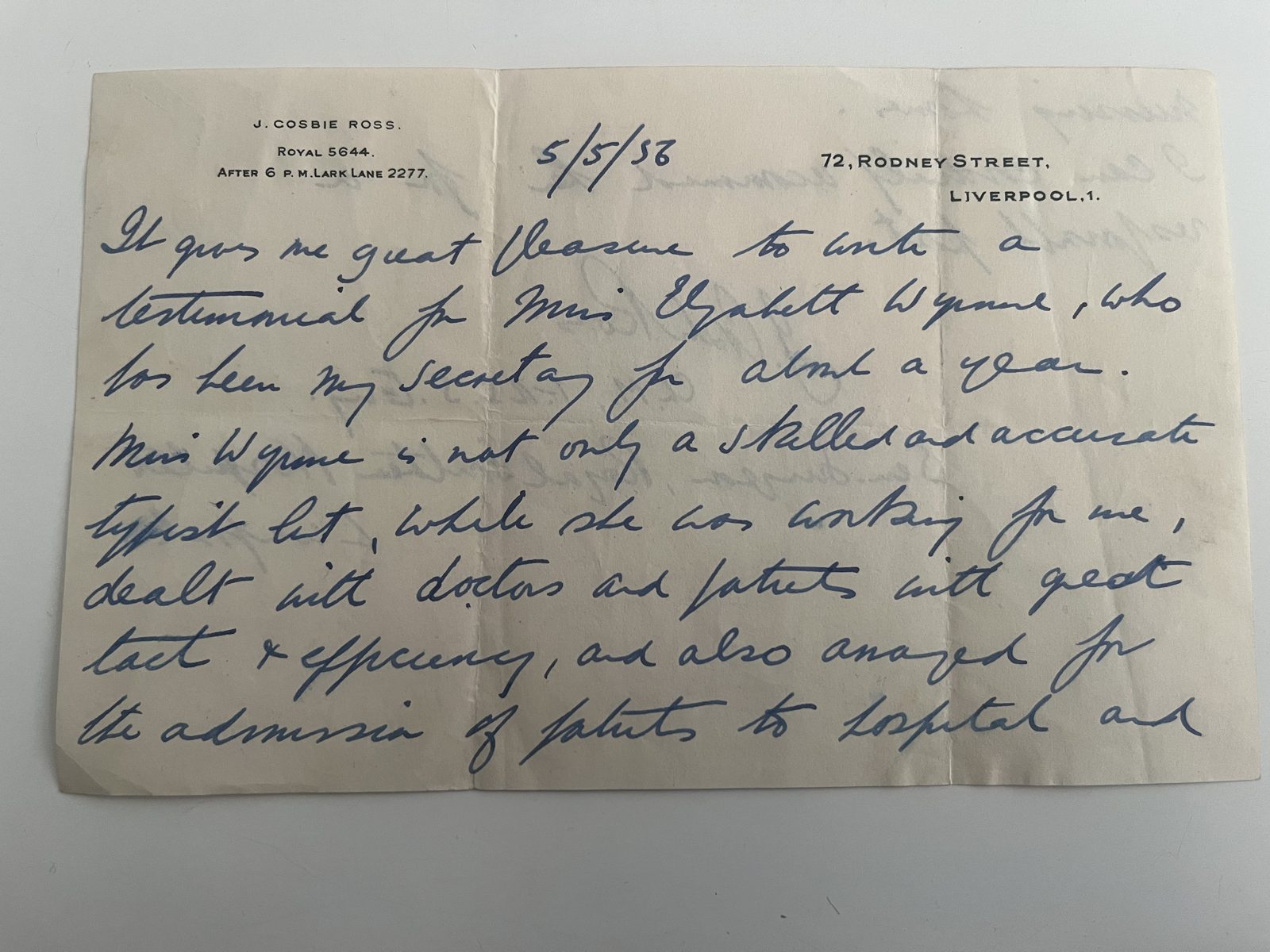
J. Cosbie Ross’s testimonial for her, 5 May 1956.
How she got in
The woman next door had a friend who was a doctor, and her advice was straightforward.
“She said, yes, you tell him that you know him.”
Three people interviewed her.
“They said, do you know anyone who is in radiography? And I said yes, doctor something or other — and he said, ‘I’m doctor something. I know you. I know you now.’“
He was one of the three, and she had never laid eyes on him. Nor he on her. She got the place, and reports that it did not count against her.
⚠ His name is gone. She cannot recover it and neither can the archive; the neighbour who could have is long dead. Whether she knew he would be in the room is not established either — having never seen him, she could not have known which of the three he was until he introduced himself. The Liverpool radiography school’s staff list for about 1954 would carry three names, and one of them is his.
And she did not choose it
“Pushed by my father. Because he wanted me to go to university and I wasn’t interested… He kept on pushing me. I hadn’t got any idea what I wanted to do, but he wanted me to do something that gets a qualification.”
Set against the alternatives as she describes them — “you were either a secretary, a nurse, or a teacher, and I wasn’t particularly keen on any of those” — a father pressing his daughter towards a qualification, and towards a university place she did not want, was not the ordinary run of things in about 1954.
And it does not fit the man. Charles Wynne is remembered in this family as Conservative. That is what makes this worth recording: not a progressive acting progressively, but a conservative man who nonetheless wanted his daughter educated, and pushed until she went and did something. A position held against type is better evidence of what somebody actually thought than one held with it. ❓ Whether it was principle, ambition, or simply not wanting her in the town hall, the archive cannot say — and she does not offer a reason.
⚠ Her own account of her schooling is harsher than the outcome: the reports were “all awful, really”, but she was at a grammar school and got six O-levels — “not including maths, or a language, that was very good really.”
⚠ She cannot reconcile the order of these jobs herself, and says so on the tape: “I’ve got gaps. I can’t resolve this thing about going to Canada, and leaving radiography, and when I was working for the surgeon.” The order above is the most likely reading, not an established one. She does firm up one link: the Canada plan came from the other girl at Rodney Street, who had family in Montreal — which puts Canada after the surgeon, not after radiography.