Appendix A: things that do not sit in a year
Threads that run the whole length of her life, and one that belongs to a different family. Kept out of the chronology deliberately — forcing them into a decade would misrepresent them.
Theatre
- The National Theatre was the focal point, with the Donmar Warehouse alongside, and she took the children through the 1980s. “You took us to see lots of things at the National Theatre.”
- Angels in America — “I thought it was wonderful.”
- Hair — she had the record, and Will remembers her talking about it.
- ★ The Alan Bennett evening, which is the best story in the session. They were in the gallery; a group behind them was noisy; Tony kept turning round and eventually said “would you mind just laughing a little bit less?” — and they rolled their eyes and moved. Days later she was ironing, heard the same voice on the radio, worked out who he was, and wrote to him. Will has the letter and quotes a line back at her that she does not accept as hers. It is the only piece of her own writing the archive knows of, apart from the diary below.
FOUND, 12 September 2026 — the letter, the name, and the replies. The noisy man was Michael Neve (1947–2019), historian of medicine at the Wellcome Institute and a London Review of Books editor, appearing on BBC2’s discussion programme Thinking Aloud; she recognised him not on the radio but on television, “having selected the sexual morality debate instead of David Copperfield — again — to enliven the weekly ironing”. Her letter is dated 21 October 1986 from Fenton, Sandy Lane, Camberley, addressed to him c/o Thinking Aloud, BBC Television, Wood Lane, and it is typed, two pages, wry from the first line. It sets out the dilemma as Man (a) and Man (b) and gives Man (b) three options; “my own choice would certainly have been (2), but my husband, who holds a more positive and radical position on most issues than me, plumped for (3)” — so it was Tony who asked him to laugh more quietly, exactly as she tells it. The line Will quotes back at her — “a desire to garrotte the wanker in the seat behind” — is hers; it is on page one. The BBC’s Bristol researcher Mary Hockaday replied on 27 October 1986 that the letter had been passed to Neve, “a good story, and one we hope he appreciates!”; and Neve passed it to Bennett, whose postcard (below) is the reply she kept. Images:
,_p2.jpg,; documentsand. ⚠ She said “radio” on 6 September; the letter says television. The letter wins — it was written the day after. The whole exchange — her letter in full, the BBC’s reply, both Bennett postcards, the play, and who Neve was — is told in its own account,(PDF alongside), which is the standalone treatment and carries its own questions for her.


Literature
Her shelves were photographed on 6 September 2026 and read off on 9 September — some three hundred titles, room by room, in. McEwan eight times, three copies of Middlemarch, Bennett’s Writing Home beside Young Betjeman on the stairs, and Julian Barnes’s Nothing to be Frightened of outside the spare bedroom.
- A bookish home only “in as much as the war” — “we had a bookshelf during the war, which had about six books in it. I can’t remember what they were.” But every birthday and Christmas she was given an Enid Blyton, “which I looked forward to… that was really important, I loved it”, at five, six or seven; and “I read a lot, I went to the library” — which is exactly what she says of her own mother. (6 Sep 2026, part of the recording, 0:00.)
- Martin Amis: she cannot read the early novels now, but rates the two memoirs, Experience above all, and admires the economy: he can do in a single sentence what others need a whole paragraph for — she likens him to Shakespeare in that, “in as much as he can, in a single sentence, do a whole paragraph.” Ian McEwan too.
- A reading group — “it was mostly CAB people.” The first firm link between the volunteering and the reading.
- Poetry, and the two letters. “I did have a period when I was very into poetry of all kinds — and it
perhaps indicates that I don’t have very great depth of understanding of poetry, because my favourites are
not very easy, really.” Betjeman, Larkin, and “best of all, John Donne” — “very formative in my
thirties and forties, because I was doing an English A-level and I was very passionate about John Donne’s
poetry” — and Andrew Marvell. Shakespeare “has actually described every emotion anybody’s ever
had, and if you find it, it’s very helpful” — but not until her late twenties, when they began going to
the theatre. The Betjeman letter is dated 22 March 1983 — typed on his 29 Radnor Walk, SW3
notepaper, “22.3.83”, signed “Yours, John B” in a shaking hand. She wrote to him because “I knew he had
Parkinson’s and I knew he was dying, so I sent him a letter to say how much pleasure he’d given me over
the years. That’s all.” He answered: “What a nice letter, it stirred me to the depths of exhultation
[sic] since I knew it was true that we had known each other for long.” He died fourteen months later.
⚠ The 9 September draft gave “22 April 1983” from the tape; the letter itself reads 22.3.83 — March —
and the document wins. The typist’s “exhultation” is on the page; her “exaltation” on the tape is the
same word remembered. Alan Bennett’s postcard after the Kafka’s Dick evening (undated; from
23 Gloucester Crescent, NW1, to Fenton, Camberley, so late 1986) confirms the story and shows he knew
the noisy man — “Michael Neve, whom I know, sent me a copy of your letter to him” — and tells her Neve
“tells the story against himself”; a second Bennett postcard, of 30 September 2004 (a Yorkshire Dales
card, to 75 The Street, Old Basing), answers her on The History Boys. All three were photographed on
12 September 2026 and are in the archive:
,,; documents,,. Her own letter that started it is under Theatre, above. (9 Sep 2026; documents 12 Sep 2026) - ★ A book that changed something. She names two. One is unrecovered on the tape. The other she read in Canada, and identifies by its film: “it became a film with Elizabeth [Taylor]” and she reaches for “A Place in the Sun”. ⚠ If that is right the novel is An American Tragedy by Theodore Dreiser, which A Place in the Sun (1951) was made from. That is an inference from a garbled passage and must be put to her.**
- ★★ SHE KEPT A DIARY, AND WILL HAS IT. “The one thing you’ve got is my O-level year.” Exams, marks — and boyfriends at fifteen. She offers, drily, “you can keep that to yourself if you like.” This is the only contemporary document in her own hand from her youth that the archive knows to exist.


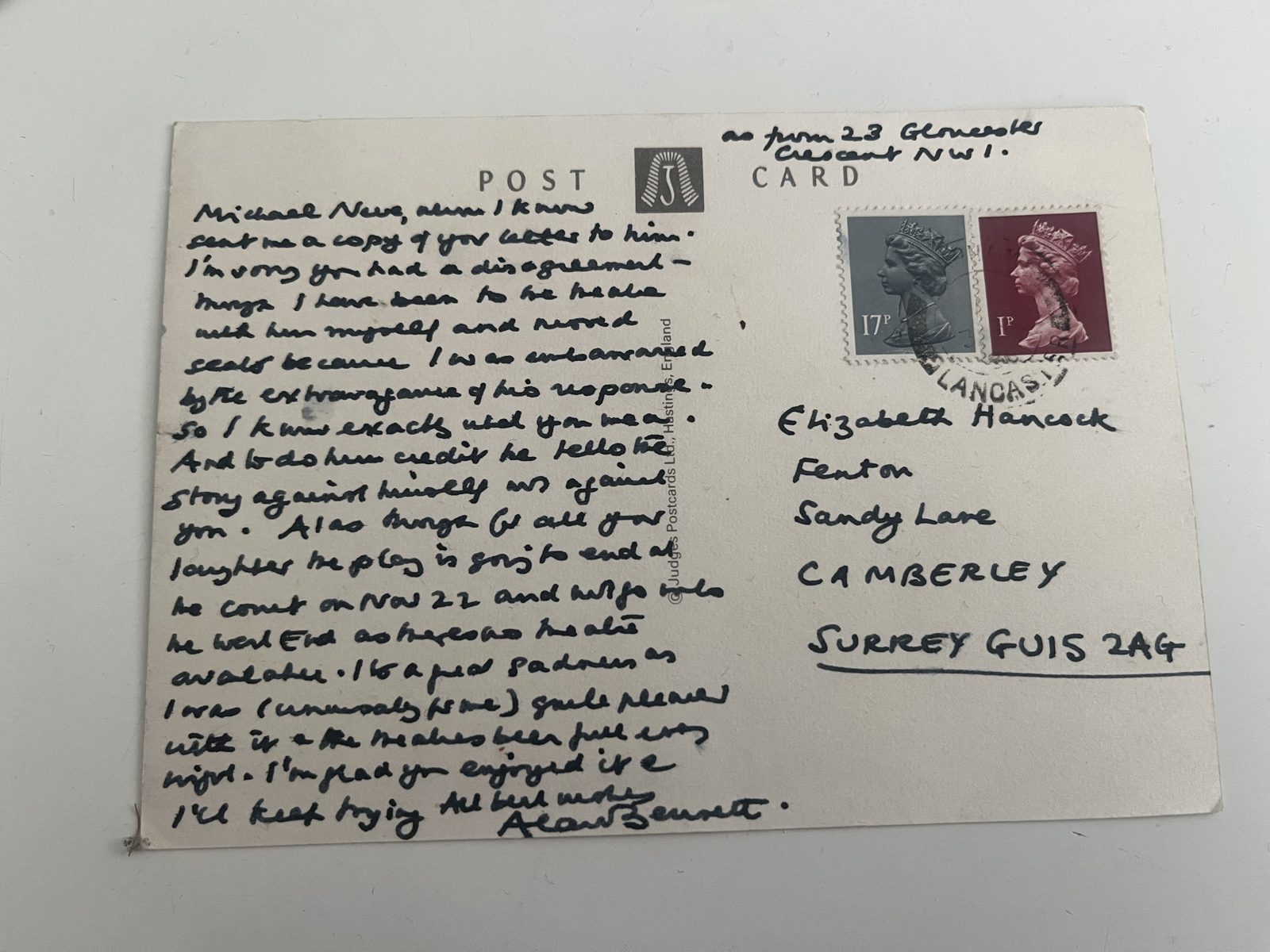
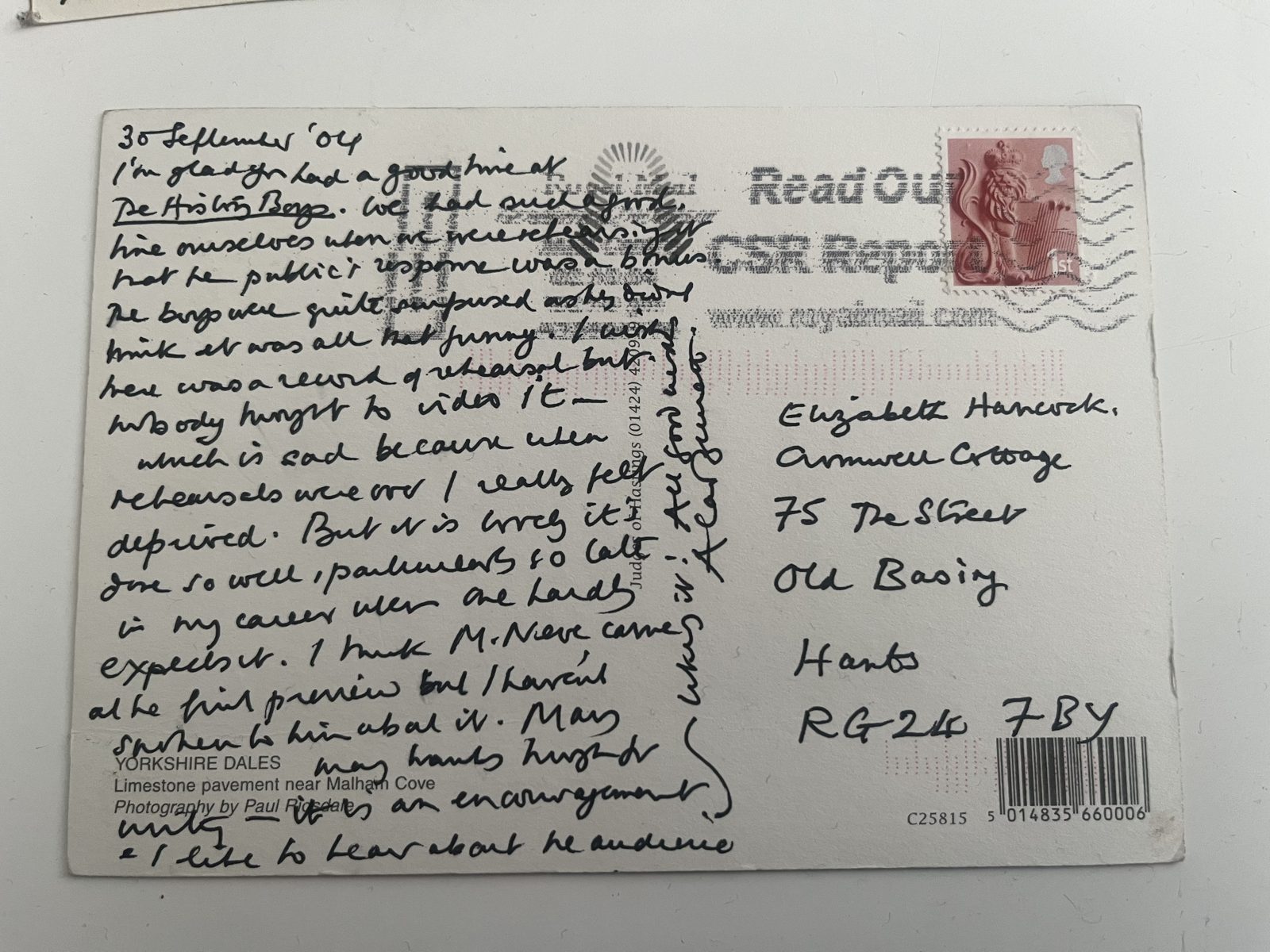
Alan Bennett’s two postcards to her, about 1986 and 30 September 2004.
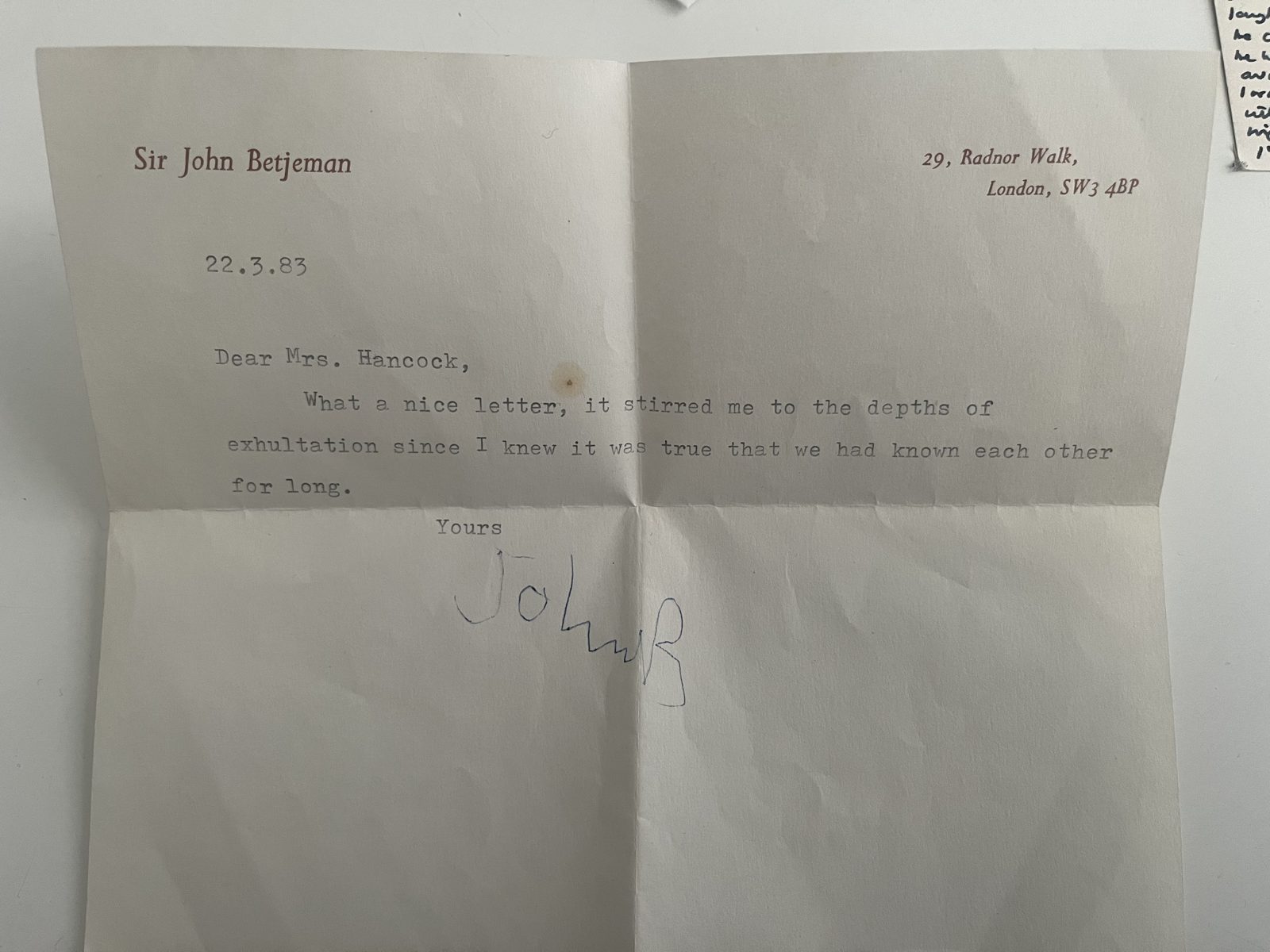
John Betjeman’s letter to her, 22 March 1983.
Art
Asked for on 8 September; she answered on the 9th by walking Will round the walls. Nothing here is dated; this is the thread, not the chronology.
- Art school on Saturdays, for a couple of years, while still at school — “they did teach more than school did about artists”; she had been “quite good at drawing”, and was keen on Seurat ⚠ (the transcription has “Sart”). She has kept a pencil drawing she made of Tony while he was studying for his commercial pilot’s licence — “a tender, loving picture” (Will).
- What she buys. “I have noticed that I tend to like head and shoulders of women in pictures.” Three paintings by one Brighton artist, now dead, whose name she can get — including the only oil, which she gave Will and he does not like; the girl at the foot of the stairs, from an art exhibition at St Paul’s School; the blue painting at the top of the stairs, of a philosopher, by a woman painter near Farnham whom Jane knows — “I absolutely love it, and I’ve never known anybody else who likes it.”
- Donna Grey. Not the architect of 5 Dyke Road Avenue but its designer: she and her architect husband built it together, divorced, and he built “another one, much inferior, further down the road.” Elizabeth bought her big oil painting — “she said it was about her divorce” — which is now in Rebecca’s flat in London, and kept in touch. Grey lived near Lewes, then Portslade; describes herself as “an abstract painter drawing inspiration from architecture, textiles and interior design” — “a woman after your own heart” — and has hung in the Royal Academy summer exhibition.
- The Miró — a limited-edition print, bought cheaply from “a very eccentric shop opposite New Brighton station” kept by a professor of art history who was selling up to move to Spain with a much younger boyfriend; the little Roman oil vessel by the stairs came from him too, for about five pounds.
- Sculpture. The terracotta woman in the bathroom, from Brighton flea market; a small white figure on the shelf outside it ⚠ (maker misheard — “Michael Andrew”); a black one in the sitting room by Caroline Peace ⚠ (machine text), from a gallery; and “the boys”, which came from Joy, the previous owner of Cromwell Cottage, whose husband was from a well-known Greywell family — his name-stamped trunk is upstairs. The ceramic model of Fenton, one of her favourite things, was made by eye by a potter, Michelle Arthur, who did not carry on.
- The head of Tony, and the picture of a young man over the loo by a friend of the woman who made it; the picture over the bar by an art teacher, Brighton College perhaps, who showed in the Brighton Festival artists’ houses and has lately died; two photographs upstairs — a celebration, and a couple at a table — by a photographer who lived above Caroline’s flat in Marine Parade; the silhouettes of “a Southern family, and I have no idea”, which followed her mother around; a famous print, faded to nothing, kept for its frame. Archbishop Warham hung over the dining-room fireplace at Old Basing and is gone. Tony made no art — “he would have got short shrift if he’d tried” — and liked collages of photographs.
- Will’s still life, aged twelve — a breakfast table with a marmalade pot, deliberately messy, which his teacher so admired she drew the cup at the front in “absolutely perfect lines” and “messed up the whole vibe”. She framed it. “I think it’s a work of genius.” (9 Sep 2026)
The Hancock side, which nobody has worked on
- ★ “Auntie Mary was your dad’s father’s sister.” A named sibling of Will’s paternal grandfather, and the archive holds almost nothing on that line. “Very, very tiny” — as was Granny Hancock, who liked Guinness.
- A run of Hancock weddings and the cousins at them: Barbara and David, Philip, Gillian, Sheila, Marie, Andrew, Stewart, Mary. “They were quite a formula, weren’t they.”
- ❓ Sheila is “absolutely gripped by all her mother’s family history” — a possible correspondent, and possibly a holder of papers.