Flight EG 465, Cologne to Berlin, 16 March 1959
⬇ flight_eg465_berlin_1959.pdf
The manifest Elizabeth kept, and the people on it
Centred on Elizabeth Hancock, née Wynne, born 1936
One sheet of typescript from an Eagle Airways Viking, thirty-three names, a Soviet ultimatum, and a letter from the House of Lords thirty-six years later.
Elizabeth Wynne was twenty-two and a stewardess with Eagle Airways. On Monday 16 March 1959 she worked a charter from Cologne to West Berlin carrying, in one twin-engined aeroplane, a cross-section of the British political class: the leader of the Liberal Party and his mother-in-law, Asquith’s daughter; a former Secretary of State for War; the Labour Party’s coming man on defence; a Conservative who had just resigned from the Treasury and another who had just been sacked by his constituency; a life peeress from the first ever batch; an Air Chief Marshal; the BBC’s wartime voice to Germany; and the press. They were flying into a city that had ten weeks left on a Soviet ultimatum. She kept the manifest. In 1995 she sent it to Denis Healey, and he wrote back.
This account sets out what the two documents say, who the people were, why they were going, and what is known against what is inferred. Elizabeth’s own memory of the flight has not yet been recorded, and the questions it should answer are listed at the end.
The sheet itself
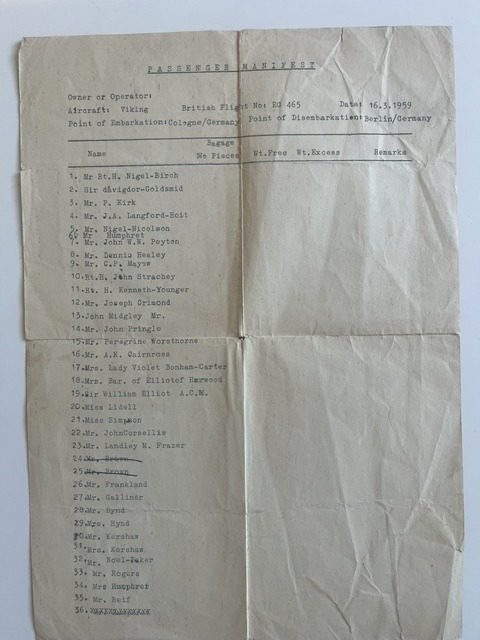
The passenger manifest, photographed 10 September 2026. Foolscap, folded in four, the folds
soft with handling. Record .
It is headed PASSENGER MANIFEST and typed on a machine with a tired ribbon by someone who did not know the passengers. The header reads:
| Owner or Operator | blank |
| Aircraft | Viking |
| British Flight No | EG 465 |
| Date | 16.3.1959 |
| Point of Embarkation | Cologne/Germany |
| Point of Disembarkation | Berlin/Germany |
Below are columns for baggage — pieces, free weight, excess — and remarks, all empty, and thirty-six numbered lines. Lines 24 and 25 both read Mr. Brown and both are struck through in ink; line 36 has been typed and then overtyped with a row of x’s until it is illegible. So the sheet was corrected against the people who actually walked out to the aircraft: thirty-three passengers flew.
The clerk’s spellings are kept throughout this account where they are quoted, because they are part of the document: Dennis Healey; Mrs. Lady Violet Bonham-Carter; Mrs. Bar. of Elliotof Harwood; Landley M. Frazer; hyphens dropped into Nigel-Birch, Nigel-Nicolson and Kenneth-Younger as if they were double-barrelled. Whoever typed it had a list of names read out to them, and no idea who any of these people were.
The aeroplane, the airline, and the stewardess
The Vickers Viking was a twin-engined piston airliner of 1945, a civil descendant of the Wellington bomber, carrying about thirty-six passengers. By 1959 British European Airways had long since retired its Vikings in favour of Viscounts, and the type had become the workhorse of the British independent airlines, bought second-hand and worked hard on trooping contracts and charters. Eagle Airways, Harold Bamberg’s company flying out of Blackbushe, was the largest independent operator of the type — it bought thirty-seven of BEA’s Vikings, and in April 1958 its fleet was seventeen Vikings and two Viscounts. Elizabeth’s own account of her flying years names the airline, the airfield and the trooping work — see her biography, section VI — and EG was Eagle’s two-letter code, registered when it joined IATA in 1957; BEA’s was BE. A thirty-six-line manifest is a thirty-six-seat Viking’s cabin, full.
Crew are not passengers and do not appear on a passenger manifest. That Elizabeth was the stewardess rests on three things that agree: she was an Eagle stewardess at exactly this date; she has had the sheet since the day it was typed; and when she sent it to Denis Healey in 1995 he thanked her for it as the person who would naturally have it. Will adds a fourth, relayed on 10 September 2026: “Mum rode in the lift with Bonham Carter.” That puts her in the party’s hotel in Berlin, not just in the aeroplane.
Why a British charter aircraft? Because nothing else could go. Under the four-power arrangements only aircraft of the three Western occupying powers — Britain, the United States and France — could fly the three twenty-mile-wide air corridors across the Soviet zone into West Berlin. A West German airline could not carry this party to Berlin. An Eagle Viking could, and did, landing at Tempelhof or at RAF Gatow in the British sector; the manifest does not say which.
The week they flew
To read the date on the sheet properly, put it against the calendar of that winter.
| 10 November 1958 | Khrushchev, in a speech in Moscow, declares the four-power occupation of Berlin at an end |
| 27 November 1958 | Soviet notes to Britain, France and the United States: West Berlin to become a demilitarised “free city”; the West has six months to agree, after which the USSR will sign a separate peace with East Germany and hand it control of the access routes. The deadline is 27 May 1959 |
| 31 December 1958 | The Western powers reject the notes but offer to talk |
| 6 February – 6 March 1959 | Willy Brandt, Governing Mayor of West Berlin, on a world tour — Eisenhower, Hammarskjöld, Nehru, the Emperor of Japan — received everywhere as the man holding the line; back in Berlin on 6 March |
| 21 February – 3 March 1959 | Macmillan in the Soviet Union — the white fur hat, the snub at Kiev, the toothache — the first Western leader to go to Moscow since the war |
| 9–10 March 1959 | Macmillan in Paris with de Gaulle |
| 12–13 March 1959 | Macmillan in Bonn with Adenauer, who distrusts the whole enterprise |
| 14 March 1959 | The American contingency planners meet to define what would count as a “forcible blocking” of the access routes |
| Monday 16 March 1959 | Flight EG 465, Cologne to Berlin. That evening Eisenhower broadcasts to the American people: “We will not retreat one inch from our duty. We shall continue to exercise our right of peaceful passage to and from West Berlin.” In the Commons the same afternoon a minister confirms that the Soviet position is formally unchanged |
| 17 March 1959 | General Norstad proposes the tripartite planning staff that becomes LIVE OAK, the Western military plan for reopening the corridors by force |
| 18 March 1959 | The SPD publishes its Deutschlandplan — a confederation and disengagement scheme Brandt disliked; the British visitors caught him in the middle of the row |
| 19–23 March 1959 | Macmillan in Washington and at Camp David with Eisenhower |
| 30 March 1959 | The Soviet Union accepts a foreign ministers’ conference at Geneva |
| c. 20–23 April 1959 | Brandt returns the visit: in London, where he “spoke to some of us the other day” (Hansard, 27 April) |
| 11 May 1959 | The Geneva conference opens; the deadline passes without a treaty; the crisis subsides into the summit diplomacy of 1959–60 |
Everybody in Britain that spring was talking about the “second blockade”. The first, in 1948–49, had been beaten by the airlift; the question of the winter of 1958–59 was whether the West would have to do it again, or fight, or give way. Healey’s phrase in 1995 — “to learn how they were standing up to the second blockade” — is exactly the language of the moment. And the timing of the flight is not accidental: the party went to Berlin three days after Macmillan left Bonn, in the week between his sounding of Adenauer and his sounding of Eisenhower, when the British position was being formed and the people on this aeroplane were the ones who would have to defend or attack it in Parliament and in print. The Viking flew the corridor on the day the President of the United States went on television to say the corridors would be kept open.
Why Cologne — the Königswinter connection
Cologne’s airport at Wahn was the airport for Bonn, the West German capital — BEA’s first international scheduled service from it, in 1951, had been London–Cologne/Bonn–Berlin. Directly across the Rhine from Bonn is Königswinter, where since 1950 the Deutsch-Englische Gesellschaft, under its formidable founder Lilo Milchsack, had brought a British party to meet a German one every spring for three days of talk at the Adam-Stegerwald-Haus. The Königswinter Conference was, and is, deliberately cross-party and cross-trade: MPs of all three parties, peers, editors and leader-writers, academics, a retired service chief or two, with the BBC’s German Service in attendance and a small volunteer secretariat. Milchsack had built the thing in its first years on Richard Crossman, Roy Jenkins and Denis Healey, and, with the Foreign Office’s help, had then worked to get more Conservatives aboard for balance. The British Embassy in Bonn gave the evening parties.
The tenth conference met in March 1959, on the theme Voraussetzungen einer friedlichen Koexistenz — the preconditions of peaceful coexistence — and the Federal President, Theodor Heuss, received the participants. The Society’s own official history records what happened next, and had happened every year since 1957:
“A new tradition was introduced in 1957 and continued throughout the Cold War: following the conference, the British delegation travelled to Berlin for a few days at the invitation of the mayor to gain a first-hand impression of the divided city.”
The mayor in March 1959 was Willy Brandt. So the sheet is the British Königswinter delegation of 1959, on the Monday after the conference, flying to Berlin as Brandt’s guests — which is exactly what Healey remembered.
Hansard agrees, by silence. Healey spoke in the Commons on 9 March and not again until the 26th; Younger on the 9th and not until 15 April; Mayhew on the 11th and not until 20 April; Strachey on the 11th and not until 8 April; Grimond on the 10th and not until the 24th. Nobody on the sheet was in the House in the week of the 16th. The manifest also passes a small test of its own accuracy: it gives Rt. H. to Birch, Strachey and Younger, who were Privy Counsellors in 1959, and plain Mr to Healey, Mayhew and Grimond, who were not yet.
⚠ Graded corroborated on the Society’s history, the date and airport, the composition of the party and the Hansard absences. What is still wanting is the printed list of the British participants for 1959, which exists: Bundesarchiv Koblenz, Deutsch-Britische Gesellschaft papers, B 296/75, “Englische Teilnehmer 1958–59”, with B 296/73 for the organisation and the Berlin programme. The Foreign Office’s own file on the 1959 conference will be in TNA FO 371, Western Department. The exact conference days are not yet fixed; a Friday-to-Sunday meeting, 13–15 March, with the Berlin flight on the Monday, is the pattern.
The people on the sheet
Thirty-three people flew. Twenty-three can be named with confidence from the list alone; the rest are placed where they can be and left open where they cannot. They are grouped here by what they were, not by their line on the sheet.
The Conservatives
1. Rt Hon Nigel Birch (1906–1981), MP for West Flintshire. Fourteen months before this flight he had resigned as Economic Secretary to the Treasury alongside the Chancellor, Peter Thorneycroft, and Enoch Powell, in protest at government spending — the resignations Macmillan dismissed as “little local difficulties” before leaving for the Commonwealth. A dry, formidable, unforgiving man; in 1963 he would deliver the Profumo-debate verdict on Macmillan, quoting Browning: “never glad confident morning again.” Later Lord Rhyl.
2. Sir Henry d’Avigdor-Goldsmid (1909–1976), 2nd Baronet, MP for Walsall South. Banker, DSO and MC in the war, a leader of Anglo-Jewry, a racehorse owner; a Conservative of the old cosmopolitan kind.
3. Peter Kirk (1928–1977), MP for Gravesend, the youngest MP on the sheet at thirty. Son of a Bishop of Oxford; a convinced European who in 1973 would lead the first Conservative delegation into the European Parliament at Strasbourg.
4. John Langford-Holt (1916–1993), MP for Shrewsbury from 1945 until 1983. Fleet Air Arm in the war. Later Sir John.
5. Nigel Nicolson (1917–2004), MP for Bournemouth East — and on this Monday, a man with weeks left in Parliament. Son of Harold Nicolson and Vita Sackville-West; co-founder of the publishers Weidenfeld & Nicolson, who had brought out Lolita in Britain that very year. He had refused to vote for Eden over Suez and opposed hanging, and his constituency association had turned on him; a postal ballot of members at the end of February 1959 had gone against him by a handful of votes. He would not stand in October. A Königswinter regular, and one of the people on this aeroplane most likely to have written it up.
7. John Peyton (1919–2006), MP for Yeovil. Five years a prisoner of war after 1940. Heath’s Minister for Transport Industries, a candidate for the party leadership in 1975, later Lord Peyton of Yeovil.
30–31. Mr and Mrs Kershaw — Anthony Kershaw (1915–2008), MP for Stroud since 1955, and his wife Barbara. He would chair the Commons Foreign Affairs Committee for most of the Thatcher years.
18. Baroness Elliot of Harwood — typed “Mrs. Bar. of Elliotof Harwood”. Katharine Elliot (1903–1994), widow of the Conservative minister Walter Elliot, who had died the previous January. In September 1958 she had been one of the first four women ever made life peers under the Act of that year, and the first woman to speak in the House of Lords; chairman, too, of the National Union of Conservative Associations. Not related to passenger 19, despite the clerk’s placing them together.
Labour
8. Mr Dennis Healey — Denis Healey (1917–2015), MP for Leeds East. Before Parliament he had been the Labour Party’s International Secretary, the man who kept the party’s lines open to the socialist parties of Europe — including the German SPD, and including Willy Brandt, whom he had known since the late 1940s. By 1959 he was the Opposition’s principal thinker on defence and foreign affairs, and had just published A Neutral Belt in Europe?, arguing for a disengagement of forces in central Europe: the Berlin question was his subject. Defence Secretary 1964–70, Chancellor of the Exchequer 1974–79, Companion of Honour; created Lord Healey of Riddlesden in 1992, from where he wrote to Elizabeth. A Königswinter founder-member.
9. Mr C. P. Mayhew — Christopher Mayhew (1915–1997), MP for Woolwich East. Foreign Office minister under Bevin, 1946–50; a television pioneer who had taken mescaline on camera for Panorama in 1955. Would leave Labour for the Liberals in 1974.
10. Rt Hon John Strachey (1901–1963), MP for Dundee West. In the 1930s the author of The Coming Struggle for Power, the most-read Marxist book in the English language; in the Attlee government Minister of Food through the years of rationing, then Secretary of State for War during Korea. The End of Empire, his last big book, came out that year. The heaviest intellectual weight on the sheet.
11. Rt Hon Kenneth Younger (1908–1976), MP for Grimsby. Minister of State at the Foreign Office 1950–51, running the office while Bevin was dying. He was leaving Parliament at the coming election — his Grimsby seat went to Anthony Crosland — to become Director of Chatham House, the Royal Institute of International Affairs, which he would run until 1971. A Königswinter man of long standing.
28–29. Mr and Mrs Hynd — John Hynd (1902–1971), MP for Sheffield Attercliffe, and his wife. From 1945 to 1947 Hynd had been Chancellor of the Duchy of Lancaster with responsibility for the British zones of Germany and Austria: the minister for occupied Germany, whose office was known in Whitehall as “Hynd’s Ministry”. Chairman of the Anglo-German Parliamentary Group, and given the Federal Republic’s Grand Cross of Merit the year before. No Briton on the aeroplane had a longer acquaintance with the German question.
32. Mr Noel-Baker. Either Philip Noel-Baker (1889–1982), MP for Derby South, the Olympic silver medallist and lifelong disarmament campaigner who would be awarded the Nobel Peace Prize seven months later, in October 1959; or his son Francis (1920–2009), MP for Swindon. The manifest gives no initial. Philip’s cause — disarmament — was the other half of the Berlin debate, and his presence would fit; against that, the clerk gave him plain Mr, where Philip had been a Privy Counsellor since 1945. The record cannot say.
The Liberals
12. Mr Joseph Grimond — Jo Grimond (1913–1993), MP for Orkney and Shetland and since 1956 leader of the Liberal Party, then six MPs strong and about to begin its revival under him.
17. Mrs. Lady Violet Bonham-Carter — Lady Violet Bonham Carter (1887–1969), the daughter of Asquith, the last Liberal Prime Minister but one; Grimond’s mother-in-law, since he had married her daughter Laura in 1938. Seventy-one years old, a Governor of the BBC, the most celebrated woman speaker in British public life, and a friend and champion of Churchill since before the First World War. She would enter the Lords in 1964 as Baroness Asquith of Yarnbury. Her diaries for these years were published in 2000 as Daring to Hope. She is the passenger Elizabeth rode with in the hotel lift.
The services
19. Sir William Elliot A.C.M. — Air Chief Marshal Sir William Elliot (1896–1971). Commander-in- Chief of Fighter Command 1947–49, Chief Staff Officer to the Minister of Defence 1949–51, then head of the British Joint Services Mission in Washington and Britain’s representative on the NATO Standing Group until his retirement in 1954. On a visit to a city that lived by an air bridge, the party had brought an airman.
Broadcasting, economics and the press
23. Mr. Landley M. Frazer — Lindley Fraser (1904–1963), head of programmes in the BBC German Service since 1948, OBE the year before. In the war he had been the BBC’s principal voice to Germany, broadcasting in German night after night; Germans of Brandt’s generation knew his voice better than any other Englishman’s. Before the war a professor of political economy at Aberdeen.
16. Mr A. K. Cairncross — Alec Cairncross (1911–1998), then Professor of Applied Economics at Glasgow; from 1961 Economic Adviser to the Government and later head of the Government Economic Service. Knighted 1967.
15. Mr Peregrine Worsthorne (1923–2020), leader-writer on the Daily Telegraph; later editor of the Sunday Telegraph. Half-Belgian, high Tory, a Königswinter fixture for decades.
14. Mr John Pringle — almost certainly John Douglas Pringle (1912–1999), deputy editor of The Observer 1958–63 between two spells editing the Sydney Morning Herald.
13. John Midgley Mr. — John Midgley (c.1911–2000), Foreign Editor of The Economist since 1956, later its Washington correspondent.
27. Mr Galliner — probably Peter Galliner (1920–2006), foreign editor of the Financial Times 1947–60. Born in Berlin, driven out by the Nazis in 1939, later Director of the International Press Institute. If it is he, one passenger was going home.
26. Mr Frankland — very probably Noble Frankland (1922–2019), Deputy Director of Studies at Chatham House 1958–60, co-author of the official history of the bomber offensive against Germany, Director of the Imperial War Museum from 1960. The Chatham House link to Younger fits. ❓ No initial to confirm.
Not yet placed
6 and 34. Mr and Mrs Humphret — as typed; possibly Humphrey. ❓ 20. Miss Lidell and 21. Miss Simpson — probably secretaries to the delegation. ❓ 22. Mr. JohnCorsellis — John Corsellis (1923–2018), Quaker, who had gone to Europe in 1945 with the Friends’ Ambulance Unit and spent years among the Slovene refugees in Austria; later in Anglo-German exchange work, and remembered as one of the British organisers of Königswinter. ❓ The organiser’s role is recollection, not yet a printed source. 33. Mr Rogers — not identified. ❓ 35. Mr Reif — not identified; the one German name on the sheet. One candidate worth testing is Dr Hans Reif (1899–1984), the West Berlin Free Democrat and former Bundestag member — a natural Berlin host travelling with his guests. ❓ 24–25. Mr Brown, twice, struck through: did not fly. (George Brown MP was a Königswinter regular in later years; whether this was he is a guess and nothing more.)
Berlin, and Brandt
Willy Brandt (1913–1992) had been Regierender Bürgermeister — Governing Mayor — of West Berlin since October 1957. He was forty-five, a Social Democrat who had spent the Nazi years in exile in Norway, and in the winter of 1958–59 he became, overnight, the most famous German in the world after Adenauer: the man who stood in front of the Schöneberg town hall and told two and a half million people that the city would not be given away. From 6 February to 6 March 1959 he had been round the world — Eisenhower, Hammarskjöld, Nehru, the Emperor of Japan — and had come home to Berlin ten days before this flight to a hero’s reception. Two days after it, his own party in Bonn published a Deutschlandplan for confederation with the East that he thought dangerous; the British visitors found him at the start of that quarrel. He would be Chancellor of West Germany from 1969, the architect of Ostpolitik, and Nobel Peace laureate in 1971.
For Healey he was also an old comrade from the Socialist International. That is what the letter’s “great pleasure” means: not the pleasure of an audience, but of a visit to a friend in trouble. Brandt returned it within weeks: he was in London about 20–23 April, and on the 27th the Foreign Secretary told the Commons “we were delighted to welcome him here last week”, while a Conservative backbencher spoke of “when he spoke to some of us the other day”.
What the party did in Berlin — whom else they saw, whether they went to the sector boundary, whether they were flown over the city, where they stayed — the two documents do not say. The hotel is the one thing Elizabeth’s memory can supply, because she was in its lift with Lady Violet.
The letter, 1995
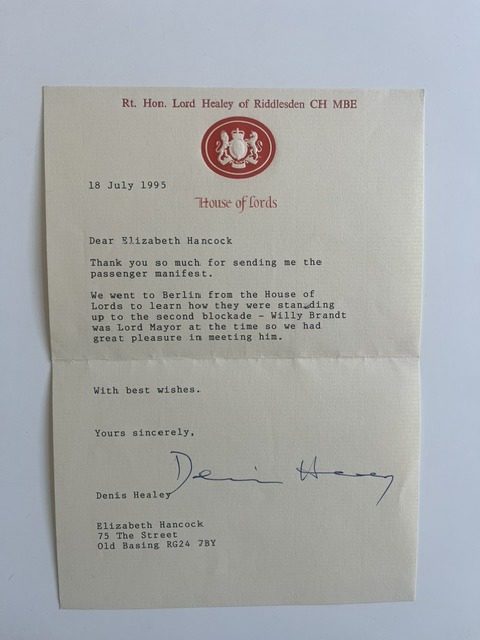
Lord Healey to Elizabeth Hancock, 18 July 1995. Record .
Rt. Hon. Lord Healey of Riddlesden CH MBE — House of Lords
18 July 1995
Dear Elizabeth Hancock
Thank you so much for sending me the passenger manifest.
We went to Berlin from the House of Lords to learn how they were standing up to the second blockade — Willy Brandt was Lord Mayor at the time so we had great pleasure in meeting him.
With best wishes.
Yours sincerely,
Denis Healey
Elizabeth Hancock, 75 The Street, Old Basing RG24 7BY
Three sentences, and each does work. The first confirms that the sheet was hers to send. The second states the purpose of the journey in the words of the time. The third names the meeting that made the journey worth making.
⚠ Two phrases need reading with care. “From the House of Lords” is where Healey was writing from in 1995, not where the party came from in 1959, when he and nearly everyone on the sheet sat in the Commons; the two women who would be peeresses were one who already was (Elliot) and one who was not yet (Bonham Carter). “Lord Mayor” is Healey’s English for Regierender Bürgermeister. He was seventy-seven and remembering a journey thirty-six years old; the letter is good for the purpose and the meeting, and should not be pressed for more.
Why she wrote to him is not recorded. Ella, her mother, had died that year; she may have been going through papers. Healey was much on television and in print in the mid-1990s. The manifest, with his name mis-spelt on it, is the kind of thing one sends after seeing a man recall the very journey one served coffee on. It is a question for her.
The crew
Nobody has yet named them, and Elizabeth does not remember. Asked on 9 September 2026, with the passengers read to her, she said: “The only thing is that I remember going up in the lift with Violet one time. I don’t remember anything else.” What follows is what the record can say around the gap, from a search made on 10 September 2026.
Four of them. An Eagle Viking of this date carried a captain, a first officer, a radio officer and one stewardess. That is the complement on Eagle’s Viking G-AJBO when it crashed at Blackbushe on 1 May 1957 (Captain E. Jones, First Officer Tunnington, Radio Officer Robertson, Stewardess Lena Lahey), and by 1961 the radio officer had gone. So on 16 March 1959 Elizabeth was one of four, and the only woman.
The aeroplane was one of thirteen. Eagle’s Viking fleet in the first half of 1959, every one named after an admiral: Lord Rodney (G-AHPM), Sir Richard Kempenfelt (G-AIHA), Lord Howe (G-AIVH), Lord Barham (G-AJCD), Lord Dundonald (G-AJPH), Sir Henry Morgan (G-AKBH), Sir Robert Calder (G-AMGG), Sir Henry Harwood (G-AMGI), Sir Philip Broke (G-AMNX), Lord Hood (G-APAT, sold six weeks later), Sir Charles Beresford (G-AGRS), Lord Hawke (G-AIVL) and Edward Vernon (G-AIVO). Eagle had no base in Germany; the aircraft and crew would have positioned out from Blackbushe for the charter. Which of the thirteen it was is not recorded anywhere found.
The captains she might have flown with. The Eagle staff association’s roll of the dead names the airline’s Viking-era captains, among them the Poles she remembered — “a lot of Poles, lovely Poles” — Stanislaw Bedkowski, Alojzy “Lou” Ciupek, Jan Malinski, Franciszek “Frank” Nikiel and Alex Plater; and the English and Irish: Harold Watkins the chief pilot, Jack Langley (Eagle 1953–68, whose complete logbooks are in the Eagle archive, and with whom Tony later flew), Stan Gage DFC, Paddy Cormican, Dixie Dean, Peter Busby, Ken Dillon, Fred Newson, Vince Twomey and some thirty others. The radio officers of the period include Jack Batley, Albert Reeks and Gerhard Heilig, who wrote a memoir. No Icelandic captain appears on any list, and the one on her Christmas Island run is still unidentified.
Was Tony aboard? He and Elizabeth met as crew on Eagle’s Manchester run, later than this. The London Gazette settles where he was in the RAF: commissioned Acting Pilot Officer on 30 July 1952 (service from 16 January 1952, number 3135255), Flying Officer 27 June 1954, and by 15 December 1958 a Flight Lieutenant on the Reserve of Officers — out of regular service, and free to fly for an airline. That is consistent with his being an Eagle first officer in March 1959, and no more than consistent; nothing found puts him on this aeroplane, and nothing found puts him at Eagle at all before the tapes do.
Where the names are, if they survive. The Eagle Group Archive (Eric Tarrant, the staff association’s archivist) holds crew logbook copies, Eagle News, passenger manifests and a chronology, and answers enquiries; it is the one place a captain’s logbook entry for 16 March 1959 Cologne–Berlin could turn up, and Elizabeth’s own name might be on its books. The RAF Gatow operations record book for 1956–60 is at Kew (AIR 28/1362), though a civil charter more probably used Tempelhof, whose logs are American. Blackbushe’s movement logs survive only from the 1960s. Flight for 13 March to 3 April 1959 was read and has nothing. And the definitive answer, if it exists, is a logbook in the family: Tony’s, or one Elizabeth kept herself.
What is verified, and what is not
| Statement | Grade | Rests on |
|---|---|---|
| An Eagle Viking, flight EG 465, flew these passengers Cologne–Berlin on 16 March 1959 | Record | The manifest itself |
| Elizabeth was the stewardess | Corroborated | Her Eagle employment at the date; her keeping of the sheet; Healey’s letter thanking her for it |
| The purpose was to see Berlin under the Soviet ultimatum, and the party met Brandt | Corroborated | Healey’s signed letter, consistent with the public record |
| She was in the party’s hotel and rode in the lift with Lady Violet Bonham Carter | Testimony | Will, 10 Sep 2026, relaying his mother; not yet on tape |
| The party was the British Königswinter delegation flying on from Bonn at Brandt’s invitation | Corroborated | The Society’s official history (the Berlin visit followed every conference from 1957); the tenth conference in March 1959; the airport, date and composition; the MPs’ absence from Hansard that week. Participant list not yet seen |
| The identifications of the twenty-three named public figures | High | Names, initials, styles and the company they are in |
| Galliner, Frankland, Pringle, Corsellis | Probable | Name and profession fit; no initial to confirm |
| Humphret, Lidell, Simpson, Rogers, Reif | Open | Nothing beyond the surname |
| Which Noel-Baker | Open | No initial |
| Who the crew were | Open | Four aboard; thirteen possible aircraft; captains’ names known as a list; no record of this flight found |
Not yet done: Bundesarchiv B 296/75 and /73 (the British list and the Berlin programme); TNA FO 371, Western Department, 1959, for the Foreign Office’s Königswinter file; the Landesarchiv Berlin, Senatskanzlei, for the Governing Mayor’s visitors’ programme in March 1959; The Times 13–19 March 1959; Daring to Hope for mid-March 1959; Nicolson’s Long Life, Healey’s The Time of My Life and Worsthorne’s Tricks of Memory for the trip; Eagle’s own records for a Viking charter numbered 465.
For Elizabeth
- What do you remember of the flight — the passengers, the crew, the weather, the corridor?
- Where did the party stay in Berlin, and did the crew stay with them? The lift with Lady Violet: what was said?
- Did you see Brandt? The sector boundary? How long were you there, and what was the return leg?
- Did anyone on the sheet make an impression — Healey, Strachey, Bonham Carter, Grimond?
- What made you write to Denis Healey in 1995, and was there anything else in the exchange?
- Is there anything else from that trip — a photograph, a ticket, a hotel bill?
- Did Tony’s flying logbooks survive, and did you keep one of your own? They are the only direct record of who crewed this flight, and of whether Tony was on it.
Sources
- The manifest,
; original with Elizabeth; images. - The letter,
; original with Elizabeth; images. - Elizabeth’s biography, section VI, for Eagle Airways, Blackbushe and the Vikings.
- Will Hancock, 10 September 2026, for the lift.
- Königswinter: Helene von Bismarck, Two countries in search of their role: a history of the Anglo-German Königswinter Conferences (Deutsch-Britische Gesellschaft, 2019), p. 16 for the Berlin tradition from 1957; Elke Berger, Zur Geschichte der Königswinter Konferenz (debrige.de) for the 1959 conference and Heuss; Bundesarchiv Findbuch B 296 for the numbering, theme and files of the tenth conference.
- Hansard, historic-hansard, March–April 1959: the Berlin exchanges of 16, 25 and 26 March and 8 April; the Prime Minister’s statement of 25 March; United Kingdom and Germany, 14 April; Foreign Affairs, 27 April; and the members’ pages for 1959 for the absences.
- Foreign Relations of the United States 1958–60, vol. VIII, Berlin Crisis 1958–59, documents 213–230, for the week of 14–18 March: Paris, Bonn, the contingency planners, Eisenhower’s broadcast of 16 March, LIVE OAK.
- Brandt: willy-brandt-biografie.de, 1957–66, for the world tour and the Deutschlandplan.
- The aircraft and the airline: the standard accounts of British Eagle, the Vickers VC.1 Viking and Cologne/Bonn airport, for Eagle’s code, fleet and the Viking’s capacity.
- The passengers: standard biographical references for each; the Guardian’s obituary of John Midgley (3 January 2001); the British-Slovene Society’s notice of John Corsellis.
- The crew: the British Eagle staff association (britisheagle.net) for the fleet, the named aircrew and the 1957 and 1961 crew complements; Ian Allan, British Airports (1 June 1959), for the fleet on that date; the London Gazette, supplements of 24 October 1952 (p. 5666), 1 July 1954 (p. 3874) and 21 April 1959 (p. 2611), for W. G. Hancock’s RAF commission, promotion and reserve status; Flight, 13 March – 3 April 1959, read in full for the flight and found silent; TNA Discovery for AIR 28/1362.
- Research done 10 September 2026 with limited web access; dates given to the day were checked against the sources above, and anything not so checked is marked ❓ in the text.