VII. Marriage, 1960
How they met
They met on a Bristol Freighter out of Manchester, and the story the family tells is wrong.
Will puts the family version to her directly: “I seem to remember being told that you met in Newfoundland.” — “No. That’s where we were posted.” The posting was to Gander, Newfoundland, and they took it together before they were a couple — “I’d been flying with him from Manchester, so I knew him quite well. I don’t think we were going out together really.”
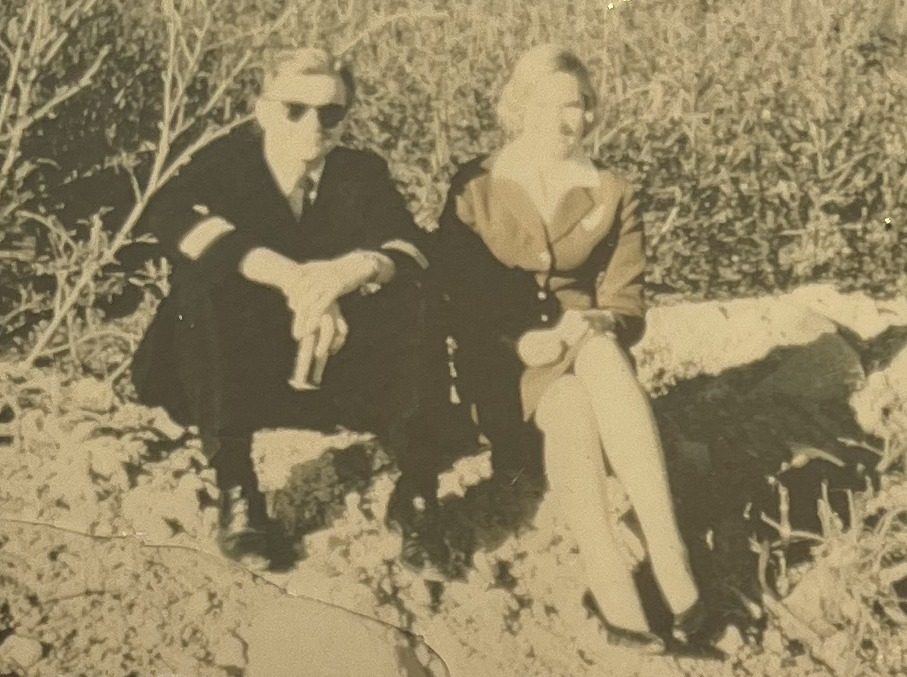
Tony in uniform, Liz in uniformIMG_0841_cut02.jpg
She had been posted from Blackbushe to Manchester — “which was happy for me, because my Auntie Con and Uncle John” were there, and she stayed with them, the same Auntie Con whose house was “The Shrubbery”. Tony was living in Stoke-on-Trent, driving down to Manchester, flying overnight, and driving back up.
There are two versions of the meeting and she prefers his.
- The sandwich. She came up to the flight deck to ask what he wanted for lunch and he could not decide fast enough. “I said something which was very putting-down.” She does not remember it; he remembered it for the rest of his life. Will, drily: “you’re quite good at those phrases.”
- The ladder. The Bristol Freighter’s flight deck was up a ladder, and the crew “had pleated skirts.” — “and they flew up when you…” “That’s the one I heard.” — “Oh, I didn’t hear that one.”
- His own telling, on film. In Michael’s The Venerable Vulnerable (2020) Tony puts the two together: a trip out of Manchester, “Mrs Hancock was on board as a stewardess”, she had to climb six vertical feet to bring the flight deck a cup of tea, he was already fancying her and could not get the words out, “and she said to me, come on Tony, spit it out.” That is the put-down she could not remember. (The Venerable Vulnerable, 29:32; 5 Oct 2026)
She was warming to him and knows how she knows: “I was obviously warming to him, because I’d make him a sandwich.”
He flew with Captain Jack Langley, “also from the North”. Tony became the youngest captain in Eagle — “he started off as a co-pilot but he became a captain. He was the youngest captain in Eagle.”
Tony was once stopped on a DC-6 in New York because he looked too young to be flying it. (21 Aug 2026)
The first marriage
Tony had been married before, and was divorced weeks before the wedding. This is new to the archive.
“We got a divorce — his ex-wife. The divorce papers are in the desk upstairs.” … “We got married within a couple of months of the divorce.”
❓ The papers are in the house at Henfield and should be photographed on the next visit. They will name the first wife, the date, the court and the grounds, and they are the only document in this whole period that is a few feet away rather than a few years away. This is the single highest-value action arising from the interview.
The marriage itself is on record: William Graham Hancock, at Wallasey, July 1960. She remains anti-rings.
The wedding day, July 1960
It was small, and it was small for a reason. Tony’s divorce had come through weeks earlier, and a second marriage in 1960 was not an occasion you filled a church for: “no friends, partly because… it was a second marriage for him.” It was held at Wallasey because her family were there — he was living in Hanley, in the Potteries.
They married at Wallasey town hall, which she remembers with unusual warmth: “a very beautiful, very grand, beautiful place.” Present, as far as she names them: Sally and Colin, and one of Colin’s friends. The best man was a friend of Tony’s, who had been using Tony’s car.
She went home to Wallasey ahead of the wedding and he arrived only just before it. They had a car each. Afterwards everyone went back to her mother’s flat, and the drinking came before the formalities rather than after — “not after you’d been drinking?” — “Yeah… we had these sort of formal things done” — and then more drinks.
Then the two of them drove to Chester in two separate cars, and stayed one night in a hotel there. Honeymoons were short: “they were mostly fairly short.”
Her mother watched them go from the pavement and disapproved. “I’ve never heard of a bride going away in a [road] car.” — two cars, two drivers, and no send-off of the kind she recognised.
There are no wedding photographs. She is clear about it, and after going through a whole box of loose photographs on the same afternoon, nothing turned up.
A wedding portrait does survive. A formal studio photograph of the two of them — Tony in a dark suit with a carnation, Elizabeth in a short-sleeved, boat-necked white dress with a birdcage veil and a bouquet of roses — is in both of grandson Michael’s films of 2020: the funeral film (0:27), and The Venerable Vulnerable, where he puts it on screen as she says “we got married a couple of months later, really very very small wedding” (31:17). It is a studio picture, not one taken at the town hall, which may be why it did not come to mind. Will: “mum definitely said there weren’t any but there it is, she must have forgotten.” The original print has not yet been found. (5 Oct 2026)
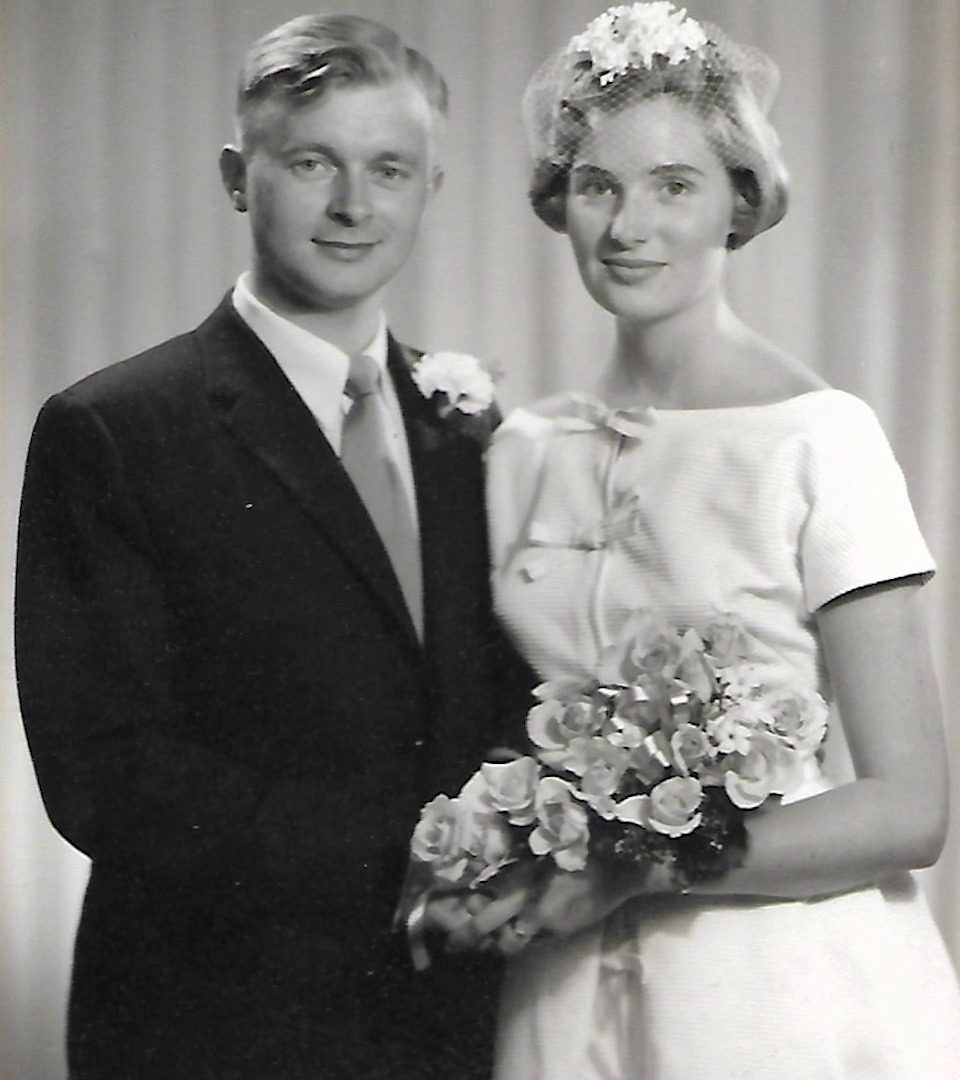
Tony and Elizabeth’s wedding portrait, c. July 1960: a frame from Michael’s funeral film.
The money, and the first house
A legacy bought the house. “Aunt Nell left me and Mary Sutherland three thousand pounds” — the same Mary Sutherland, Rollo’s daughter, who had met her off the train in Toronto. The house at Fleet cost £3,450, against Tony’s salary of £1,000 a year, “so without much of a mortgage.”
They lived in Pete’s flat briefly first. ⚠ “Pete Leach” appears twice in the recording, once as a landlord and once as a pilot with a right bundle branch block. Probably one man.
❓ Why Fleet? She cannot say — the friendships she names there, Eric and Anne, came after. The likeliest answer is the one she half gives: it was where the flying people were.