Trekenning, St Columb Major: the ancestors' house
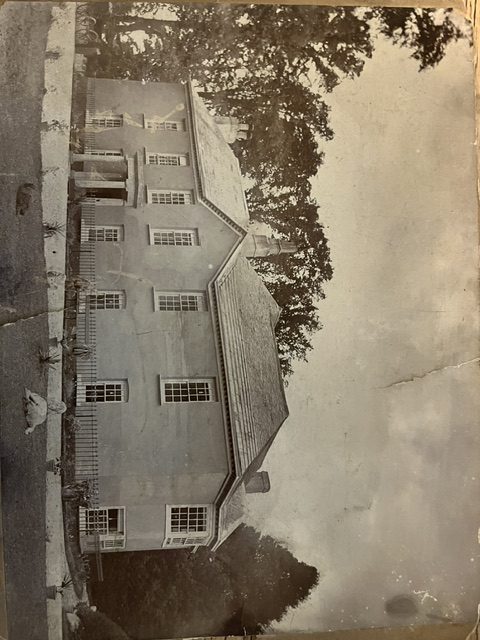
Trekenning House, St Columb Major. Old photograph, received September 2026.
A house south of St Columb Major, Cornwall, and the people known to have lived in it.
Compiled 2 August 2026 from the family records and published sources. Everything asserted here is sourced; where the evidence runs out, it says so.
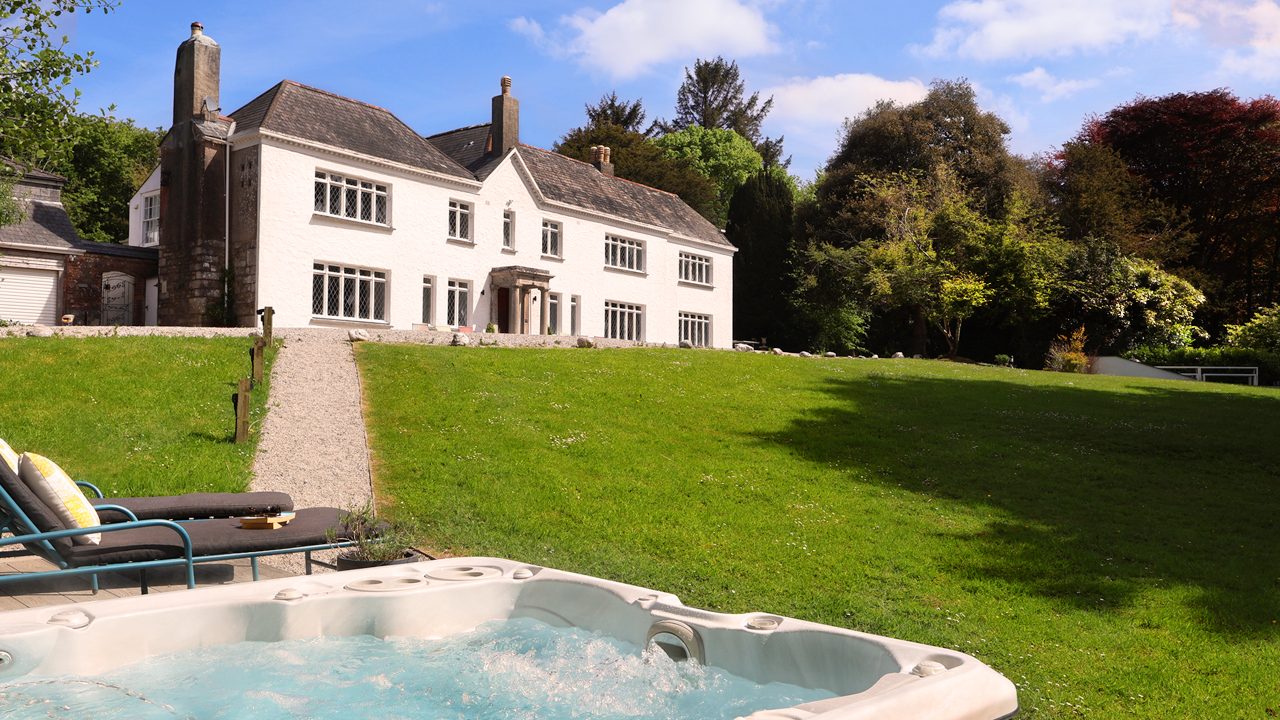
Trekenning House today, from the south lawn — the early 18th-century symmetrical front with
its Doric portico and gable above, exactly as the Historic England listing describes it. The
right-hand end carries the large mid-to-late 19th-century addition made in our family’s time.
Source: the current holiday-let listing, trekenninghouse.co.uk,
downloaded 14 August 2026. Copyright the owners; held here for family reference, not for
republication. A second view down the drive is at .
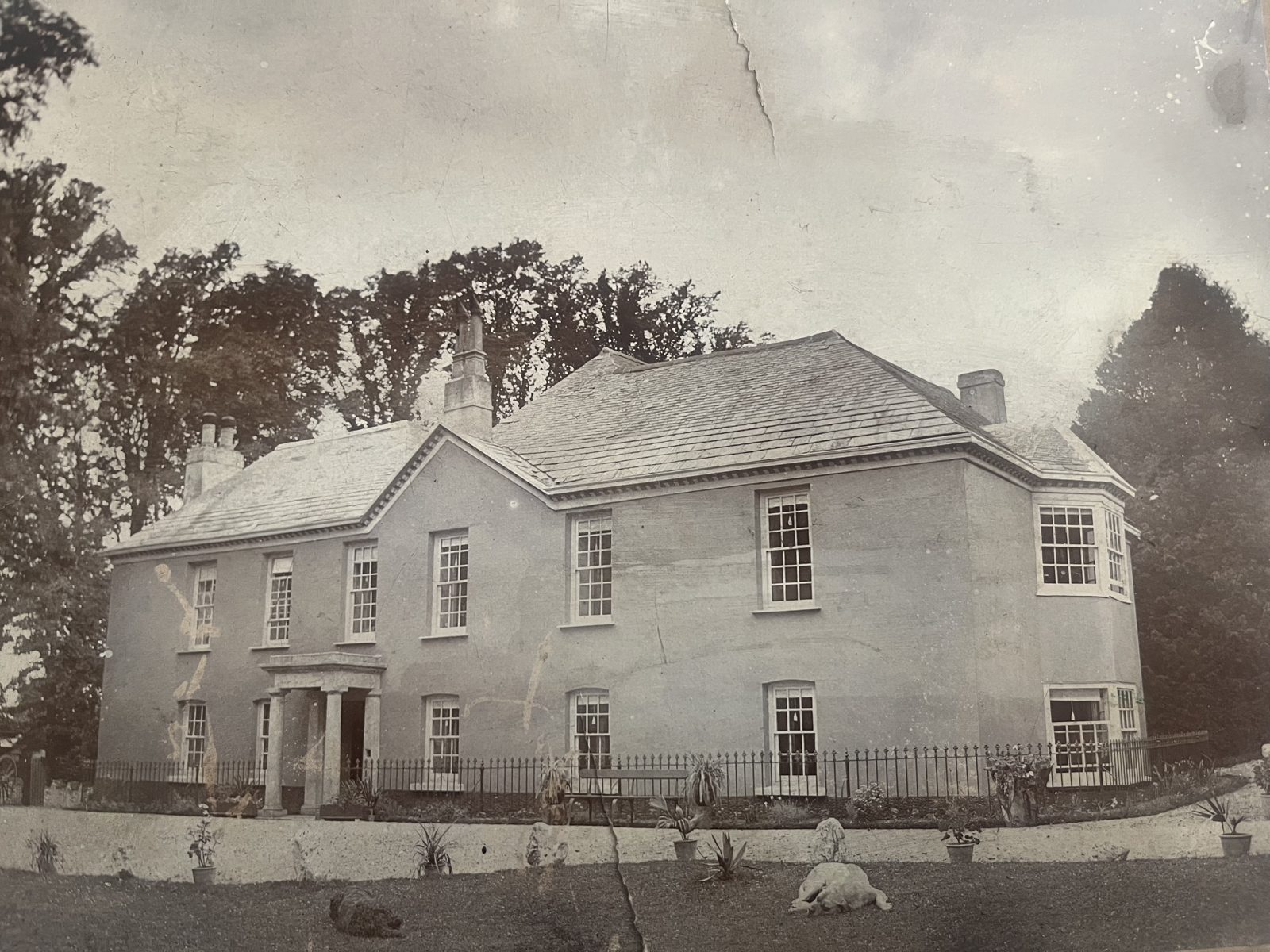
Trekenning as the family knew it. A black-and-white print from Elizabeth Hancock’s papers,
photographed by Will on 12 September 2026 — the same south front, portico and gable, with the
19th-century bay-windowed addition at the right, iron railings along the terrace, potted plants on
the lawn and a dog asleep on the grass. The print is cracked and foxed and carries no date or
inscription that has yet been read; the railings and planting suggest the late 19th or early 20th
century, i.e. the Sutherland–Nicholls tenure or just after. ⚠ Date and provenance are inference;
ask Elizabeth where the print came from. Archive copy:
(HEIC original IMG_1009 in the
Media library).
The place
Trekenning is a hamlet a mile or so south of St Columb Major, in mid-Cornwall, inland from Newquay. The Cornish form of the name is Trehepkenyn — tre being the common Cornish element for a farmstead or settlement, which is what the place began as. It sits at 50°25′31″N, 4°56′44″W.
Trekenning House is Grade II listed — Historic England list entry 1327377. The listing describes a farmhouse, now a house, of probable mid-17th-century origin, considerably enlarged and remodelled in the early 18th century, with 19th- and 20th-century alterations. It is built of rendered stone rubble with granite dressings under a slate roof.
The early 18th-century remodelling gave it the face it still wears: a symmetrical front entered through a Doric portico with a gable above, opening into a central hall with an open-well staircase to the rear and one large room to each side. Inside there is fielded panelling of the same date. Around the middle-to-late 19th century — which is precisely when our family were there — a large one-room addition was made at the right-hand end, and the interior was remodelled in the Gothic style.
The pair of granite gate piers at the east entrance are separately listed (1312084): 19th-century square granite monoliths with swept caps and unusually large ball finials.
So the house our family lived in was a 17th-century farmhouse given a polite Georgian front, and then Gothicised — probably by them, or by whoever held it in their time.
Before us: the Paynters
Trekenning was once the home of the Paynter family, a junior branch of the wealthy Paynters of Hayle.
James Paynter, the Jacobite (b. 1666)
The most colourful person ever to live at Trekenning. In October 1715 James Paynter proclaimed James III — the Old Pretender — in the market square at St Columb Major, leading the Jacobite rising in Cornwall. He was taken and tried at Launceston for high treason.
He then did something very Cornish and very clever. Claiming his right as a Cornish tinner, he demanded to be tried by a jury of other Cornish tinners — and was acquitted.
The Jacobite court, which had already created him Marquess of Trelissick in the Jacobite peerage on 20 June 1715, thereby acquired a marquess who had beaten a treason charge on a point of stannary privilege.
Commander John Pender Paynter, R.N. (1788–1856)
Of the same family, and resident at Trekenning. He entered the Royal Navy in 1804 and had a hard Napoleonic war:
- the blockade of Brest, 1804–06
- Lord Cochrane’s attack on the French fleet at Aix Roads, April 1809
- bombardments along the coast of Calabria
- service in America in the War of 1812, including the capture of Fort Washington and Alexandria
- Flag Lieutenant to Lord Exmouth aboard HMS Boyne, 1815
- the Bombardment of Algiers, 1816, where he was briefly detained by the Dey
- promoted Commander on returning to England in 1816
A note on the gap. We have no evidence at all of how Trekenning passed from the Paynters to the Nicholls, or whether it did — the Nicholls may have bought it, leased it, or come in by marriage. Commander Paynter died in 1856; John Nicholls was styled “of Trekenning” by the 1870s. That twenty-year gap is unexamined, and the Cornwall Record Office deeds would close it.
Our family at Trekenning
John Nicholls (1796–1874 or 1882)
Will’s 3× great-grandfather. Born at St Columb Minor in 1796, son of James Nicholls (1768–1851) and Mary Penrose. He married Amelia Anne Johns of Crantock at Crantock on 25 November 1830.
His obituary of his son calls him plainly “the late John Nicholls, of Trekenning House, St Columb”.
The family did not start there. Their elder children were born at Gustaveor, in the neighbouring parish of St Columb Minor — Dr James Nicholls “was born at Gustaveor, in St. Columb Minor, Oct. 18, 1831”. By the 1861 census the household is at St Columb Major, and by the 1871 census they are unambiguously at Trekenning. The move happened somewhere between 1846 and 1861 and is not yet pinned down.
A conflict, recorded not smoothed: one Ancestry page has him dying at Trekenning on 11 September 1874; another has him dying at Liskeard in April 1882. Both cannot be right and neither is a record.
Amelia Anne Johns (1807–1894)
Will’s 3× great-grandmother. Born at Crantock, christened there 22 May 1807, daughter of John Johns (1773–1852) — himself “of Carloggas”, another St Columb Major property — and Elizabeth Bradford (1778–1823).
She died at Trekenning on 5 December 1894 and was buried at St Columb Minor on 10 December. Widowed, she is recorded as head of the household there in the 1881 and 1891 censuses. She lived at Trekenning for at least thirty years and died in the house.
The household on census night, 2 April 1871
The single best picture we have of the place. Twelve people were in the house; seven are named in the transcript we hold (piece 2255, folio 75, page 19):
| Age | |
|---|---|
| John Nichols — head | 75 |
| Amelia Ann Nichols — wife | 62 |
| Thomas Nichols — son, solicitor | 37 |
| George Jasper Nichols — son | 29 |
| Mary Sutherland Nichols — daughter, married | 27 |
| Ellen G. Sutherland — granddaughter | 1 |
| William Edward Sutherland — grandson | 1 month |
Three generations under one roof, with the army daughter home from her husband’s regiment and a month-old baby in the house.
Mary Nicholls (1843–1875) — and the question of her husband
Baptised at St Columb Minor 21 November 1843, and the family member most continuously associated with the house. She is there in 1861, there at her marriage in 1867, and there in 1871 with two children.
When she married Lieutenant and Adjutant William John Edward Graham Sutherland of the 44th Regiment at St Columb Major on 13 November 1867, the register gives his residence as Aldershot and hers as Trekenning — two households, seventy miles apart, on the day they married.
On the census of 2 April 1871 she is recorded at Trekenning as “Mary Sutherland Nichols, aged 27, relation to head of house: Daughter” — with Ellen aged 1 and a baby of one month beside her. Daughter, not head of a household of her own. That is how a married daughter staying with her parents is entered, and it is the strongest single statement in the record of where she was actually living.
So did her husband live here too? Almost certainly not, and the point is worth stating plainly because it is easy to assume otherwise. His residence at marriage is Aldershot. He is not among the seven occupants named in the 1871 household transcript — John, Amelia, Thomas, George Jasper, Mary, Ellen and the baby — though five of the twelve are still unidentified, so his absence is probable rather than proved.
What this looks like is an ordinary Victorian army marriage. He was Adjutant of the 44th Foot at Aldershot in 1867 and a Captain by 1869; the regiment moved as regiments did; and his wife went home to her father’s house in Cornwall for her confinements. Both her Cornish children were born at Trekenning and baptised at St Columb Major. She joined him in India afterwards — a son was born at Kamptee in February 1872 and a daughter there in August 1873 — and she died on 5 May 1875, buried at Madras the next day, aged 32.
Trekenning was her home, not theirs. He was a visitor to it at most, and nothing yet found puts him under its roof.
William Edward Sutherland (b. 16 February 1871)
Born at Trekenning. The certified copy of his birth entry — District of St Columb, entry 3 — survives in the family papers and is the oldest civil registration document the family holds. Baptised at St Columb Major on 26 February; on the census six weeks later he is in his grandfather’s house, aged one month.
He does not appear again. A second son was born at Kamptee, India on 19 February 1872 and christened William Edward Rose Jasper — the same first two names, a year later. That is the Victorian pattern for a dead child’s name given again, so the boy born at Trekenning almost certainly died in infancy, probably on the passage out.
His brother, Edward William Rose Jasper Sutherland, became a master mariner at Liverpool and is Will’s great-grandfather.
Ellen “Nell” Graham Sutherland (1869–1953)
Mary’s eldest, born July 1869 and baptised at St Columb Major 4 October 1869. At Trekenning aged 1 on the 1871 census. Elizabeth still knew of her by her household name three generations later.
Thomas Nicholls (1834–1885)
Second son; a solicitor. Recorded at Trekenning aged 37 in 1871, and died at Trekenning on 23 August 1885, aged 51. A stained-glass window in St Columb Minor church — north aisle east, four lights, made by Gibbs & Howard in 1887 — was dedicated to him.
A conflict: the same Ancestry tree elsewhere gives a Thomas Nichols 1834–1900 dying at Winona, Minnesota. Both cannot be the same man.
Dr James Nicholls (1831–1917)
The eldest son, baptised 21 November 1831, born at Gustaveor. A physician: schooled under Dr Dimock at Truro Grammar School, apprenticed to a relative, Dr Edward Martyn, in London, then St George’s Hospital; qualified at Apothecaries’ Hall at 21, M.D. St Andrews, L.R.C.P. London 1867; practised many years in West Somerset.
He lived at Trenarren House, Newquay, and then at Trekenning House, St Columb — so he came back to the family house at the end. He died 28 July 1917, aged 85, and donated the 1887 window at St Columb Minor to his brother’s memory. Kelly’s Directory of Cornwall for 1893 notes “a number of stained windows presented by Dr. James Nicholls, of Trenarren, Newquay, and his family.”
George Jasper Nicholls (1841–1920)
Fourth son, born at Gustaveor, at Trekenning aged 29 in 1871. Exeter Grammar School, then St John’s College, Cambridge, 1859, where he rowed in the University eight and won the cup for best shot of the year. Entered the Indian Civil Service: secretary to the Nagpur Government, inspector-general of police, judge at Azimgurh, Ghazipur, Ballia, Cawnpore, Benares, Agra and Futtehgurh, finally District and Sessions Judge of Moradabad. Wrote the standard book on opium and morphia, “translated into several foreign languages”, and was twice given the special thanks of the Crown. A noted shikari, “in at the death of over 100 tigers”.
In retirement he became a genealogist, compiling the marriage registers of Cornwall from 1400, said to be preserved in Exeter Cathedral. He died at Bideford, Devon.
Also of the house
Elizabeth Helen Nicholls (1836–1869), who died at Kensington; William Francis Nicholls (b. 1838); and John Godolphin Nicholls (1845–1855), who died a child.
Afterwards
The family’s tenure ends with Amelia in December 1894; her probate was granted in London about 29 January 1895. What happened to the house then is unresearched here.
In the later 20th century the land around it became Trekenning Tourist Park, a caravan and camping site, which is how the present generation of the family knows it. Elizabeth Hancock wrote to the Cornwall Online Parish Clerks in August 2023:
“I have never visited Trekenning but all my children have when it was a caravan park.”
Trekenning House itself still stands, still listed, and is now let as a large family holiday house.
What is still open
- How the house passed from the Paynters to the Nicholls, and whether the Nicholls owned or leased it. Cornwall Record Office deeds and the c.1840 tithe apportionment and map for St Columb Major would settle both, and the tithe map would give the acreage.
- When the family moved from Gustaveor to Trekenning — somewhere between 1846 and 1861.
- Whether the mid-19th-century Gothic remodelling was theirs. The dates line up.
- John Nicholls’s death — Trekenning 1874 or Liskeard 1882.
- Thomas Nicholls — Trekenning 1885 or Winona, Minnesota 1900.
- The full 1871 household: five of the twelve are still unnamed.
Sources
in the family records: the obituary of Dr James Nicholls; the certified birth
entry of 1871; the research papers of Elizabeth Hancock, including Karen
Tuplin’s Cornwall OPC transcripts and the 1867 marriage certificate; the maritime cuttings carrying the obituary of George Jasper Nicholls
; the stained-glass research in research-papers-elizabeth-hancock.
Published: Historic England list entries 1327377 (Trekenning House) and 1312084 (gate piers); Wikipedia on Trekenning, James Paynter and John Pender Paynter; Kelly’s Directory of Cornwall, 1893, p. 1074.