The ball of light through the cabin
Elizabeth Hancock’s ball-lightning flight, c.1958–61, and the scientists who wanted to know
Centred on Elizabeth Hancock, née Wynne, born 1936
A storm over the Alps, a lightning strike, a ball of light down the length of the aeroplane, two holes in the fuselage — and, twenty-five and thirty years later, letters from two of the country’s physicists asking her about it.
Somewhere between 1958 and 1961, on a flight home over the Alps, the aircraft Elizabeth Wynne was crewing for Eagle Airways was struck by lightning in a storm. What she saw next has been reported by a few dozen people in the whole history of aviation: a ball of light that came through the cabin, travelling its whole length, and was gone. On the ground there was a small hole in the nose with a blackened ring round it and a bigger hole in the tail. Her colleague in the galley, strapped in beside her, said: “I think we’ve had a fuse.”
She said nothing about it to anyone who mattered for more than twenty years. Then, in 1982, she heard a Cambridge physicist on Radio 4 asking for exactly this, and wrote to him. Seven years after that a second physicist wrote back. Both letters are the reason this account can be written; her own voice note of September 2026 is the reason it has a storm, a galley and a colleague in it.
What she remembers
Her account, recorded on 10 September 2026 after she had found the 1989 letter among her papers, is eighty-five seconds long. It is given whole, because it is the only first-hand description of the event that survives in her own words:
“I heard on Radio 4 many years ago a scientist, I think from Cambridge, who was talking about ball lightning as a phenomenon not seen a great deal and I remembered a flight I took, I can’t remember where I was coming from, but it was going back to Heathrow, flying over the Alps and we hit a storm in which the aircraft was hit by lightning, it was ball lightning, as described in the letter. And I remember when we landed that there was a smaller ring of, a hole in the nose of the aircraft and blackened ring surrounding the hold and a larger, as I remember it, a larger hole in the tail of the aircraft. It appeared to be like a ball of light running right through the cabin and one of my colleagues, we were in the galley and strapped in, said I think we’ve had a fuse.”
Four things in it are not in either letter: the Alps; that the crew were strapped in in the galley, so the aircraft was in turbulence and the cabin service had stopped; that the nose hole was the smaller and the tail hole the larger; and the colleague’s sentence, which is the kind of detail memory keeps and invention does not.
⚠ “Going back to Heathrow.” Eagle flew from Blackbushe until 1960 and from Heathrow after it. Either this is a slip for Blackbushe, or it places the flight in Eagle’s last year before she stopped flying in 1961. She stopped when Suzanne was on the way; she and Tony married in July 1960. The Alps on a homeward leg means a flight from Italy, Switzerland, Austria or beyond — Eagle served Innsbruck and flew Mediterranean trooping. As the next section shows, the aeroplane itself can probably be named.
The letter of 1989
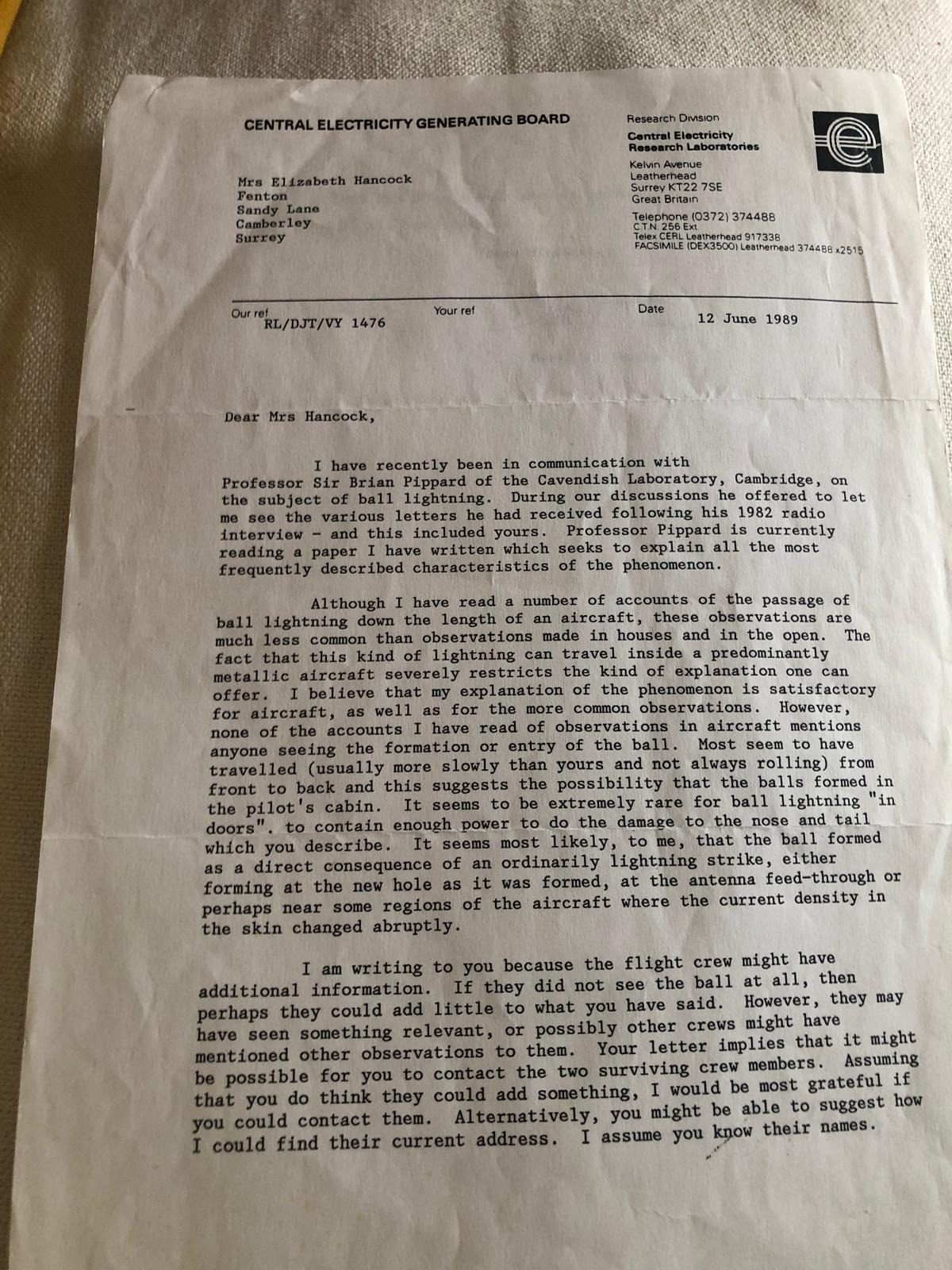
David J. Turner, CEGB Research Division, to Elizabeth Hancock at Fenton, 12 June 1989, page 1.
Record .
The letter is from the Central Electricity Generating Board’s research laboratories at Leatherhead, reference RL/DJT/VY 1476, and it opens by explaining itself:
“I have recently been in communication with Professor Sir Brian Pippard of the Cavendish Laboratory, Cambridge, on the subject of ball lightning. During our discussions he offered to let me see the various letters he had received following his 1982 radio interview — and this included yours.”
So the Radio 4 scientist was Sir Brian Pippard, Cavendish Professor of Physics at Cambridge, and the year was 1982; and her letter to him had been kept. Turner had written a paper that “seeks to explain all the most frequently described characteristics of the phenomenon”, and Pippard was reading it.
Then he tells her, in effect, why her case mattered to him. He had read other accounts of ball lightning passing down the length of an aircraft, but they were rare beside reports from houses and the open air, and the fact that the thing could travel inside a metal tube “severely restricts the kind of explanation one can offer”. In the accounts he knew, the ball had usually moved “more slowly than yours and not always rolling”, from front to back, as if it had formed in the cockpit. And “it seems to be extremely rare for ball lightning ‘in doors’ to contain enough power to do the damage to the nose and tail which you describe.” His own view was that the ball had been made by the ordinary lightning strike itself — “forming at the new hole as it was formed, at the antenna feed-through or perhaps near some regions of the aircraft where the current density in the skin changed abruptly.”
What he wanted was the flight crew: had anyone seen the ball form, or enter? “Your letter implies that it might be possible for you to contact the two surviving crew members … I assume you know their names.”
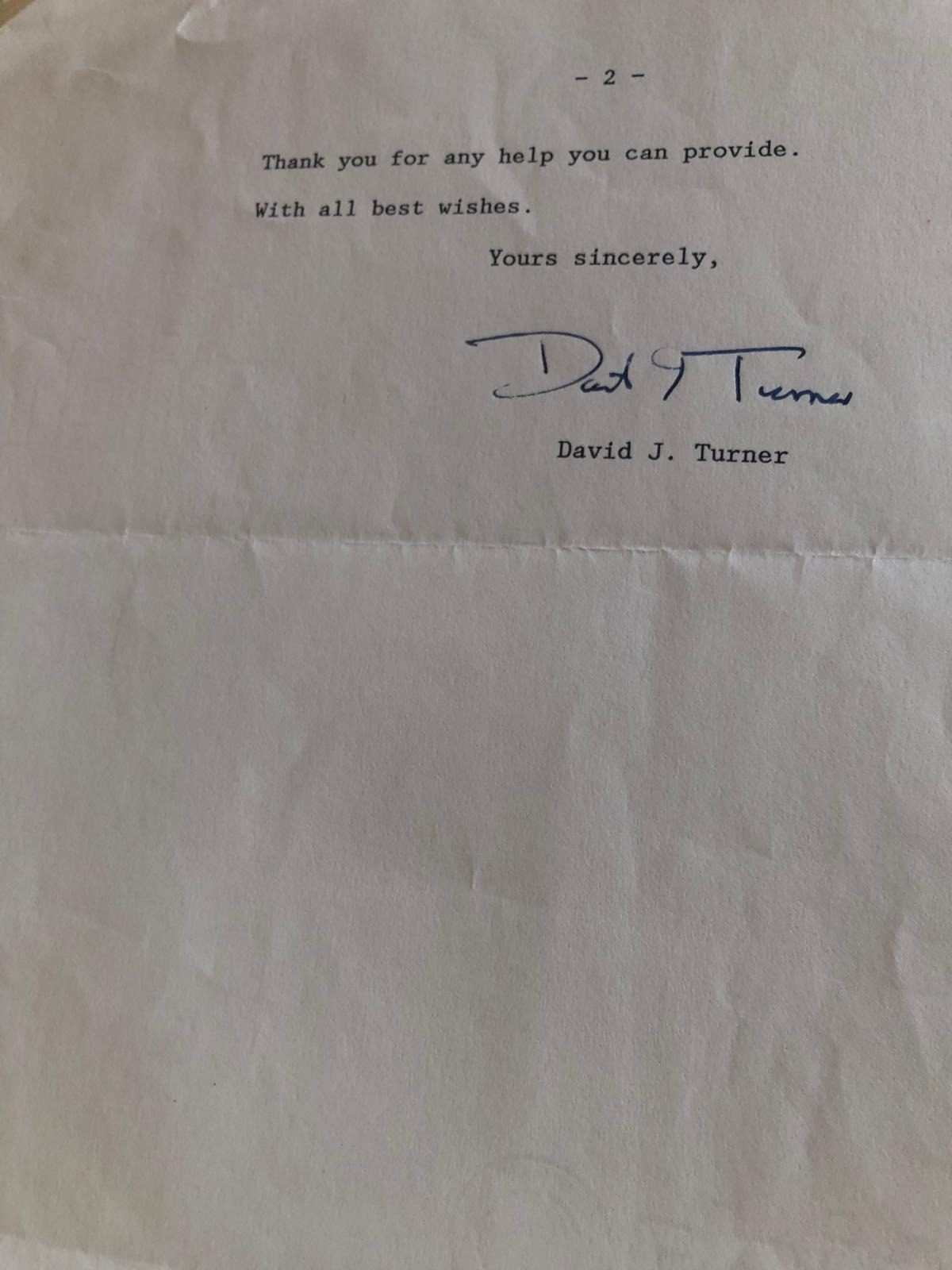
Page 2, with the signature.
From this one letter, then, three of her 1982 statements are recovered second-hand: the ball went down the length of the aircraft; it was fast, and rolling; and the strike holed the nose and the tail. Twenty-seven years before the voice note, and forty-four years apart, the two tellings agree.
Her flight is in the literature
The standard scientific book on the subject is Mark Stenhoff’s Ball Lightning: An Unsolved Problem in Atmospheric Physics (1999). Its chapter on aircraft lists the handful of cases in which a ball has been seen inside an aeroplane. One of them, on page 115, reads:
“A DC6 aircraft was flying north over the Alps in heavy turbulence when a luminous ball with fuzzy edges, about 10 in. in diameter, was seen traveling rapidly along the floor of the central aisle. There was no internal damage, but on landing blackened holes were found in the nose and tail of the aircraft, 3 to 4 in. and 10 to 12 in. in diameter, respectively.”
Set that beside her voice note. Over the Alps, on a northbound — homeward — flight. Heavy turbulence: she and her colleague were strapped in in the galley. A ball moving rapidly along the floor: Turner’s letter had hers moving faster than the others he knew of, and rolling. Blackened holes in the nose and tail, the nose one small, the tail one three times the size: “a smaller … hole in the nose of the aircraft and blackened ring surrounding … and a larger, as I remember it, a larger hole in the tail.” Every particular she gave in 2026, without having read the book, is in the book.
Stenhoff’s source is a paper by Professor Roger Jennison of the University of Kent — the physicist who had himself seen ball lightning in an airliner cabin in 1963 — given at the fourth conference of the Tornado and Storm Research Organisation at Oxford in July 1992. Jennison gives no date, airline or witness in the version Stenhoff quotes. But the chain is short and plausible: Pippard collected the letters in 1982; Turner had them in 1989; Jennison, working in the same small field with the same collection of reports, published the case in 1992. The DC-6 over the Alps is very probably her. It is not proved, and the paper itself, which is not online, would settle it.
⚠ Graded plausible, not corroborated. Two things would make it hers beyond doubt: Jennison’s 1992 paper (TORRO proceedings, pp. 25–39) naming the witness or the airline, or her own 1982 letter.
And it names the aeroplane. She could not remember it; the book says a DC-6. Eagle Airways had exactly three: G-APOM and G-APON, bought in 1958, and G-APSA, early 1959, its first four-engined airliners, used on the long trooping runs and charters that took her round the Mediterranean and to Christmas Island. A DC-6 carried two stewardesses, which is why there was a colleague in the galley. So the flight was most probably in 1958, 1959 or 1960, homeward from the Mediterranean, in one of those three aircraft.
The people who wrote to her
Sir Brian Pippard (1920–2008) was Cavendish Professor of Physics at Cambridge, one of the great experimental physicists of his generation. On 3 August 1982 a violent thunderstorm broke over the Cavendish Laboratory and several of his staff saw ball lightning — one of them watched a spinning, sparking object fly in through a ground-floor door, bounce off a photocopier and fly out again. He wrote it up for Nature that month under the title “Ball of fire?”. The report led to an article in The Times and an interview on BBC Radio 4, and those brought him more than thirty letters from listeners and readers describing what they had seen. Elizabeth’s was one of the thirty.
David Turner was a physical chemist at the Central Electricity Generating Board’s research laboratories, whose day job was the behaviour of ions in steam turbines, and who had never seen ball lightning himself. He became convinced it was a chemical phenomenon as much as an electrical one: a hot core, ions drifting outward into a shell of charged water droplets, a kind of heat pump powered by the thunderstorm’s electric field. The paper he told her Pippard was reading became, after the CEGB was broken up, “The structure and stability of ball lightning” in the Philosophical Transactions of the Royal Society in 1994; a sixty-page review in Physics Reports followed in 1998, and he was still publishing on it from retirement in Maryland in 2002. Aircraft cases mattered to him because a ball that can travel inside a metal tube rules out most explanations — which is why he wanted the crew.
What ball lightning is nobody yet knows. It is a luminous ball, usually the size of a grapefruit to a football, that appears during thunderstorms, lasts a few seconds, moves horizontally at walking pace, and vanishes silently or with a bang. It has been reported for centuries and photographed almost never; there are several competing theories and no accepted one. Inside aircraft it is rarer still — a survey in 2009 could find thirty-eight documented incidents in the whole world between 1938 and 2001, eighteen of them with the ball inside the airframe. The Eastern Airlines case of 1963, in which Jennison watched a ball pass down the aisle a foot and a half from his seat, is the one every account cites. A Soviet Ilyushin over the Black Sea in 1984, and a BOAC VC-10 over Italy whose flight engineer wrote to Stenhoff in the same appeal year of 1982, both ended, like hers, with holes in the nose and the tail.
What is verified, and what is not
| Statement | Grade | Rests on |
|---|---|---|
| Ball lightning passed the length of an aircraft she was crewing, after a lightning strike, and the nose and tail were holed | Corroborated | Her 1982 letter as summarised by Turner; her 2026 voice note; the two agree |
| It was a homeward flight over the Alps, in a storm, crew strapped in in the galley; nose hole small with a blackened ring, tail hole larger | Testimony | Voice note, 10 Sep 2026, first-hand |
| She wrote to Pippard after his 1982 broadcast, and Turner wrote to her in June 1989 | Record | Turner’s letter |
| The family lived at Fenton, Sandy Lane, Camberley in 1989 | Record | Turner’s letter |
| Two of the flight crew were alive in 1989 | Plausible | Turner’s reading of her letter |
| The case in Stenhoff (1999) p. 115 — a DC-6 north over the Alps, ball along the aisle, blackened holes in nose and tail — is hers | Plausible | Every detail matches her two accounts; Stenhoff’s source (Jennison 1992) gives no name; the chain Pippard–Turner–Jennison is short |
| The aircraft was an Eagle DC-6A (G-APOM, G-APON or G-APSA), 1958–60, homeward from the Mediterranean | Plausible | Follows if the Stenhoff case is hers; Eagle’s DC-6 fleet and dates from the staff association |
| The exact date, the route, the crew, the colleague in the galley | Open | Nothing found |
| Whether she replied to Turner, and whether he used her account | Open | Nothing found |
For Elizabeth
- Was it the DC-6 — the big four-engined one? Where were you coming from: Cyprus, Malta, Italy?
- Roughly when: before or after you and Tony married? Was Tony on the flight?
- Who was the colleague in the galley? Who were the flight crew, and which two were still alive when you wrote to Pippard?
- Did you keep your 1982 letter to Professor Pippard, or his reply? Did you answer Mr Turner?
- What happened to the aircraft afterwards — was it grounded for repair?
Sources
- The voice note,
: audio, transcribed locally and checked for holes; the transcript is atinterviews/transcripts/. - The letter,
: original with Elizabeth; images atand_p2.jpg. - Elizabeth’s biography, section VI, for Eagle Airways and the years she flew.
- The published case: Mark Stenhoff, Ball Lightning: An Unsolved Problem in Atmospheric Physics (Kluwer/Plenum, 1999), ch. 7, p. 115, citing R. C. Jennison, “Concerning the assessment of ball lightning reports”, in M. Stenhoff (ed.), Proceedings: Fourth TORRO Conference: Ball Lightning, Oxford Brookes University, 11 July 1992, pp. 25–39.
- Pippard: B. Pippard, “Ball of fire?”, Nature 298, p. 702 (19 August 1982); M. Longair and J. Waldram, memoir of Pippard, Biographical Memoirs of Fellows of the Royal Society 55 (2009), for the Times article, the Radio 4 interview and the thirty-odd letters; A. Keul, History of Geo- and Space Sciences 12 (2021) for the Cavendish event.
- Turner: D. J. Turner, Phil. Trans. R. Soc. A 347 (1994) 83–111; Physics Reports 293 (1998) 2–60; Phil. Trans. R. Soc. A 360 (2002) 107–152; Science News, 4 February 2002; Carl Zimmer, Discover, July 1993.
- Aircraft cases: R. C. Jennison, Nature 224, 895 (1969); R. Doe and A. Keul, EGU 2009 abstract 6227, for the count of thirty-eight incidents.
- Eagle’s DC-6 fleet: britisheagle.net, history of Eagle Airways.
- Research done 10 September 2026; Jennison’s 1992 paper and Turner’s full texts were not accessible online and remain the open sources.