"Would you mind laughing a little bit less?"
⬇ bennett_exchange_1986_2004.pdf
The Alan Bennett exchange, 1986–2004: a matinee at the Royal Court, a letter to the BBC, and two postcards from Gloucester Crescent
Centred on Elizabeth Hancock, née Wynne, born 1936
A man laughs too loudly behind them at an Alan Bennett play. Her husband asks him to stop. A day later she recognises him on television, writes to him, and the letter travels — from a BBC researcher in Bristol to the man himself, and from him to Alan Bennett, who answers her by postcard. Eighteen years on, she writes to Bennett again, and he answers again.
This is a small story and a complete one. It is told here because every document in it survives: her own letter, the BBC’s acknowledgement, Bennett’s reply, and his second card of 2004. They were found together among her papers and photographed by Will on 12 September 2026. Before that day the archive had her telling of it on tape, a line Will remembered from the letter that she refused to own, and a name nobody could recall. Now it has all three.
The evening
An autumn matinee in 1986, at the Royal Court in Sloane Square. The play was Kafka’s Dick, Alan Bennett’s new comedy, which had opened on 24 September with Alison Steadman, Jim Broadbent, Geoffrey Palmer and Andrew Sachs, directed by Richard Eyre. Bennett’s own diary for the week records the notices as “mixed, with only the Standard and the Financial Times wholehearted in its favour”, and adds, a little sourly, that “few of them bother to say that it is a funny evening.”
Somebody in the circle that afternoon found it very funny indeed. Her account, recorded on 6 September 2026, forty years later and before any of the documents had been found:
“We were in the gallery and there was a group behind us who were very noisy. Dad was very involved and kept turning around looking at them, but in the interval he said to them, would you mind just laughing a little bit less … there was a man and about three women, I think it was, and they just sort of rolled their eyes and went and moved somewhere else.”
Then the coincidence:
“A few days later I was ironing and listening to … something tele-topical. I heard the voice of the man who had been behind us making all the noise. And I got his name … I found out his name.”
Will, who has carried a line from the letter in his head for decades, offered it back to her: that she had been “debating whether to turn around and say something polite … or garrotte” him. She would have none of it — “I wouldn’t have written that … I’m pretty sure I didn’t say that.” And she closed the story with the part that mattered to her: “Anyway, Alan Bennett sent it to him. He wrote that to me … he sent me a postcard.”
The letter settles all of it. She did write the line. It was television, not the radio. The man’s name was Michael Neve. And she wrote not a few days later but the very next day.
The letter, 21 October 1986
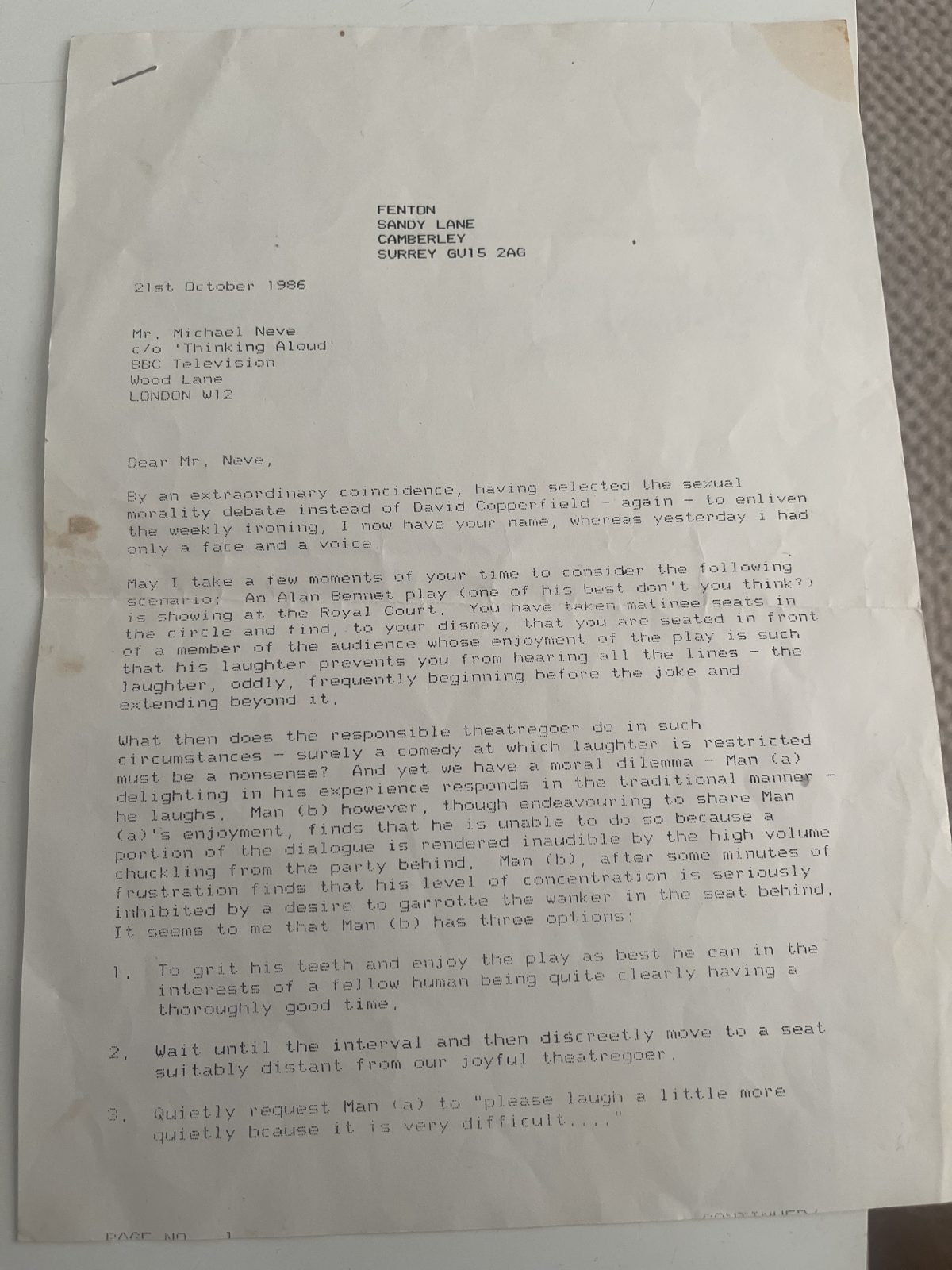
Typed at Fenton, the house she and Tony had built at Camberley, and addressed to Mr Michael Neve c/o ‘Thinking Aloud’, BBC Television, Wood Lane. What survives is her own file copy — two pages, stapled, creased, the signature block typed and unsigned. It is the only piece of her adult writing the archive holds, apart from the diary of her O-level year, and it is given whole.
FENTON, SANDY LANE, CAMBERLEY, SURREY GU15 2AG
21st October 1986
Mr. Michael Neve, c/o ‘Thinking Aloud’, BBC Television, Wood Lane, LONDON W12
Dear Mr. Neve,
By an extraordinary coincidence, having selected the sexual morality debate instead of David Copperfield — again — to enliven the weekly ironing, I now have your name, whereas yesterday I had only a face and a voice.
May I take a few moments of your time to consider the following scenario: An Alan Bennet play (one of his best don’t you think?) is showing at the Royal Court. You have taken matinee seats in the circle and find, to your dismay, that you are seated in front of a member of the audience whose enjoyment of the play is such that his laughter prevents you from hearing all the lines — the laughter, oddly, frequently beginning before the joke and extending beyond it.
What then does the responsible theatregoer do in such circumstances — surely a comedy at which laughter is restricted must be a nonsense? And yet we have a moral dilemma — Man (a) delighting in his experience responds in the traditional manner — he laughs. Man (b) however, though endeavouring to share Man (a)’s enjoyment, finds that he is unable to do so because a portion of the dialogue is rendered inaudible by the high volume chuckling from the party behind. Man (b), after some minutes of frustration finds that his level of concentration is seriously inhibited by a desire to garrotte the wanker in the seat behind. It seems to me that Man (b) has three options:
To grit his teeth and enjoy the play as best he can in the interests of a fellow human being quite clearly having a thoroughly good time.
Wait until the interval and then discreetly move to a seat suitably distant from our joyful theatregoer.
Quietly request Man (a) to “please laugh a little more quietly because it is very difficult....”
My own choice would certainly have been (2), but my husband, who holds a more positive and radical position on most issues than me, plumped for (3).
Which, I wonder, would you have chosen? Since I suspect that the story of this ‘incredible bloke in the row in front who actually asked me to stop laughing in an Alan Bennet play’ will enchant your dinner guests for some time to come, it would be such fun if I too, though unlikely to be amongst your guests, could share your considered views on this tricky social problem.
Yours sincerely,
Elizabeth Hancock
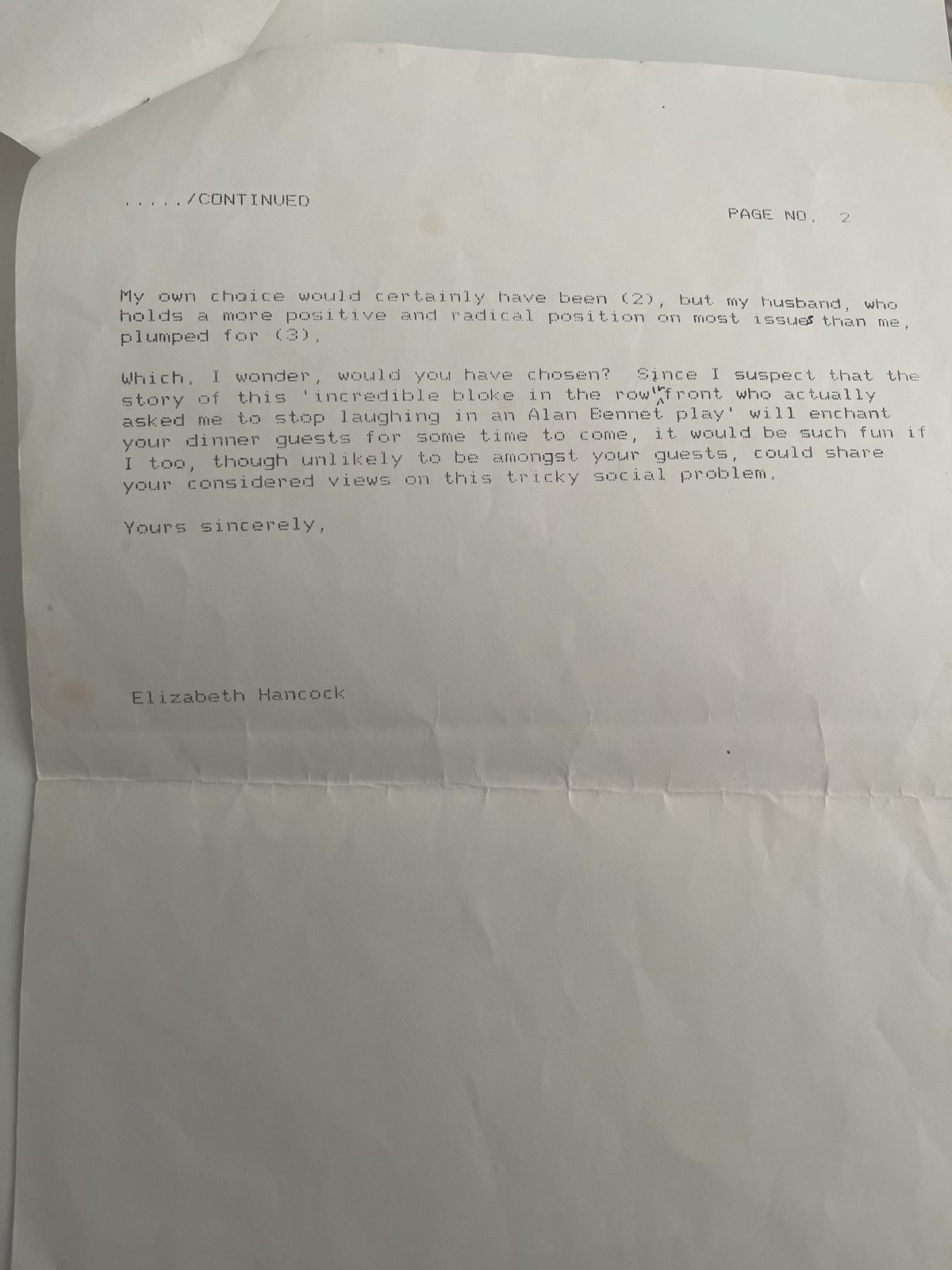
Three things in it are worth holding on to.
It was Tony who spoke. “My husband, who holds a more positive and radical position on most issues than me, plumped for (3).” That is the whole marriage in a sentence — her instinct to move seats, his to say something — and it matches exactly what she said on tape forty years later, before the letter had been found: “in the interval he said to them …”
The line is hers. “A desire to garrotte the wanker in the seat behind” is on page one, in her own typing. Will had it nearly right and she was sure she had never written it. ⚠ She was wrong, and the document wins; but it is worth noticing that what she disowned was the tone, not the event. The letter is a comic performance — Man (a), Man (b), the numbered options — and she is performing.
She recognised him by his face, on television. “Yesterday I had only a face and a voice.” The tape says radio; the letter says she was watching Thinking Aloud on BBC2 while she ironed — the programme’s “sexual morality debate”, chosen over a serialised David Copperfield — and saw the man from the row behind. It was 20 October 1986; she wrote on the 21st. ❓ BBC Genome will give the transmission and its subject; the reading of the programme’s topic is hers.
Who Michael Neve was
Her letter was addressed to a man she did not know. The archive can now say who he was.
Michael Neve (1947–2019) was a historian of medicine — a senior lecturer at the Wellcome Institute, later the Wellcome Trust Centre for the History of Medicine at University College London — and, from 1983, a member of the editorial board of the London Review of Books, to which he contributed for decades. Thinking Aloud was BBC2’s discussion programme of ideas, made by BBC Bristol and presented in 1986 by Michael Ignatieff; Neve appeared on it as one of the talkers. He was, by the accounts of those who knew him, a brilliant and unrestrained conversationalist — which is to say that the laughter “beginning before the joke and extending beyond it” was entirely in character. He was also, as the next document shows, a friend of Alan Bennett’s.
⚠ The identification rests on the name and the programme. Nothing in the archive proves that the Michael Neve of the Wellcome Institute is the Michael Neve of Thinking Aloud, but a historian of medicine with a seat on the LRB board is exactly who that programme booked, and Bennett’s card says “whom I know” — Bennett and Neve moved in the same LRB circle. Held as near-certain.
The BBC replies, 27 October 1986
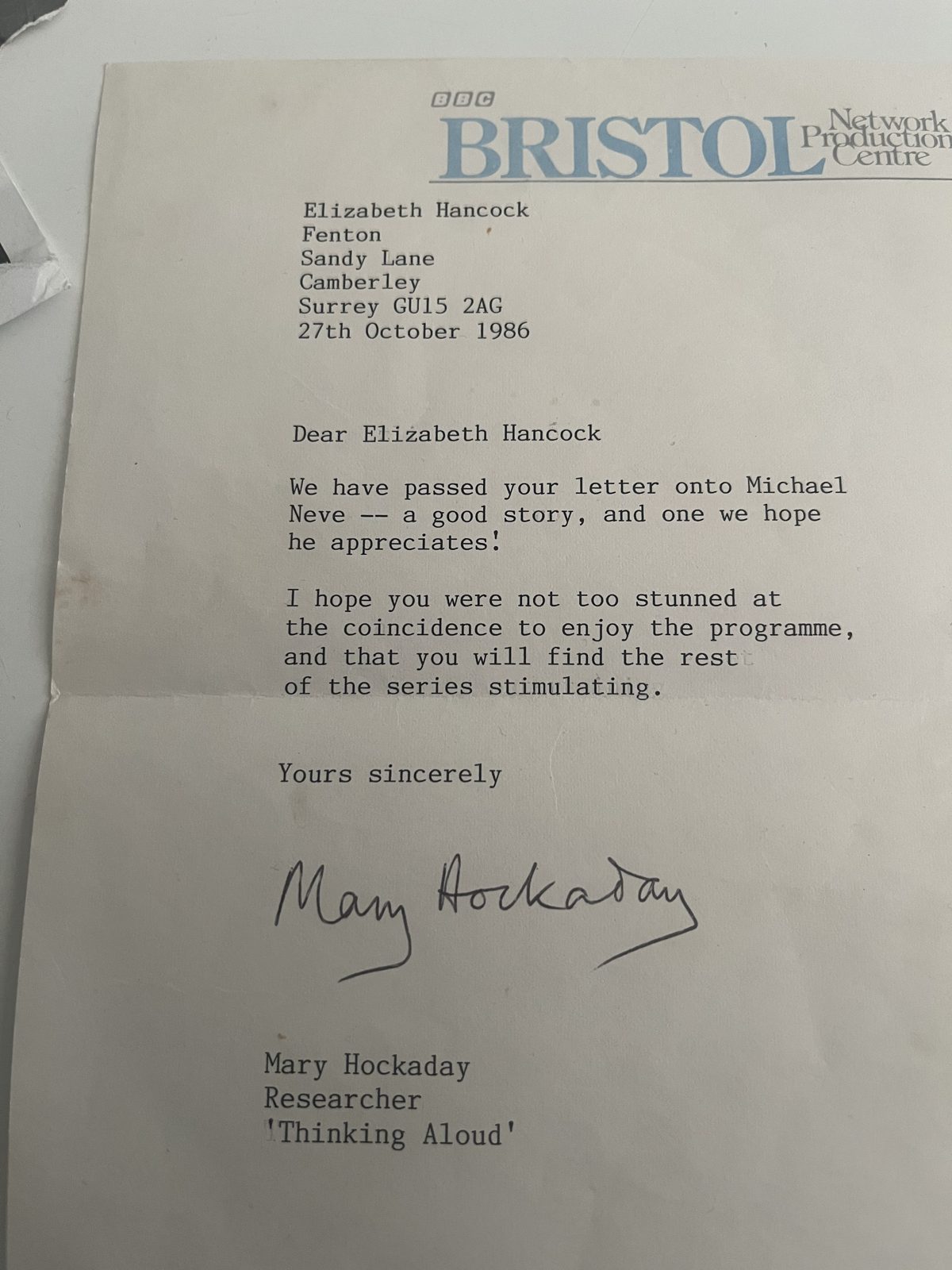
Six days after she wrote, a typed letter came from the BBC Bristol Network Production Centre:
Dear Elizabeth Hancock
We have passed your letter onto Michael Neve — a good story, and one we hope he appreciates!
I hope you were not too stunned at the coincidence to enjoy the programme, and that you will find the rest of the series stimulating.
Yours sincerely
Mary Hockaday, Researcher, ‘Thinking Aloud’
This is the link that explains everything that follows. Mary Hockaday — then a researcher on the programme, later Controller of the BBC World Service — forwarded the letter to Neve. Neve, instead of answering it himself, sent a copy to the man whose play it was about.
Alan Bennett’s postcard, late 1986
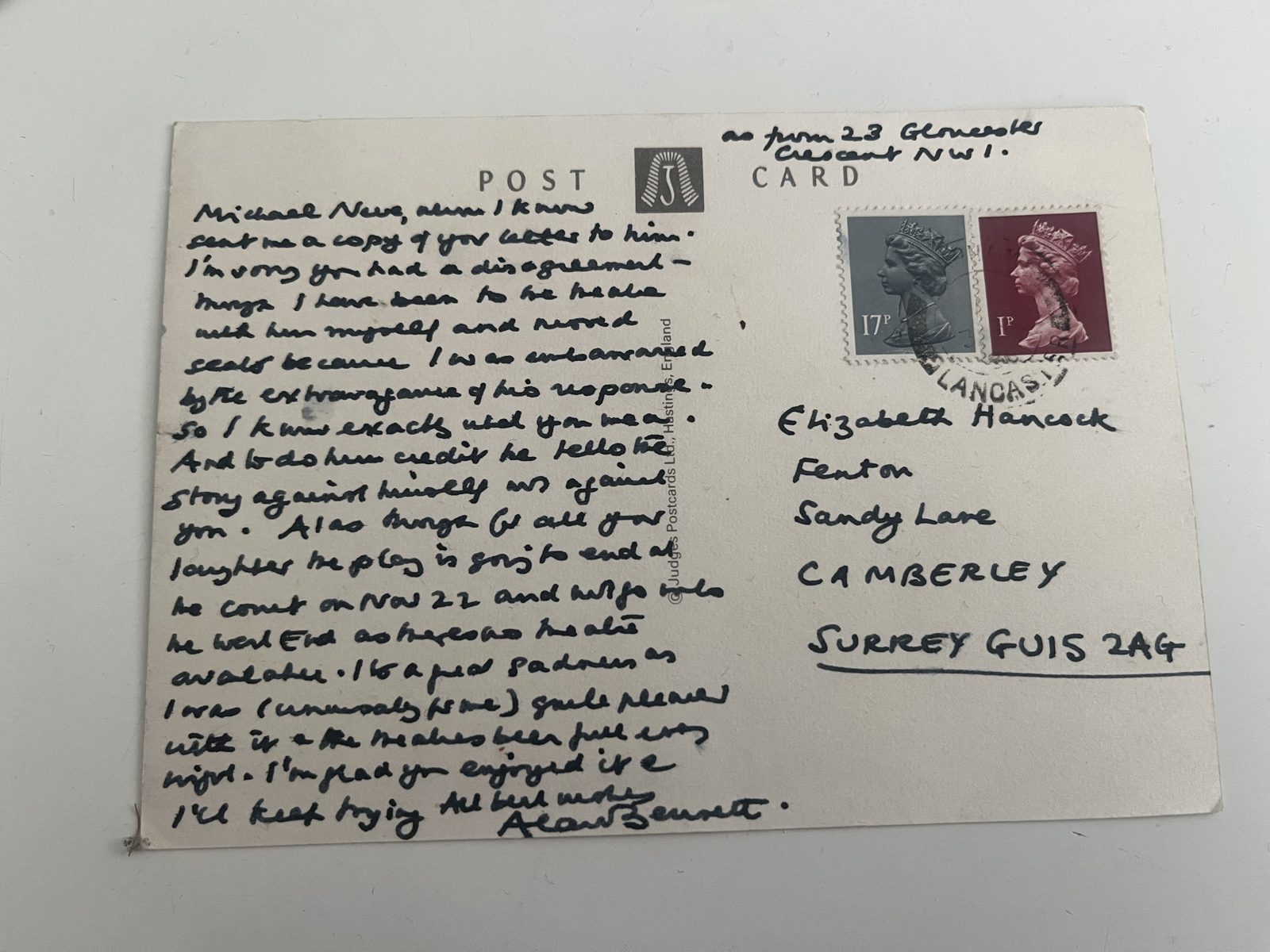
A Judges of Hastings postcard, addressed in Bennett’s hand to Elizabeth Hancock, Fenton, Sandy Lane, CAMBERLEY, SURREY GU15 2AG, with “as from 23 Gloucester Crescent NW1” written across the top — the Camden house he had lived in since 1969, outside which the lady in the van was then in her twelfth year. It is undated; it must fall between the BBC’s letter of 27 October and 22 November, which it names as the closing night. The postmark is Lancaster: he wrote it from Yorkshire.
Michael Neve, whom I know, sent me a copy of your letter to him. I’m sorry you had a disagreement — though I have been to the theatre with him myself and moved seats because I was embarrassed by the extravagance of his response. So I know exactly what you mean. And to do him credit he tells the story against himself not against you. Alas though (& all your laughter) the play is going to end at the Court on Nov 22 and will [not] go to the West End as there is no theatre available. It’s a great sadness as I was (unusually for me) quite pleased with it & the theatre’s been full every night. I’m glad you enjoyed it & I’ll keep trying.
All best wishes Alan Bennett
Reading notes: the bracketed aside is a probable reading; the “not” before “go to the West End” sits at the card’s edge and is supplied from the sense — the play did not transfer.
Everything she said on tape is in it, and one thing she could not have known. Bennett had sat behind Neve himself, and had done what she would have done — “moved seats”. Neve “tells the story against himself”: her prediction that it would “enchant your dinner guests” was right, and the guest it enchanted was Alan Bennett. And there is the sadness under the joke: the play was closing in a month with nowhere to go, the notices had not called it funny, and here was a letter from Camberley whose whole subject was how funny it was. “I’m glad you enjoyed it & I’ll keep trying” is the line she quotes.
Eighteen years later: The History Boys, 30 September 2004
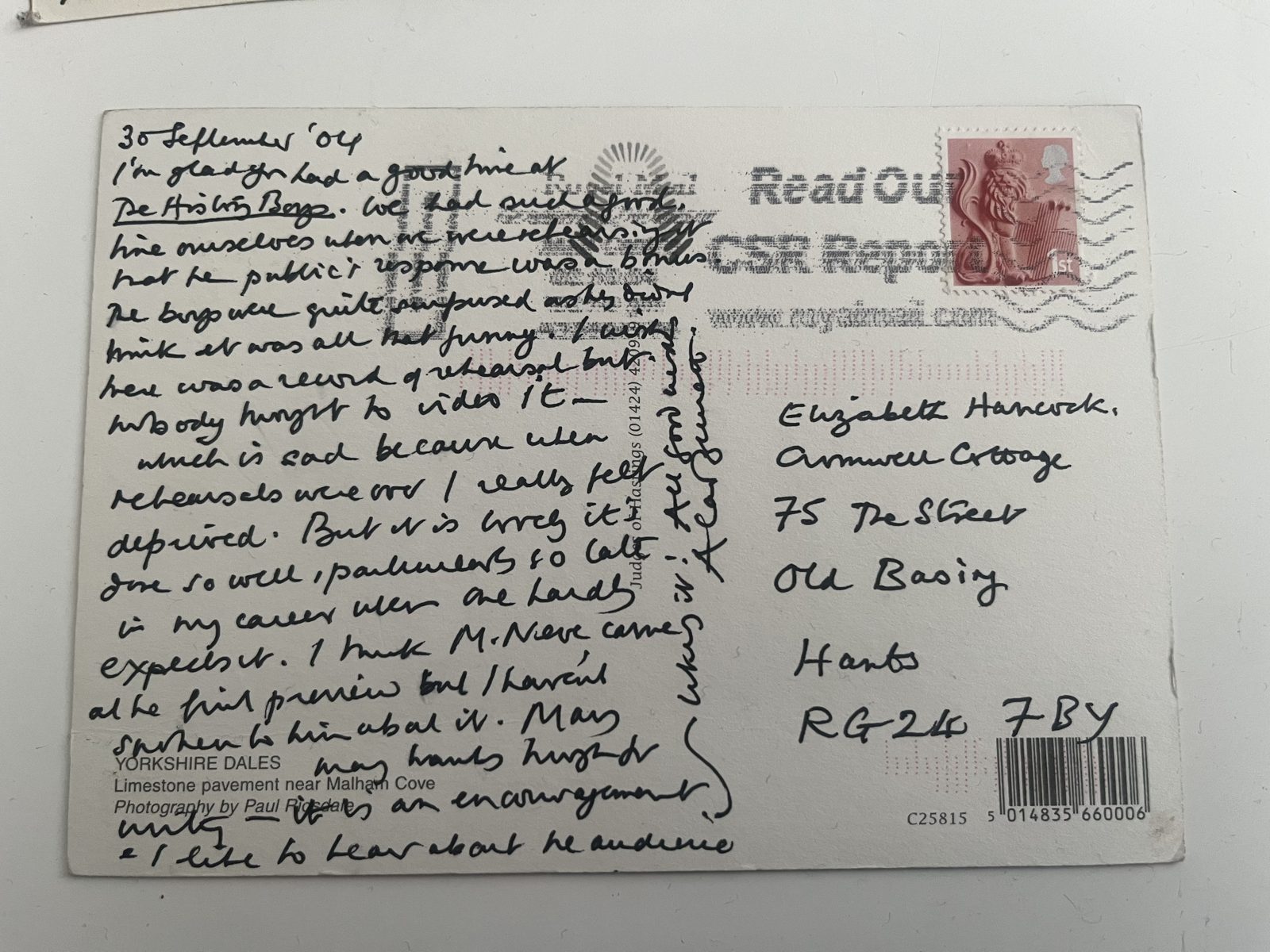
She kept writing to him — “frequent correspondents they were”, as Will put it on 9 September 2026, half in jest; the archive has two cards and cannot say how many letters. In 2004, now at Cromwell Cottage, 75 The Street, Old Basing, she saw The History Boys at the National, in its first months, and wrote. A Yorkshire Dales card came back — limestone pavement near Malham Cove — dated by him:
30 September ‘04
I’m glad you had a good time at The History Boys. We had such a good time ourselves when we were rehearsing that the public’s response was a bonus. The boys were quite surprised as they didn’t think it was all that funny. I wish there was a record of rehearsal but nobody thought to video it — which is sad because when rehearsals were over I really felt deprived. But it is lovely it’s done so well, particularly so late in my career when one hardly expects it. I think M. Neve came at the first preview but I haven’t spoken to him about it. Many many thanks though for writing — it is an encouragement & I like to hear about the audience.
All good wishes, Alan Bennett
Two things. “The boys were quite surprised as they didn’t think it was all that funny” — a second Bennett card, a second play, and the same question of who is laughing and why. And “I think M. Neve came at the first preview”: eighteen years on, Bennett remembered which man she would want to hear about. The story had lasted.
Why she wrote
Set beside the rest of her papers, the Bennett letter stops looking like a one-off. She wrote to Sir John Betjeman in March 1983, knowing he was dying, to thank him for his poetry, and had a one-line reply that “stirred me to the depths of exhultation”. She wrote to Professor Brian Pippard at the Cavendish in 1982 after a radio appeal about ball lightning, and seven years later a second physicist wrote back. She sent Denis Healey the passenger manifest of a flight she had crewed to Berlin in 1959, and had a letter from the House of Lords. She wrote to Bennett twice, eighteen years apart. In every case the pattern is the same: something she had seen or read or lived through, a public figure who would want to know, a letter, and a reply she kept.
She is, on her own account, “not keen on looking at the past particularly”. The letters say otherwise. They say that when something struck her she wrote it down and sent it to the person it concerned, and that the people it concerned wrote back.
What is settled, and what is not
| Question | Status | Evidence |
|---|---|---|
| Which play | Settled — Kafka’s Dick, Royal Court, opened 24 Sep 1986, closed 22 Nov 1986 | Her letter (“Royal Court”); Bennett’s card (“end at the Court on Nov 22”); Bennett’s 1986 diary |
| Who spoke to the man | Settled — Tony | Her letter, option (3); her tape, 6 Sep 2026 |
| Who the man was | Settled — Michael Neve | Her letter (addressee); BBC letter; Bennett’s card |
| Radio or television | Settled — BBC2 television, Thinking Aloud, 20 Oct 1986 | Her letter; BBC Bristol letterhead |
| The “garrotte” line | Settled — hers, page one | Her letter |
| Whether Neve ever answered her himself | Open | No letter from him survives; Bennett’s reply is the only one she kept |
| The exact date of Bennett’s first card | Bracketed 27 Oct – 22 Nov 1986 | Undated; Lancaster postmark |
| How many times she wrote to Bennett | Open | Two replies survive; “frequent correspondents” is Will’s phrase |
| The Thinking Aloud episode and subject | Open — “sexual morality debate” is her description | BBC Genome not yet consulted |
For Elizabeth
- Did Michael Neve ever write back himself, or was Bennett’s card the only reply?
- Did you write to Bennett between 1986 and 2004? Did you keep your 2004 letter?
- Do you remember the Thinking Aloud programme — what the debate was, who else was on it?
- Was it really a matinee, and was it the circle or the gallery? The letter says circle; you said gallery.
- Where did Tony say it — in the interval, as you remember, or during the play?
Sources
- Her letter,
: her retained typed copy, two pages; imagesand_p2.jpg. - The BBC’s letter,
: original, signed Mary Hockaday; image.. - Bennett’s first card,
: original; image.. - Bennett’s second card,
: original; image.. - Her testimony: interview day three, 6 September 2026, part of the recording c. 3:21–7:23; day four, 9 September 2026, memo 17, 3:13–6:36.
- Elizabeth’s biography, Appendix A (Theatre; Literature — “Poetry, and the two letters”).
- Kafka’s Dick: Alan Bennett, “Diary: What I did in 1986”, London Review of Books vol. 8 no. 22 (18 December 1986) — the 24 September opening and the notices; Wikipedia, Kafka’s Dick, for the cast and director.
- Thinking Aloud: BBC2, 1984–87; presented by Bryan Magee and, from 1986, Michael Ignatieff (IMDb, tt2178833; The Canadian Encyclopedia, “Michael Ignatieff”).
- Michael Neve: Mike Jay, “On Michael Neve”, London Review of Books vol. 41 no. 22 (21 November 2019); LRB contributor page.
- All four documents photographed by Will, 12 September 2026 (iPhone IMG_1004–IMG_1008; Media library photos.db ids 23326–23330). Research done 12 September 2026.