The ships of her uncle Ken and her grandfather, Captain Edward Sutherland
Every vessel this archive can put the two of them in, father and son, sail and steam — and what each one looked like, where a picture survives.
Compiled 16 August 2026 from the family records, from the Sea Breezes papers and the obituaries already held, and from published fleet lists and open picture collections consulted the same day.
Two warnings before the list. First, the ships are identified from his own writings and his obituaries; the registers then supply the hulls, builders, tonnages and fates. The registers are good for the ships and are not evidence that he sailed in any of them — that link comes only from the documents, and it is stated below only where a document says so. Second, Fernie’s fleet and the Johnston Line both reused names. Ron Parsons warns that earlier historians confused Fernie’s Pythomene with her fleetmate Philomene; the Johnston Line had a Kenmore torpedoed in 1917 and a Dromore sold in 1913, neither of which is the one Edward was in. Where a name is ambiguous the number is given.
Nine of the twelve ships below have no picture in this document. That is stated at each one, with where to look next, rather than filled with something approximate.
Captain Edward William Rose Jasper Sutherland
1872 – 1942 · · Master Mariner · Will Hancock’s great-grandfather; Ella Wynne’s father
Apprenticed at fifteen into Henry Fernie & Sons of Liverpool in 1887 and kept nine years in their square-riggers; master’s certificate at Liverpool in 1899, and into steam the same month; forty years with the Johnston Line and Furness Withy; his own command by 1930; retired 1935. He then wrote it all down for Sea Breezes — which is why the sail ships below can be named at all.
In sail — Henry Fernie & Sons of Liverpool, 1887 – c.1896
| Ship | Built | Builder | Tons | His part in her |
|---|---|---|---|---|
| Laomene | 1880 | W. H. Potter & Son, Liverpool | 1,797 | Apprenticeship ship, five years; left her a junior officer |
| Pythomene | 1880 | Oswald, Mordaunt & Co., Southampton | 1,954 | Second mate |
| Aristomene | 1881 | W. H. Potter & Son, Liverpool | 1,795 | Second mate, then mate |
| Chrysomene | 1873 | Potter & Hodgkinson, Liverpool | 1,835 | Named in his own writings; rank not stated (not established) |
| Sardomene | 1882 | Oswald, Woolston | 1,860 | Named in his own writings; rank not stated (not established) |
| Idomene | 1874 | Oswald & Co., Pallion, Sunderland | 1,424 | Named in his own writings; wrecked within months of his joining the firm |
Laomene — the apprenticeship ship
Five years of his life, from fifteen. He gives her as 1,745 tons where the register says 1,797, and calls her Mersey-built — and Potter’s was a Liverpool yard, so he is right.
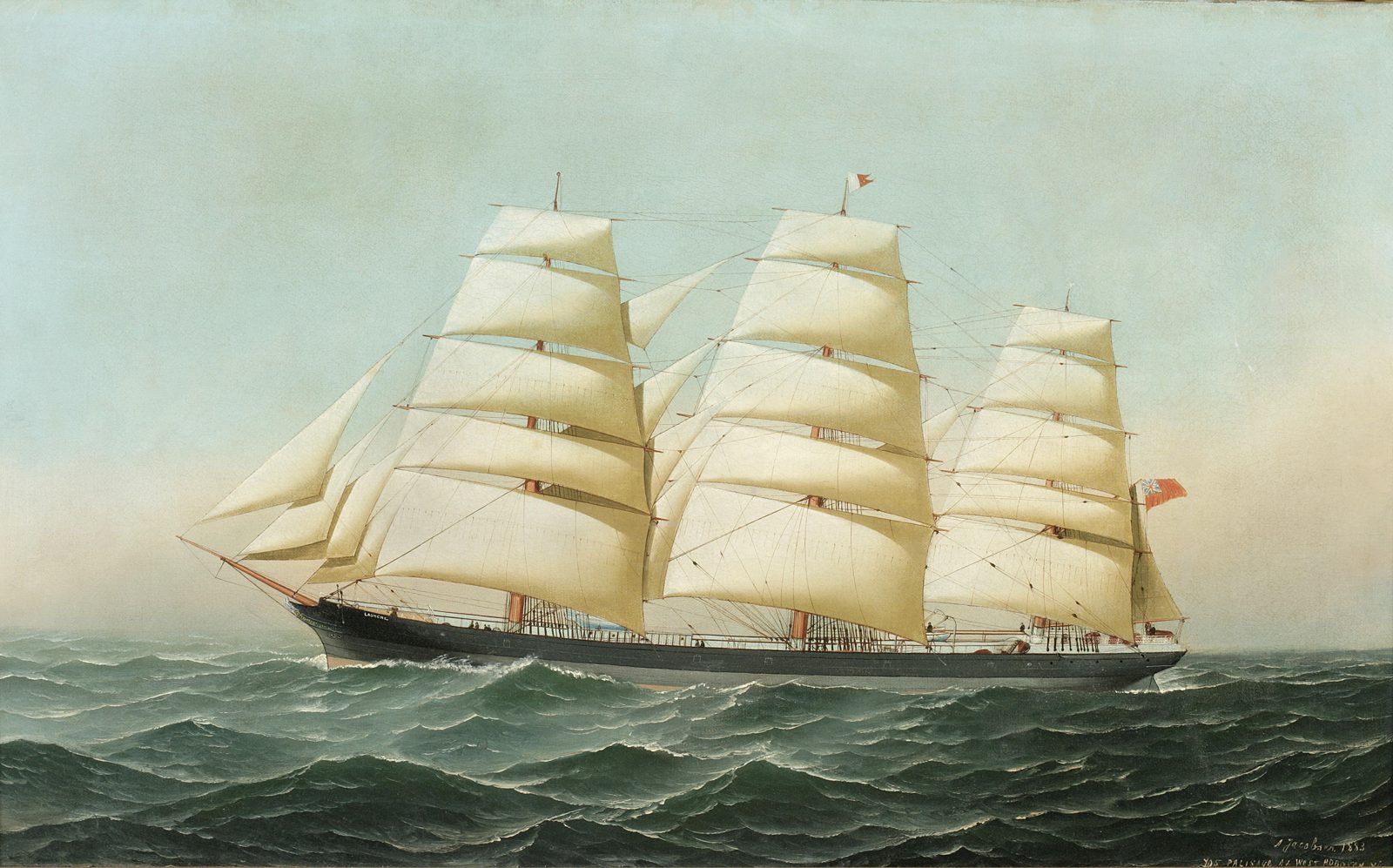
LAOMENE under full sail, painted by Antonio Jacobsen in 1883 — three years before Edward joined her. Her name is on the bow, the red ensign is aft and the owner’s house flag flies at the main truck.
Antonio Jacobsen (1850–1921), oil on canvas, 1883. Public domain; digital copy via Wikimedia Commons, credited to Bonhams. Jacobsen painted working ships from the Hoboken waterfront and his portraits are usually accurate to the vessel’s rig and colours.
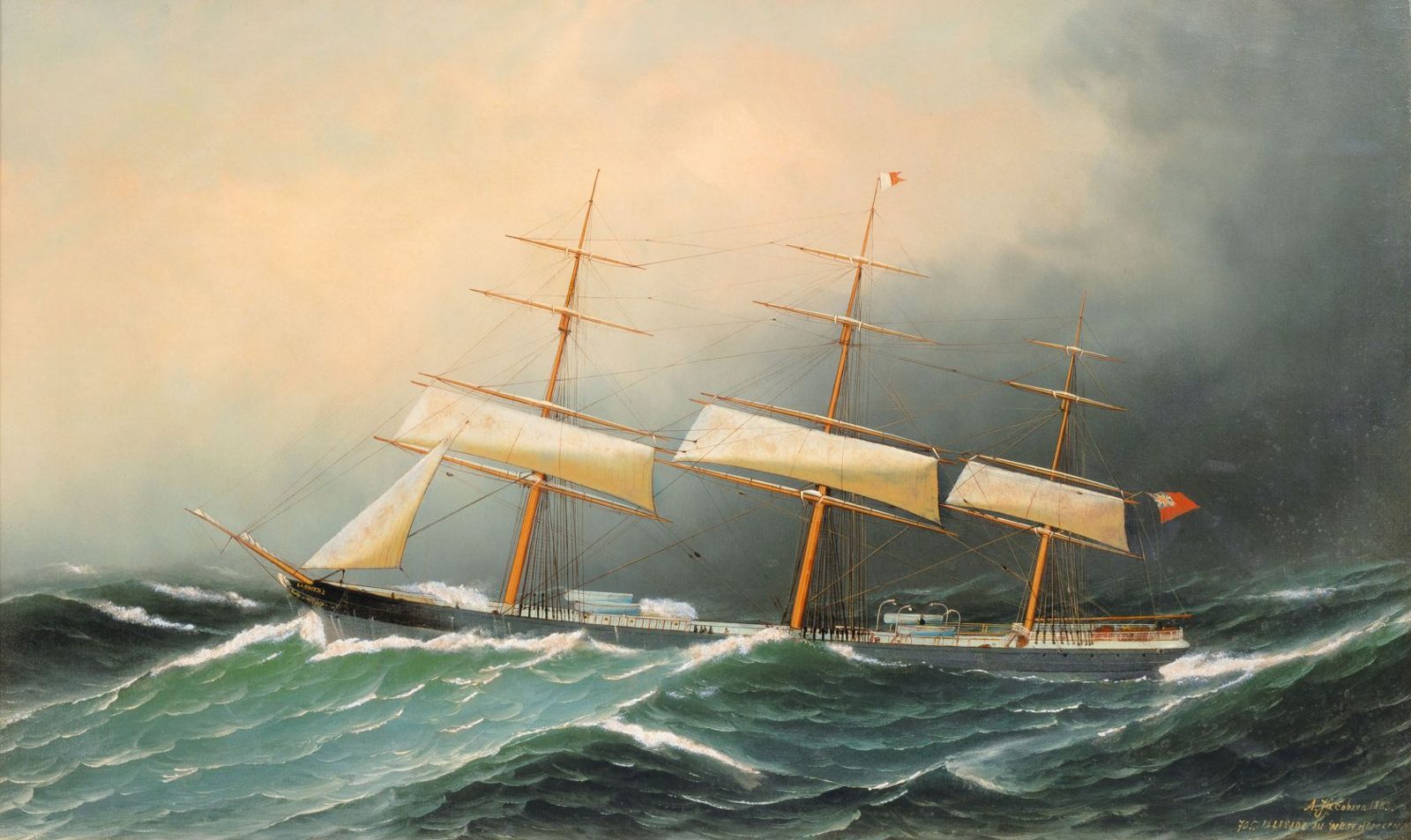
The same ship, the same painter, the same year — under storm sail. Oil on canvas, 56 × 92 cm.
Antonio Jacobsen, 1883. Public domain; digital copy via Wikimedia Commons, credited to Auktionshaus Stahl.
Pythomene — second mate
That he was second mate in her is stated by the magazine’s own editor, not by him. The detail that authenticates the whole body of his writing sits here: forty years later, at sea, he named her builder and her yard correctly. She went Italian about 1910 as Reno, was renamed Monte Nero about 1919, and was broken up in the 1920s.
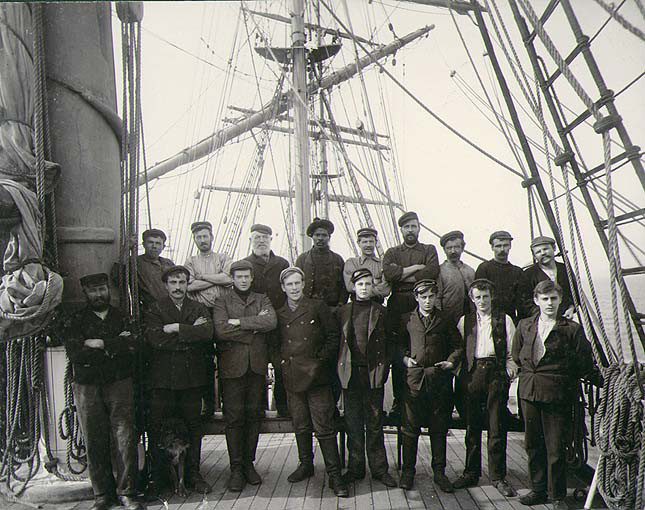
The crew of the PYTHOMENE mustered on her deck for the camera, about 1904. Sixteen men and a dog, in a Puget Sound port. Edward had left Fernie’s about eight years earlier, so he is not among them — but this is the deck he kept watch on.
Wilhelm Hester, c.1904 (HESTER 70). Original caption: “Br. Ship Pythomene, Capt. Sharry.” Public domain; digital copy via Wikimedia Commons, from the Wilhelm Hester Photographs Collection. Hester photographed ships’ crews and officers’ quarters in Puget Sound ports around the turn of the century and sold the prints to the men in them.
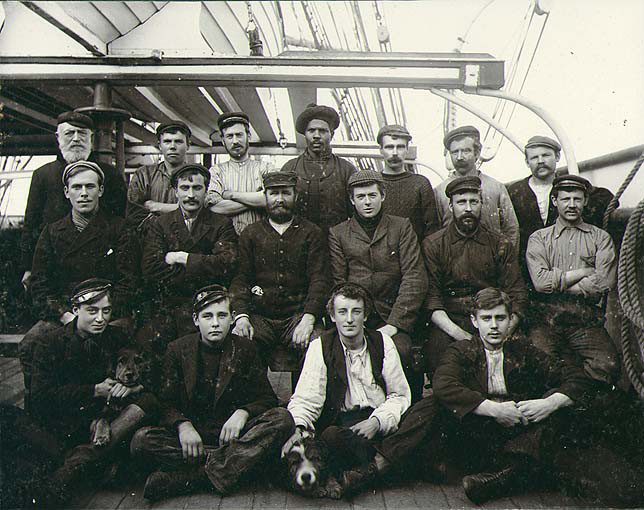
Two of her crew with the ship’s dogs, from the same sitting.
Wilhelm Hester, c.1904 (HESTER 116). Public domain; via Wikimedia Commons.
Do not confuse her with Philomene. Ron Parsons records that Lubbock and Hurst both mixed up these two Fernie ships and gave each the other’s later names. Any future work on Pythomene has to check which of the pair a source means.
Aristomene — second mate, then mate
His step up. She went Italian about 1910 as Olona, was cut down to a diesel auxiliary barque in 1918, and was broken up about 1922.
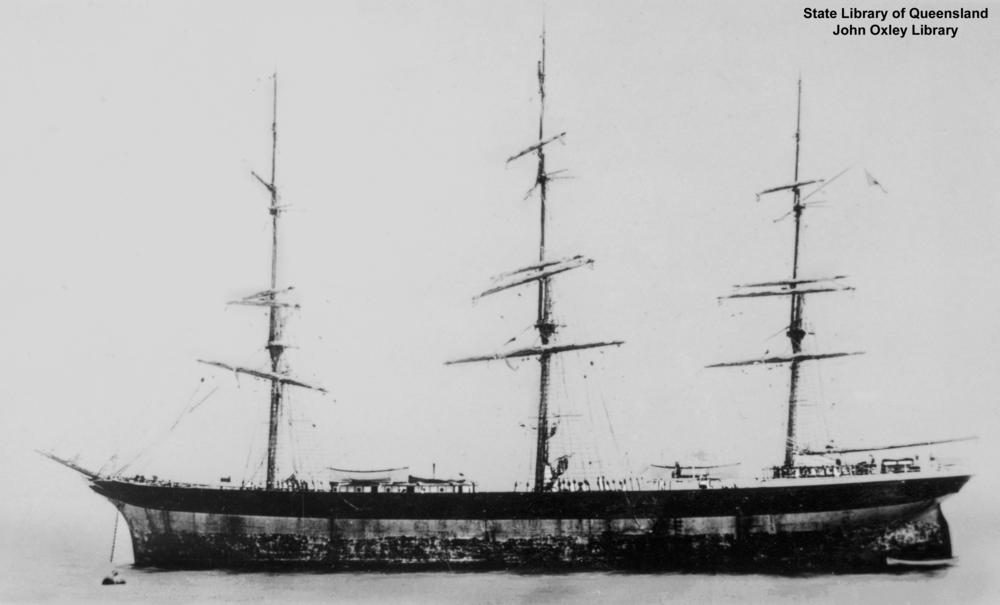
ARISTOMENE lying at anchor, yards down and sails furled — a working iron ship of 1,795 tons between voyages. Undated.
John Oxley Library, State Library of Queensland (image 134222). Public domain; digital copy via Wikimedia Commons. She was also photographed at Wallaroo, South Australia, in January 1906 in company with the SS Kuranda and the barque Oakhurst.
Chrysomene, Sardomene, Idomene — named, not pictured
No picture is held for any of these three. (not established)
- CHRYSOMENE, 1873, 1,835 tons. Sold German about 1900 as Elfrieda; seized by Britain in the First War as Clevedon; hulked at Fremantle in 1922. A photograph exists — the iron ship Chrysomene, 1,835 tons, in an unidentified port, in the A. D. Edwardes Collection, PRG 1373, State Library of South Australia. Not reproduced here: the library’s catalogue is not machine-readable from this system and reuse terms have not been checked. That is the next thing to fetch.
- SARDOMENE, 1882, 1,860 tons, built by Oswald at Woolston. Sunk by the Germans in July 1915, nineteen years after he left the firm. No picture found.
- IDOMENE, 1874, built by Oswald & Co. at Pallion, Sunderland. Wrecked 14 November 1887 — within months of his joining Fernie’s, and quite possibly the first ship he ever heard reported lost. The dossier gives her as 1,424 tons; one published source says 1,390. The discrepancy is recorded, not resolved. No picture found.
In steam — Johnston Line and Furness Withy, 1899 – 1935
| Ship | Built | Tons | His part in her | Fate |
|---|---|---|---|---|
| Lochmore | 1889 | 2,140 | His first steamer — third officer, March 1899 | Sold to Greece 1912, renamed Theokespasti |
| Dromore (4) | 1920 | 4,096 | Writing from her in the Mediterranean, 1927 | — |
| Kenmore (2) | 1923 | 3,616 | His command — writing from her July 1930, Nov 1931, Mar 1932, May 1933 | To Johnston-Warren Line 1935, the year he retired |
No picture is held for any of the three. (not established) Wikimedia Commons has nothing; the published Johnston Line fleet list carries no Cargo steamers of this class were photographed constantly by dock and shipping photographers, so pictures almost certainly exist — the places to try are the Maritime Archives & Library, National Museums Liverpool, the Ships Nostalgia fleet threads, and the commercial ship-photograph agencies.
He joined Lochmore as third officer in the same month he took his master’s certificate, March 1899 — a man newly qualified to command, starting again at the bottom of a steamer’s ladder because that was where sail had left him. That single fact is the hinge of his career.
Note the numbering. The Johnston Line’s Kenmore (1) was built 1912 and torpedoed near Inistrahull in 1917; its Dromore (2) was built 1898 and sold to Stettin in 1913 as Italia. Neither is his. His are the later ships of the same names.
The cattle tenders
He writes of “the joys (?) of a cattle tender, in the foc’s’le of more than one Western Ocean trader”. That was his own firm’s trade: the Johnston Line’s Atlantic service, begun in 1880 with the Baltimore & Ohio Railroad, specialised in carrying live cattle. The ships are not named. (not established)
Captain Kenneth Graham Sutherland
1902 – 1948 · · Master Mariner, Harbour Master of British Guiana · Edward’s son; Ella Wynne’s elder brother; Will Hancock’s great-uncle
He went to sea at fourteen — about 1917, in the worst of the U-boat campaign — took a master’s or mate’s certificate at Liverpool on 19 May 1922 aged twenty, certificate 0015698, and came out to British Guiana in 1933 carrying molasses to Trinidad.
The ships of his first sixteen years at sea, 1917 to 1933, are not recorded anywhere in this archive. (not established) That is the largest single gap in this document. His certificate number is the key to it: the Board of Trade registers of Masters and Mates give the ships served in.
Athel Line — the tanker fleet of the United Molasses Company
His shore employer was The Pure Cane Molasses Company (British West Indies) Limited, 10–11 Lombard Street, Georgetown, on whose letterhead his one surviving letter is written.
| Ship | His part in her | Fate |
|---|---|---|
| Athelrill | Master | — |
| Athelbrae | Master | Mined and sunk 4 October 1942, off Trinidad |
No picture is held for either. (not established) The Athel Line was a large and well-documented fleet and photographs of its tankers are common; the Ships Nostalgia “Athel Tankers” threads and the Acorn Archive Athel Line pages are the places to look, and the Imperial War Museums record of the Athel Line war memorial lists the fleet’s losses.
The Athelbrae
She is named in his own hand, in the letter he wrote to his sister Ella seven weeks into the war, three years before any other evidence in this archive puts him aboard her:
“I have not heard from my owners yet & as somebody must be out here, as long as there is something for the ‘Brae’ to do suppose I shall be kept here, though I was due home on holiday early next year.”
The home leave, due early in 1940, the war presumably took. On 4 October 1942, on passage from Trinidad to Demerara with a cargo of diesel oil, she struck a mine — an American-laid mine, by the published account — at 10°02′N 61°51′W and sank. The Athel Line war memorial records her simply as “Athelbrae Mined Trinidad 4.10.1942”.
The published casualty record says no lives were lost; his obituary says he was slightly injured and laid up a few weeks. The two are not in conflict — an injured survivor is not a casualty — but the detail is his, and it comes from the obituary, not the register. [R/P]
Two months later, on 15 December 1942, he was made Harbour Master of British Guiana.
The two family pictures
The archive holds two pictures of ships that belong to this story rather than to the registers, and neither can be tied to a named vessel.
The oil on canvas — a three-masted full-rigger under most plain sail with a second vessel astern, unframed and tacked to a stretcher, in Will’s house. Family attribution: a ship Edward commanded. Ship portraits of exactly this kind were routinely commissioned by a master from a quayside painter to mark a command, so the story is the right shape. The ship is not named on the canvas, and there is an illegible mark at the lower left whose first character reads plausibly as an E. There is also a small flag at the main truck — dark over white over red at four pixels — which is a house flag, not a national ensign. Reading that flag would name the owner and so narrow the ship. (probably)
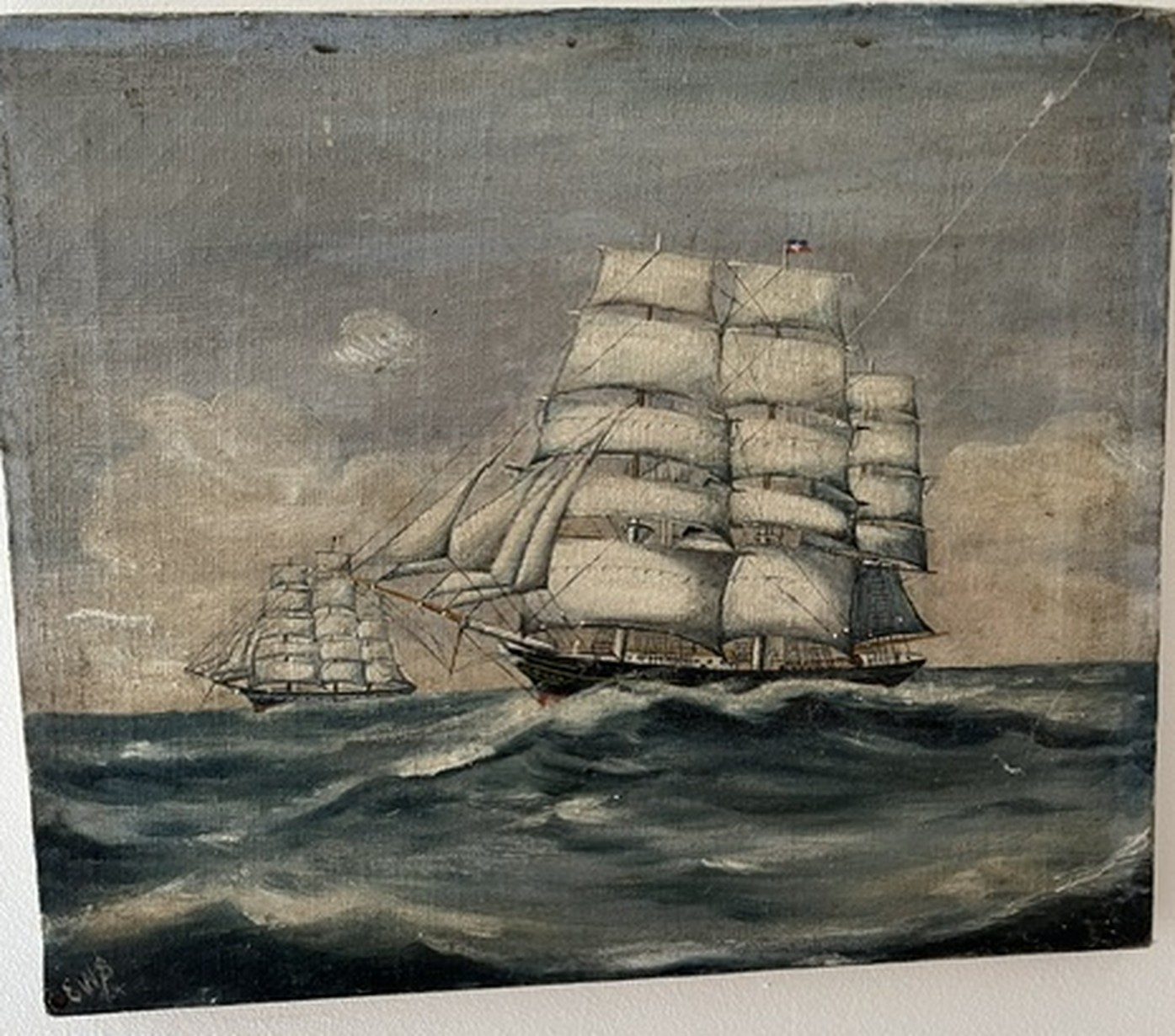
THE FAMILY OIL. A three-masted full-rigger under most plain sail, heeling to port on a green swell, a second square-rigger astern to port. Oil on canvas, unframed, tacked to a stretcher; edge wear and a diagonal crease upper right. The flag at the main truck is a house flag. An illegible mark sits at the lower left.
Photographed in Will’s house, 2 August 2026, at 480 × 640; cropped here to the canvas.
Held as . Family attribution, oral and
untested. (probably)**
The fireside picture — two old men in Victorian dress arguing beneath a ship portrait, hand-worked on a coarse woven support in a carved gilt frame. Will is told Edward painted it; the reverse has been checked and is blank. (probably)
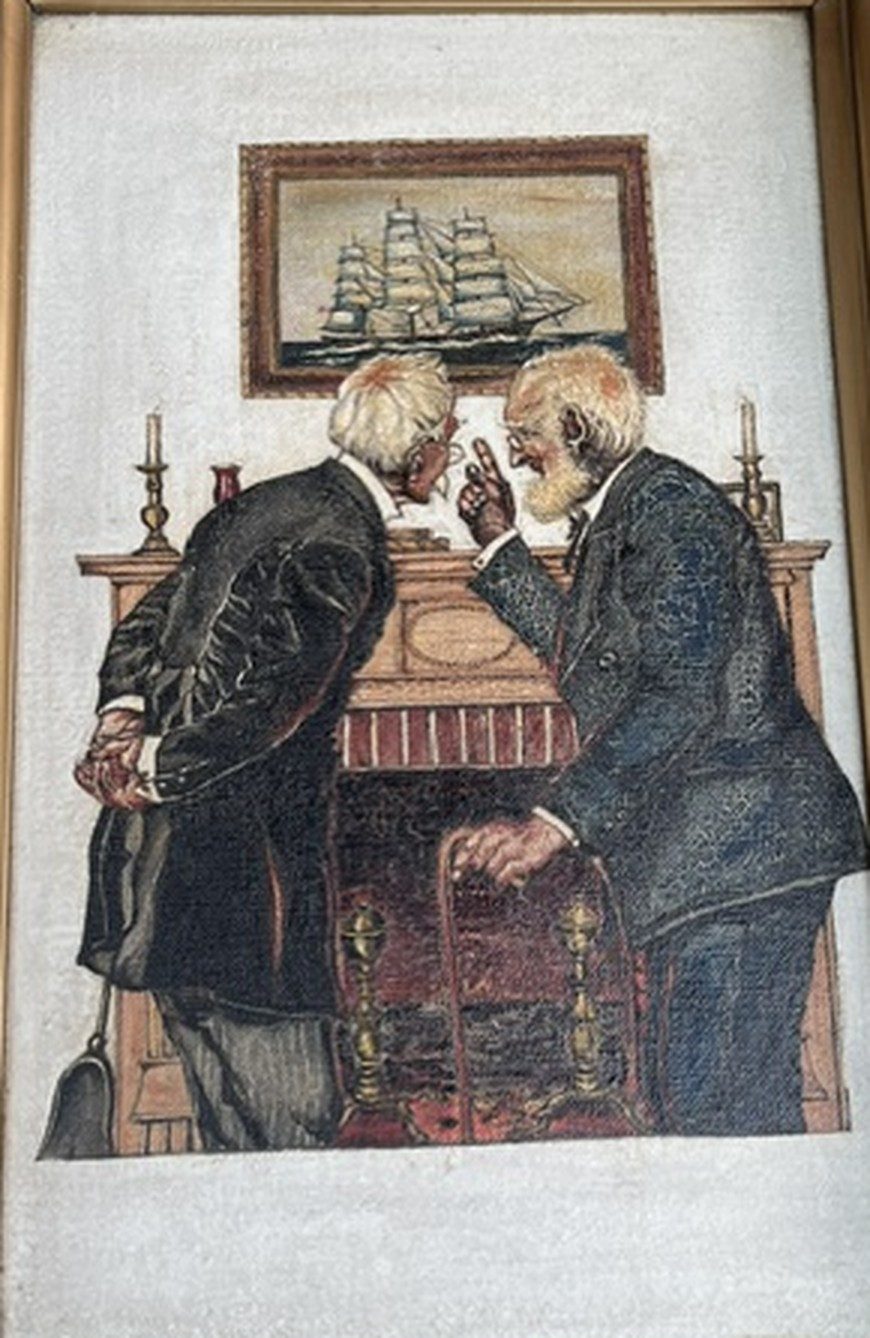
THE FIRESIDE PICTURE. Two elderly white-haired men, both spectacled, nose to nose at a chimneypiece; the right-hand one leaning on a stick with his finger raised. Over the mantel hangs a portrait of a full-rigged ship — the same subject, in the same broadside pose, as the canvas above. Brass candlesticks, fire-dogs, a coal scuttle.
Photographed 16 August 2026 at 480 × 640; cropped here to the picture and its margin, inside
the gilt slip. Held as .
Will is told Edward painted it. (probably)**
Both are recorded in full atand, and set side by side — with
their two ships brought to the same size — at
.
If the oil is a command portrait, then on the evidence of this document it can only be the Kenmore (2) or the Dromore (4) — and both were steamers. A full-rigged ship under sail is not a portrait of either. So the oil is a picture of the sail years, painted or bought long after them, exactly like the Sea Breezes articles and exactly like the fireside picture. That does not disprove the family story; it changes what the story can mean.
What is missing, and where to look
- The Chrysomene photograph — A. D. Edwardes Collection, PRG 1373, State Library of South Australia. Known to exist. Fetch it and check reuse terms.
- Ken’s ships, 1917–1933 — Board of Trade Masters and Mates registers, against certificate 0015698, Liverpool, 19 May 1922.
- Edward’s own certificate and ships — UK Masters and Mates Certificates 1850–1927 will give his certificate number and the ships he served in; Lloyd’s Register does the rest.
- The house flag on the family oil — a raking-light photograph of the main truck, then a flag book. Lloyd’s house-flag plates would name the owner in one look.
- Pictures of Lochmore, Dromore (4), Kenmore (2), Athelrill, Athelbrae — Liverpool Maritime Archives, Ships Nostalgia, the commercial agencies.
- The one known photograph of Edward himself — the crew of Fernie’s Pythomene, himself second mate, printed at page 248 of the magazine. Page 248 is not among the seven pages the family photographed. It is the only known likeness of him and it is one page away.
Sources and picture credits
From the archive. captain-ew-sutherland-dossier, sea-breezes-papers-ew-sutherland,
sea-breezes-printed-articles, cuttings-capt-ew-sutherland-sea-career,
cuttings-capt-kg-sutherland-harbour-master, biography-kenneth-graham-sutherland,
, painting-sailing-ship-master-mariner,
picture-two-old-men-fireside-ship-over-mantel.
Pictures. All five images reproduced here are public domain and were downloaded from Wikimedia Commons on 16 August 2026.
| Image | Creator | Date | Holding institution / credit |
|---|---|---|---|
| Laomene under full sail | Antonio Jacobsen | 1883 | via Wikimedia Commons, credited to Bonhams |
| Laomene under storm sail | Antonio Jacobsen | 1883 | via Wikimedia Commons, credited to Auktionshaus Stahl |
| Pythomene crew (HESTER 70) | Wilhelm Hester | c.1904 | Wilhelm Hester Photographs Collection |
| Pythomene crew with dogs (HESTER 116) | Wilhelm Hester | c.1904 | Wilhelm Hester Photographs Collection |
| Aristomene at anchor | not stated | undated | John Oxley Library, State Library of Queensland, 134222 |
Consulted, not reproduced. TheShipsList / benjidog Johnston Line and Athel Line fleet pages; the A. D. Edwardes Collection catalogue, State Library of South Australia; the Acorn Archive Athel Line pages; the Imperial War Museums record of the Athel Line war memorial.
Compiled with the help of an AI research assistant for the family records, 16 August 2026. The web searches behind the picture research went out to the open internet — flagged as data egress.