III-b. School
She was at school in three places, and on 9 September she named them all, with a report card in her hand.
The first was a convent school at Pinner, before she was five, during the Mossgiel years — she has the report. The second was Westbury Primary School, Shropshire, in the war: “a single room with an iron boiler to heat the room, and it had all levels, all the years” — one classroom for the whole village. The third was Wallasey High School, from about five to seventeen, a girls’ school of about five hundred: “it had been a private school… then it became a grammar school.” She passed the eleven-plus there — “all of these things about shapes”, non-verbal reasoning — and did not have to move; her best friend failed it and had to leave. “Very brutal.” Of the five hundred, “only about three or four went to university.” What she says of it is brief and faintly dismissive: “I went to a grammar school and I got quite good O levels.”
⚠ Names supplied 9 September 2026 from the reports themselves, which she has kept — “hundreds” of them, with her typing and shorthand certificates. The convent’s name is garbled on the tape (“the convent school of the Mother of…”); the report will give it. The A-levels she began and left were at the same school. (9 Sep 2026)
Six of them, and she is precise about the shape of it: “not including maths, or a language — that was very good really.” Her own verdict on her schooling is harsher than the result. She had turned up her reports not long before the interview: “they were all awful, really.” One, read out on 9 September, at nine years and ten months: “Elizabeth is making progress in some subjects, but she must try to overcome her diffidence for work that does not appeal to her.” — “That’s a fair assessment, I would say.”
She began A-levels and walked out of them. Botany and zoology, abandoned mid-course — “I had done no work at all, so the exams at Christmas, so I left” — and asked whether her social life was taking off, she agrees that it was. It is the reason she had no physics A-level when she came to radiography, and the reason her father’s push towards a university place came to nothing.
She also went to art school while she was still at school, and was “keen at one time”. What stopped her is a sentence that recurs across her whole life and explains a good deal of it:
“I think if I’m not going to be really good at something — but that was true of ballet as well. I loved doing it.”
And she was a competitive swimmer, which she volunteers only to disown: “That’s the only prize I got. I wasn’t into sports at all. I was very bad at everything.”
Art school, ballet, and a swimming prize
“I did go to art school, when I was still at school… I was keen at one time. I think if I’m not going to be really good at something — but that was true of ballet as well. I loved doing it.”
She made her own clothes throughout — the dress in the Castle Howard photographs, a coat run up out of gold material, cushions, a cover for a commode. And, in passing and against her own account of herself: she was a competitive swimmer. “That’s the only prize I got. I wasn’t into sports at all. I was very bad at everything.”
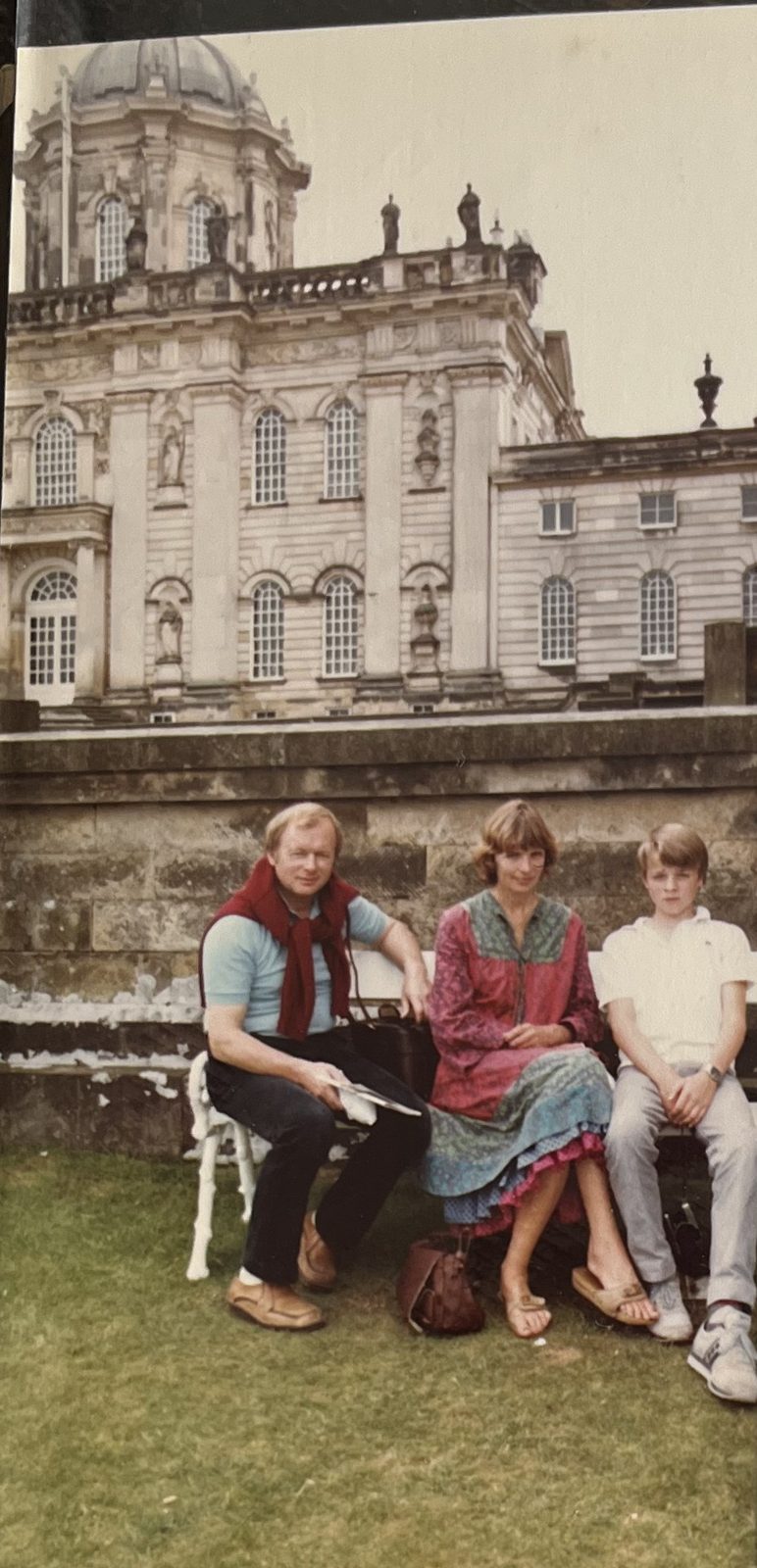
Tony, Liz and Will at Castle Howard, in the dress she made.
Home, and the friends who came to it
She lived near the school and brought her friends home, and her mother fed them: Ella “would cook chips and chocolate biscuits for everybody”. It is the single warmest thing Elizabeth says about her, and it is offered as evidence — the sentence begins “she was a very good mother, because…”
Two school friends survive into the rest of the story. Mavis Owen, a close friend at school, later heard that Elizabeth was flying and got in herself — “so I flew with her as well” — and is now a hands-on farmer on a large place outside Sydney. And Meryl Ikin, a year below her, “totally brilliant”, possibly a physicist, dead before thirty.
⚠ The name of the school is not recorded anywhere in this archive, nor is the name of the Pinner school, nor whether there was a third in between. It is a single question and it opens the school records, the class photographs and any surviving register. Asked in the editing questions document.